Timmons Makes Case for Bipartisan Permitting Reform on “535 News”
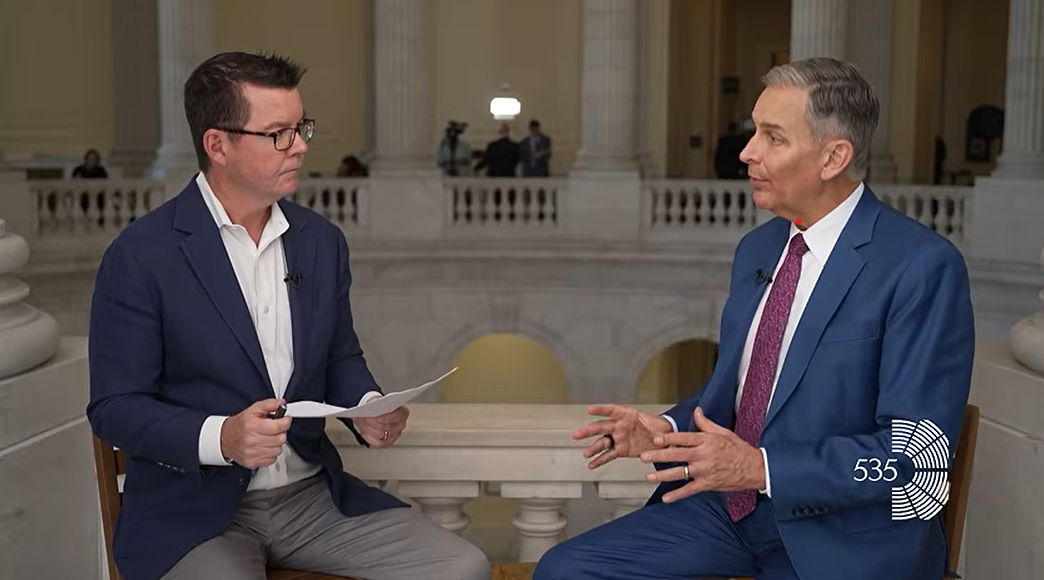
Permitting delays cost manufacturers more than $12 billion annually—money that could instead fuel investment, job creation and economic growth. That was the message NAM President and CEO Jay Timmons reinforced on “535 News,” following the Senate’s overwhelming bipartisan vote to advance the Bipartisan American Affordability and Jobs Act.
The show: Speaking from the Cannon House Office Building rotunda on a busy day on Capitol Hill, with the House back in session and newly elected lawmakers arriving for orientation, Timmons joined Brody Mullins, Pulitzer Prize–winning journalist, former Wall Street Journal investigative reporter and now co-founder and editor in chief of “535 News,” to make the case for BAAJA.
- The interview followed Monday night’s 73–25 Senate procedural vote, a major step toward passage of bipartisan permitting reform.
- “535 News” is a nonpartisan Capitol Hill news program featuring interviews with lawmakers, policy experts and advocates about the legislation and debates shaping Washington.
The $12 billion problem: “[T]he National Association of Manufacturers conducted some research, and we found that permitting delays result in about $12 billion of additional costs for manufacturers,” Timmons said.
- “[$8 billion] of that is getting your permit and then having to renew it as you wait for the approvals,” Timmons continued. “About $4 billion of that has to do with paying for power that you’re really not using. … I say it goes into the abyss. So that $4 billion is what I think we’ll see in immediate savings for manufacturers. What that means is it’s going back into the economy for investment and job creation.”
The economic payoff: If enacted, BAAJA could cut permitting-related costs by 35%, saving manufacturers approximately $4.2 billion annually—money that could instead be invested in expanded operations and job creation, Timmons underlined, citing NAM data.
- “Anything that we do or anything that we advocate for at the National Association of Manufacturers is to reduce the cost of doing business here in the United States so that we can attract more investment and hire more people,” Timmons said.
Bipartisanship delivers: Timmons credited Sens. Shelley Moore Capito (R-WV), Sheldon Whitehouse (D-RI), Mike Lee (R-UT) and Martin Heinrich (D-NM) for bringing both parties together to advance the legislation.
- “Neither side got everything they wanted, but really the message that was sent is that we want to show that America really is open for business,” he said.
- Timmons expressed optimism about the bill’s prospects but emphasized that Congress still has work to do to get it across the finish line.
An all-of-the-above energy approach: Timmons underscored why permitting reform matters across the energy sector, from traditional fuels to renewables.
What’s next: There’s ample reason to be optimistic about BAAJA’s future, Timmons said.
- “Manufacturers, we care about all of the above,” he said. “We want to see all of the above developed because we use a third of this nation’s energy.”
Protecting the environment and communities: Faster permitting does not have to come at the expense of environmental stewardship or community involvement, Timmons emphasized.
- Timmons expressed confidence that the legislation’s forthcoming manager’s amendment would help address outstanding environmental concerns.
Business and labor united: Timmons emphasized that the push for reform has united manufacturers, utilities, the broader business community and organized labor—all working toward the same goal.
- He pointed to a recent NAM-hosted event with Sen. Whitehouse alongside labor and policymakers.
- “Labor was sitting at the same table, and we were having the same conversation, get this bill passed,” Timmons said, calling the show of duty “something phenomenal to see.”
The NAM at work: The NAM has spent years making the case for permitting reform—and intensified its advocacy as BAAJA advanced through Congress.
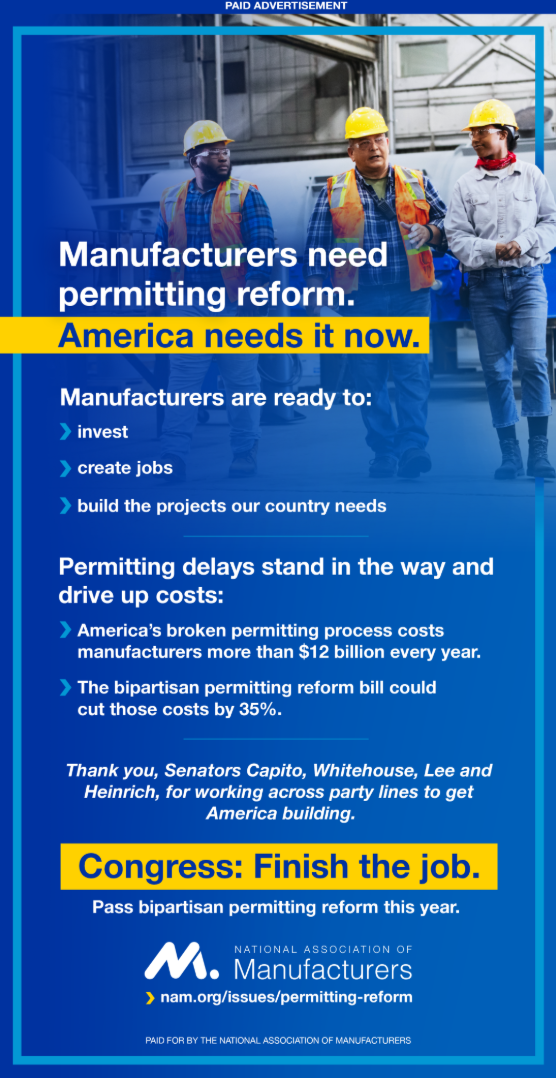
- The NAM has run ads, mobilized coalitions and conducted and published original economic research on the costs of a broken permitting system, along with hosting lawmakers on both sides of the aisle at manufacturing facilities.
- Those facility visits give lawmakers a firsthand look at “what those investments look like once we can get shovels in the ground,” while connecting them with manufacturing workers who can speak to the jobs, families and communities at stake, Timmons told Mullins.