As Washington Shifts, Manufacturers Keep Working Across the Aisle
Democrats swept control of the House and Senate in Tuesday’s elections, intensifying the focus in Washington on addressing the economic pressures facing Americans. One potential solution already has bipartisan backing: permitting reform.
The big picture: Voters sent a clear message Tuesday: They are frustrated with the persistently high cost of living (The Wall Street Journal, subscription). For manufacturers and lawmakers on both sides of the aisle, permitting reform offers a bipartisan path to meet soaring demand for energy, unlock new energy supplies and bring down costs for families and businesses all while supercharging manufacturing in America.
A bipartisan push: Senate Democratic Leader Chuck Schumer (D-NY) today acknowledged the ongoing negotiations, saying, “We have a bipartisan group working on permitting, permitting reform and hopefully they’ll come up with a good deal on that.”
- But the election has also raised questions about whether lawmakers will advance the existing agreement during the lame-duck session or revisit negotiations in the new Congress.
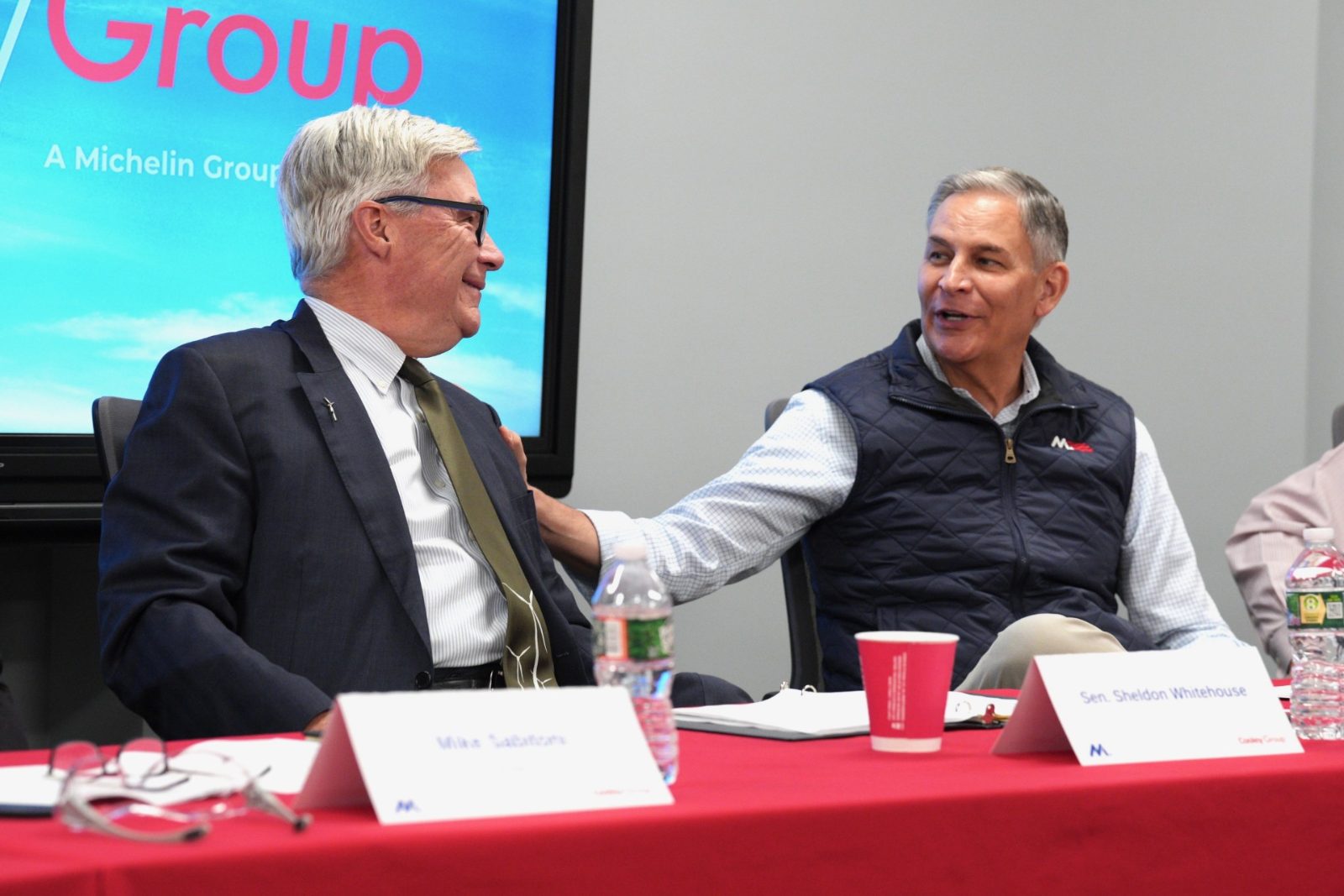
Building momentum: Just ahead of the election, NAM President and CEO Jay Timmons and Sen. Sheldon Whitehouse (D-RI), ranking member of the Senate Environment and Public Works Committee and key architect of the permitting reform legislation introduced in the Senate, the Bipartisan American Affordability and Jobs Act, convened a permitting reform roundtable that followed a facility tour at manufacturer Cooley Group in Pawtucket, Rhode Island.
- The NAM-hosted event brought together leaders from manufacturing, organized labor and the business community to build support for the bipartisan agreement, negotiated by Sens. Whitehouse, Shelley Moore Capito (R-WV), Martin Heinrich (D-NM) and Mike Lee (R-UT).
- Participants included Cooley Group President and CEO and NAM Executive Committee member Dan Dwight; Partnership for Rhode Island Executive Director Liz Catucci; Rhode Island Manufacturers Association President and CEO Melissa Travis; Greater Providence Chamber of Commerce President Laurie White; Laborers’ International Union of North America General Secretary-Treasurer Mike Sabitoni; and Rhode Island AFL-CIO President Pat Crowley.
Policy, not politics: Timmons emphasized that the agreement reflects shared priorities that transcend party lines: lower costs, more jobs, greater investment and responsible environmental stewardship.
- “This bill is not about politics; it’s about the success of manufacturers here in the United States,” Timmons said, praising the four Senate negotiators for putting country over party.
- “It’s a good thing when we have a stronger economy with more jobs and lower costs and a cleaner environment, all at the same time,” said Sen. Whitehouse. “So that’s what our intention is to deliver here. And I appreciate the terrific work that was done in the Senate to pull this together. … This was a good example of solid bipartisan work. It took a ton of time and a ton of effort.”
A historic connection: Timmons highlighted a personal connection between Sen. Whitehouse and the NAM that dates back more than 130 years. Thomas Dolan, the NAM’s first president in 1895 and Sen. Whitehouse’s great-great-grandfather-in-law, was a woolen manufacturer who later entered the energy business, helping develop the nation’s emerging electrical grid.
- Timmons drew a parallel to Sen. Whitehouse’s leadership on permitting reform, praising his efforts to expand energy infrastructure and create opportunities for American manufacturers.
- Calling Cooley Group an “American success story,” Timmons praised the century-old manufacturer and its 300 employees for driving innovation and creating jobs in Rhode Island.
- “We want to make sure companies like Cooley have every tool that they need to make the next 100 years even more competitive than the last,” Timmons said. He also pointed to the NAM’s “America on Hold” report, which found that permitting delays cost manufacturers nearly $8 billion annually.
Sen. Whitehouse’s warning: During the roundtable, Sen. Whitehouse pushed back on the idea that Democrats should wait until the new Congress to negotiate a different deal if they made significant electoral gains.
- “I vehemently disagree with that strategy,” Sen. Whitehouse said, arguing that delaying action could jeopardize an agreement that has a path to passage in both chambers and a presidential signature.
- “Don’t sacrifice now for later,” he urged, emphasizing the importance of securing the benefits of the current agreement rather than restarting negotiations.
- “This [isn’t] over, but I think we’re in a good place, assuming that the administration does what it has said it will do with respect to making its regulatory posture for clean energy fair,” he concluded.
- Sen. Martin Heinrich (D-NM), a lead negotiator who is poised to chair the Senate Energy and Natural Resources Committee next year, echoed that urgency. “It doesn’t necessarily get easier just because of who the chair is,” Sen. Heinrich told Punchbowl News today. “This is the closest we have come to actually finding something that can get signed into law, and I’m not going to wait.”
Cooley Group says: Dwight emphasized why permitting reform matters so much to companies like his.
- “Permitting is an important protection that does not need to come at the expense of growth,” he said. “Companies like Cooley Group will be able to continue our investments to decrease our environmental footprint without compromising business growth.”
- “As manufacturers, we know what happens when reviews are duplicative and unpredictable. Investments are delayed, costs rise and opportunities to expand good jobs [disappear],” Dwight said. “Faster, more predictable permitting would bring infrastructure projects online sooner and unlock business growth for manufacturers of every size.”
Business and labor agree: The roundtable also highlighted the costs that permitting uncertainty imposes on employers and workers alike.
- Dwight explained that faster permitting could help manufacturers expand domestic sourcing and reduce dependence on foreign suppliers.
- Sabitoni stressed that “when business and labor and then government get on the same page, that’s usually when good things happen,” underscoring the importance of collaboration to advance the legislation, while Crowley emphasized the need to build new energy infrastructure to create jobs and achieve environmental goals.
- Catucci pointed to the importance of regulatory certainty in attracting businesses and investment to Rhode Island, noting that delays cost money and jobs.
- Travis praised Sen. Whitehouse’s “tenacity and determination” in building bipartisan support for legislation critical to Rhode Island’s nearly 1,800 manufacturers employing approximately 75,000 people.
More labor groups join the push: On Tuesday, four more unions joined the three unions who already endorsed the bipartisan legislation: Iron Workers, Sheet Metal Workers, Boilermakers and Teamsters joined Engineers, Laborers and Plumbers in a letter first reported by Politico. The NAM highlighted labor’s support on X.
- The Laborers’ International Union of North America also called for permitting reform in an op-ed in The Hill.
In the news: The NAM’s roundtable was scooped by Punchbowl News in its Friday Midday newsletter as well as by reporter Josh Seigel on X. Punchbowl also covered it in its Monday AM newsletter, which Siegel amplified on X. In addition, the event was covered by Providence Business First (subscription), whose reporter, Mary Serreze, attended the event. Sen. Whitehouse highlighted the roundtable on X, amplified by Timmons, as well as in a press release.
A united message: Timmons and Sen. Whitehouse also joined forces in a video highlighting the bipartisan push for permitting reform and the importance of getting a deal across the finish line.
The bottom line: As Congress returns to Washington following the election, the coalition is focused on converting the support into legislative action—and addressing one of the cost drivers holding back American investment, job creation and economic growth.