Oil Producers Seek Alternative Routes to Strait of Hormuz
With Iran’s Strait of Hormuz blockade nearing the five-month mark, Gulf nations are preparing to spend big to redirect oil shipments (Associated Press).
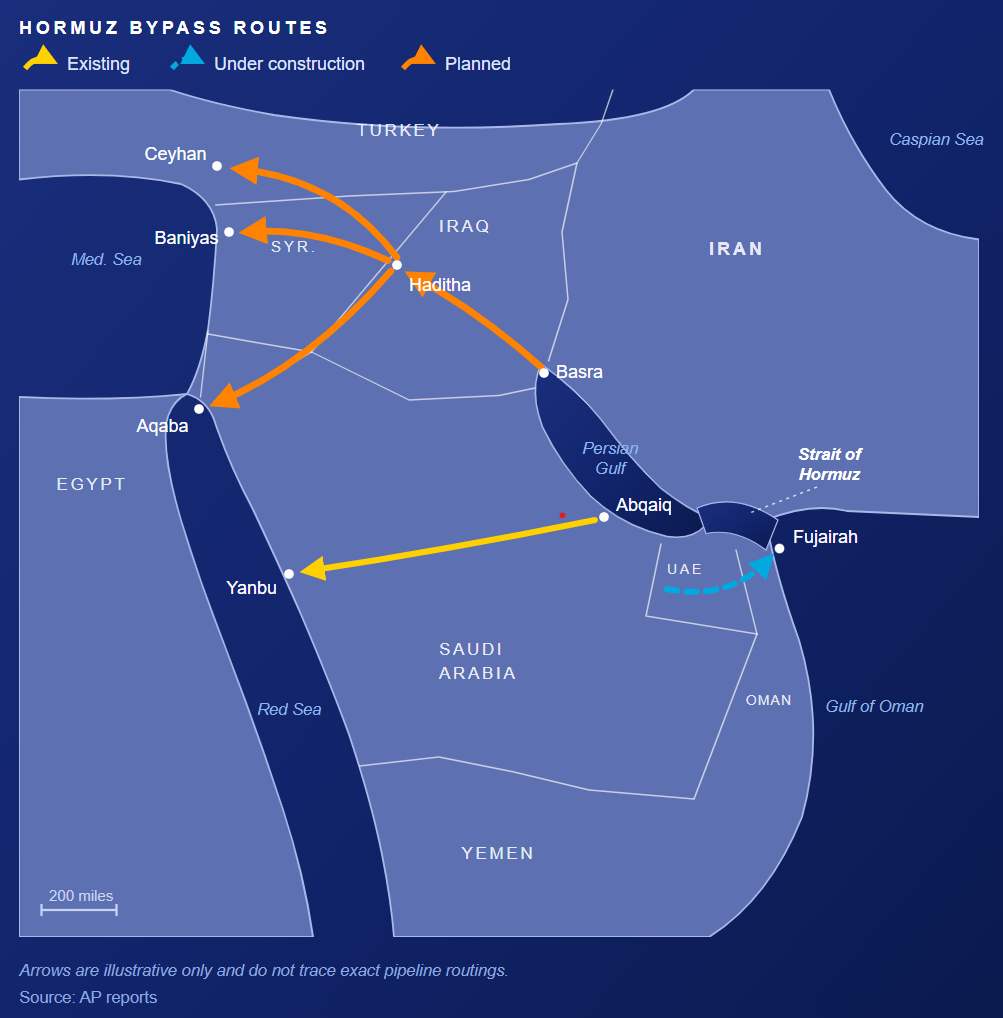
What’s going on: As the chokehold “drags on and oil prices surge, countries across the Gulf are planning to spend billions of dollars to build pipelines enabling them to redirect more supplies to ports on the Red Sea, the Gulf of Oman and the Mediterranean.”
- At least seven large pipeline projects are now being built, planned or discussed.
- Though some alternative routes will take longer and cost more, producers have recognized that continued heavy reliance on the strait is unwise.
Why it’s important: About one-fifth of the world’s liquefied natural gas traveled through the strait prior to the start of the war.
Other transport means: The current oil shipment disruption would be even worse had Saudi Arabia not built its East–West pipeline in the 1980s.
- The pipeline takes oil from a processing site in Abqaiq in Saudi Arabia to the Saudi Red Sea coastal city of Yanbu, and from there, either to the Arabian Sea or Suez Canal.
- The United Arab Emirates has begun sending more oil to its eastern coast, to the port of Fujairah, about 90 miles south of the Strait of Hormuz.
- Abu Dhabi’s state-owned oil company is speeding construction of a $3 billion, 200-mile pipeline to Fujairah that aims to increase the oil supplied to that port by over 1.2 million barrels a day. It’s slated for early 2027 completion.
Iraq: Iraqi officials are accelerating plans for alternative export routes for oil from fields around Basra.
- Before the war, some 3 million barrels were exported daily from a terminal in Basra to the Turkish port of Ceyhan.
- Iraq “has been pursuing pipeline projects with U.S. companies” and has held talks with Jordan about plans for a pipeline to carry oil from Basra to Aqaba.
The impact: “Taken together, the new projects to bypass Hormuz could carry an added 3.8 million barrels of oil a day by the end of next year, and 7.3 million barrels per day by the end of 2028,” according to Goldman Sachs.