Timmons Talks Permitting Reform, Tax, Trade and More at B20 Summit
NAM President and CEO Jay Timmons made the case for bipartisan cooperation and consensus to strengthen manufacturing in the U.S. during the B20 USA Summit in Washington, D.C., recently, highlighting opportunities to work across the aisle on permitting reform, tax, trade and more as the NAM prepares for the new Democratic-majority Congress.
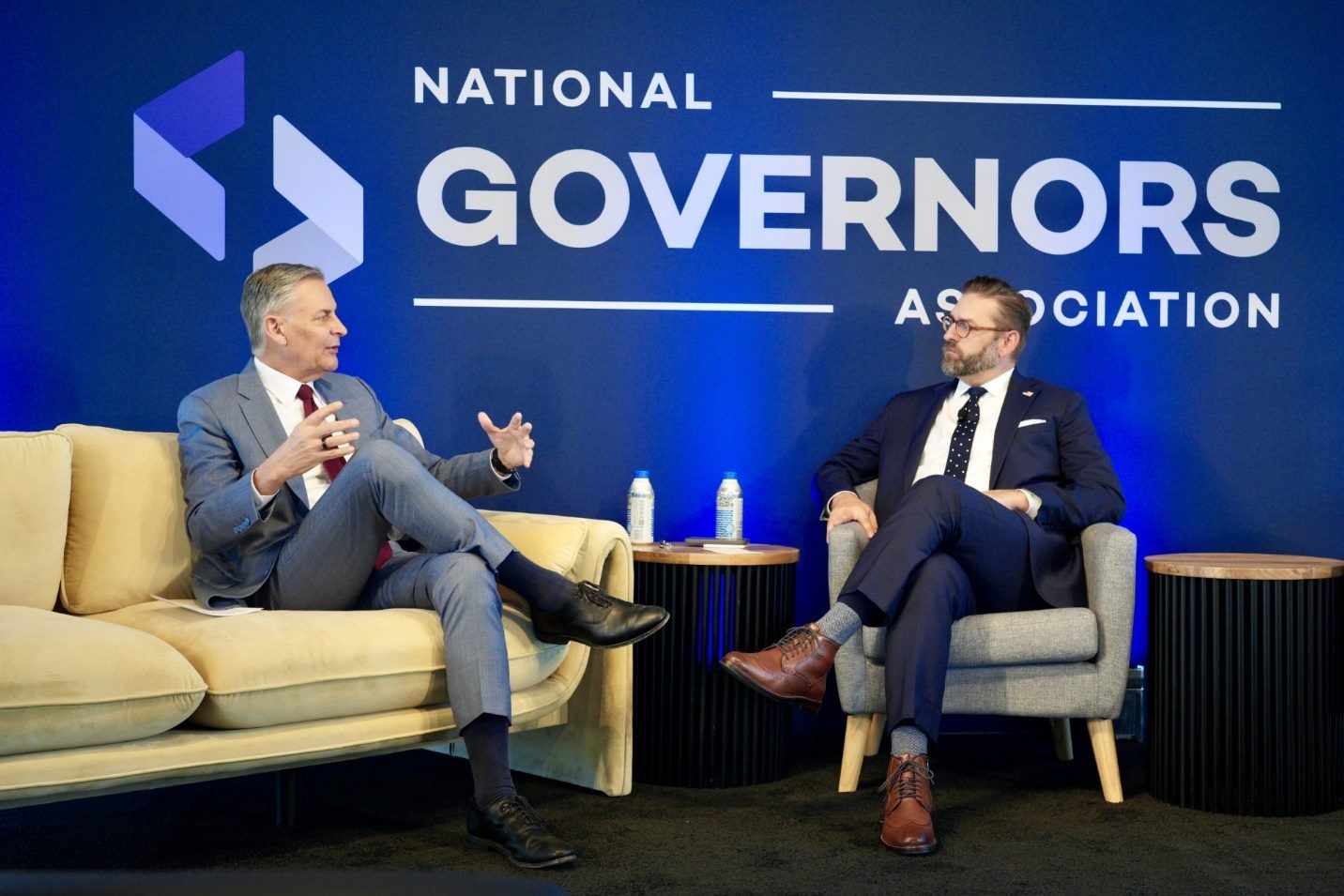
On stage: Timmons joined National Governors Association CEO Brandon Tatum for a fireside chat titled “All In: Driving Innovation in American Manufacturing,” part of the NGA’s programming at the Summit.
- The conversation, highlighted by NGA in its event recap and on X, focused on policies to drive investment, create jobs and strengthen U.S. manufacturing competitiveness, with particular emphasis on permitting reform.
A longtime colleague: Timmons, who served as chief of staff to Virginia Gov. George Allen, told Tatum that he has been a longtime friend of the NGA, where he worked as a contractor after Allen’s term ended.
The discussion took place as Timmons and the NAM awaited a Senate vote on permitting reform. The legislation became the first topic of conversation—as a major priority for manufacturers, federal lawmakers and state governments alike.
The case for permitting reform: “If you think about how unlikely it is for Shelly Moore Capito, Sheldon Whitehouse, Mike Lee and Martin Heinrich to come together and agree on something, anything, it’s truly remarkable,” Timmons said. This bill will remove politics from the permitting process, he continued.
- “What this bill does is it ensures that once a project is permitted, that permit can’t be taken away for political reasons basically. It puts a shot clock in place so that instead of a permit going through, let’s say 10 different agencies one after another, those 10 agencies will be looking simultaneously at the scope of the project so that the bureaucracy is not delaying the permitting process. And it also cuts down on some of the litigation holds that you get on many of these projects.”
On AI: Timmons also pushed back on campaign-season rhetoric about artificial intelligence eliminating jobs, pointing to America’s long history of innovation and technological advancement.
- “We heard all this rhetoric [saying that artificial intelligence] is going to kill jobs,” Timmons said. “We heard that when the assembly line was created by Henry Ford. We heard that when automation kind of kicked into full force starting in the 50s and the 60s. We heard it when the computer era started. We heard it when robotics became a thing. And it’s never been the case.”
- “What impacts employment in manufacturing operations is really more about the things that we can control in terms of taxes and regulation and energy policy,” he emphasized. “Those are the three drivers of investment and hiring decisions, the ability of a facility to expand and grow.”
- That growth “will require more people, but those people will probably need different skill sets, just like they needed different skill sets in each advance of technology that we’ve had over the course of the last 150 or so years,” he concluded.
The obligation of workforce development: As new technologies transform manufacturing, employers and policymakers have responsibility to help prepare the next generation of workers, Timmons said.
- “I think we have an obligation to give some basic skill sets to young people so that they can maneuver in their careers,” he said.
- “They can go into the skilled trades, they can go into manufacturing, they can be a production assistant. Hopefully they will have that basic skill set that we can then build on as employers to take them to next career option.”
On data centers: “There is a tremendous amount of need and demand for capacity and not only more build out in the data center world, but also the energy inputs that make them operate,” Timmons said.
- “And so all of those components from the federal and the state level need to come together in order to be able to support those types of investments. That’s again, why permitting reform is so important.”
The new Congress: Looking ahead, Timmons identified opportunities for bipartisan progress on trade and immigration, alongside the need to protect pro-manufacturing tax policies enacted in 2025.
- “As we go into this new Congress, I think we have a few opportunities,” he said.
- “We have an opportunity to maybe rebalance the scale when it comes to our trading priorities. I am hopeful that there will be some legislation that comes out of Congress to produce a strong and durable immigration system that focuses on the economic needs of this country and will be more humanitarian in its application.”
- “And then we’re going to have to be on the defense because there are those on both sides of the political aisle, I might add, who would like to undo some of those 2025 tax reforms. And so we’ll [try to not let] that happen.”
The manufacturing multiplier: Timmons underscored manufacturing’s outsized contribution to the U.S. economy, from supporting jobs across other industries to creating high-paying career opportunities. “For every dollar that’s invested [in manufacturing], you get about $1.85 of spinoff economic activity. No other sector does that,” said Timmons, making the case for manufacturing’s continuing strength.
- “For every manufacturing job that’s created, another four to five jobs in other sectors are created. No other sector does that. And then we have one of the highest average starting salaries of any sector of the economy. You can literally come out of high school or community college and you could be making six figures at a starting job with probably no college debt.”
The case for optimism: Despite tax policy disagreements, Timmons expressed confidence that bipartisan cooperation on manufacturers’ priorities can unlock greater investment and economic growth.
- “I go back to tax policy, regulatory policy, energy policy, infrastructure, trade policy, workforce development,” said Timmons.
- “If you get all those things lined up, there’s nothing that can stop us. Are there going to be disagreements about how to prioritize certain things within each one of those areas? Sure. But I do believe that you can finally get to balance.”
Another event: The NAM also hosted an NGA reception with Gov. Wes Moore (D-MD) and Gov. Kevin Stitt (R-OK) the following day, which Timmons also attended.