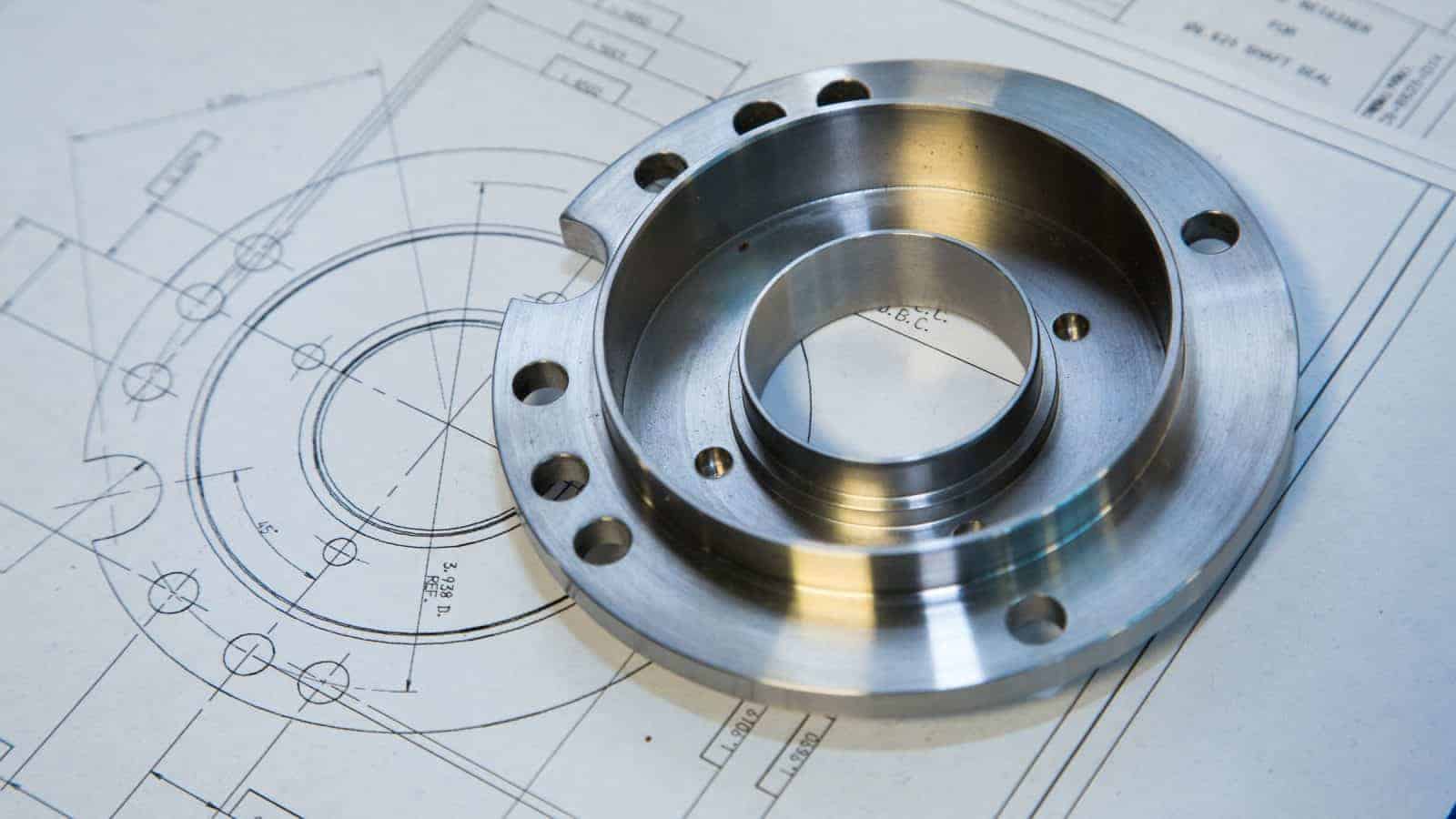
Q&A with Sen. Young on R&D Expensing

NAM: Sen. Young, H.R. 1 restored immediate domestic R&D expensing, ending the amortization requirement that had been in effect since 2022. You have been one of the Senate’s most dedicated champions of R&D competitiveness through the American Innovation and Jobs Act. How did your years of sustained advocacy help deliver this outcome in the final reconciliation package?
Sen. Young: The American Innovation and Jobs Act laid the foundation for a multiyear, bipartisan effort to restore full and immediate expensing. From the outset, our goal was to make clear that strong R&D incentives are essential to maintaining America’s competitive edge. With the support of my Senate Finance Committee colleagues and active industry partners like the NAM, we built a broad coalition that understood the real-world consequences of the amortization treatment. This sustained advocacy was critical to ensuring this policy was included in the final version of the One Big Beautiful Bill Act.
NAM: The amortization requirement that was in effect from 2022 to 2024 was particularly damaging for manufacturers, who conduct 52% of private-sector research. Now that immediate expensing is restored and prior-year costs can be accelerated, what are Indiana manufacturers or other stakeholders telling you about how this relief changes their investment and hiring plans?
Sen. Young: During the three-year span when businesses had to amortize, I heard from countless Hoosier employers, including many in the manufacturing and life sciences industries, about how the R&D tax treatment was forcing incredibly difficult decisions. These included delaying R&D projects, scaling back hiring for key personnel like engineers and scientists and, in some cases, even considering shifting research activity overseas. That kind of uncertainty is especially challenging for industries that rely on long-term investment cycles.
Now that immediate expensing has been restored, and restored on a permanent basis, there is a renewed sense of confidence. Businesses back home have shared with me that they are moving forward with previously delayed investments, expanding their research operations and accelerating plans to grow their workforce. Those are the types of business decisions we should be encouraging in our tax code.
NAM: Restoring R&D expensing is a major step, but the United States still trails competitors like China in the overall generosity of R&D incentives. What is your honest assessment of where America now stands in the global innovation competition, and what further actions—whether through additional tax policy, increased federal R&D investment or streamlined regulatory pathways—should Congress prioritize to ensure the U.S. remains the world’s leading destination for manufacturing innovation?
Sen. Young: As our global competitors, like China, are expanding their R&D incentives, we simply cannot allow our nation and our economy to fall behind. To remain the world’s leading destination for innovation and advanced manufacturing, we need a more comprehensive approach. That includes increasing federal investment in critical research areas, ensuring our regulatory environment supports the commercialization of new technologies and strengthening workforce development and apprenticeship streams so that we can better connect students and workers to high-demand careers in manufacturing and innovation.
My focus going forward is on advancing policies that not only restore our competitiveness but position the United States to lead in rapidly growing industries like advanced manufacturing, artificial intelligence, quantum and biotechnology.
NAM: Thank you, Sen. Young. What can NAM members do to help manufacturers take advantage of the restored R&D deduction and to support continued investment in American manufacturing innovation?
Sen. Young: I would encourage NAM members to continue engaging with policymakers and sharing examples of how R&D incentives are driving investment, hiring and innovation in their communities. Those real-world stories about the advancements companies are making are incredibly important as we consider future policy decisions.
I’d also urge manufacturers to fully utilize the restored deduction and continue investing in their workforce and research capabilities. By doing so, and by staying engaged in the policymaking process, you can help ensure we build on this progress and continue strengthening America’s leadership in manufacturing.
Manufacturers Back Long-Awaited Federal Action on Data Privacy
House Energy and Commerce Bill Would Protect Consumers and Clarify Rules so Manufacturers Can Continue to Innovate, Compete
Washington, D.C. – Manufacturers today welcomed the introduction of the SECURE Data Act by House Energy and Commerce Committee Chairman Brett Guthrie (R-KY) and Vice Chair John Joyce (R-PA).
National Association of Manufacturers Executive Vice President Erin Streeter issued the following statement endorsing the SECURE Data Act:
“Processing personal data has become integral to modern manufacturing operations and modern manufactured products. Manufacturers are encouraged that this first-of-its-kind federal law would establish a uniform national framework that is both forward-looking and adaptable to new technology, while avoiding the regulatory morass of a 50-state patchwork. Manufacturers believe granting consumers much-needed privacy protections and creating clear guidelines will keep the industry innovating and competing in the age of AI. We thank Chairman Guthrie and Vice Chair Joyce for championing this legislation.”
-NAM-
The National Association of Manufacturers is the largest manufacturing association in the United States, representing small and large manufacturers in every industrial sector and in all 50 states. Manufacturing employs nearly 13 million men and women, contributes $2.95 trillion to the U.S. economy annually and accounts for nearly 52% of private-sector research and development. The NAM is the powerful voice of the manufacturing community and the leading advocate for a policy agenda that helps manufacturers compete in the global economy and create jobs across the United States. For more information about the NAM or to follow us on Twitter and Facebook, please visit www.nam.org.
733 10th St. NW, Suite 700 • Washington, DC 20001 • (202) 637-3000
Q&A with Sen. Lankford on Tax Policy
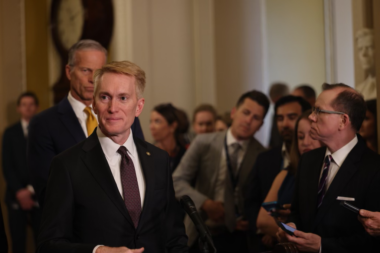
NAM: Sen. Lankford, H.R. 1 permanently restored 100% bonus depreciation for qualifying property acquired after Jan. 19, 2025, reversing a phasedown that had reduced the deduction to 40% in 2025 and would have eliminated it by 2027. As a member of the Senate Finance Committee, what does permanent full expensing mean for manufacturers making long-lived capital investment decisions, and how does permanency change their planning horizon relative to a temporary extension?
Sen. Lankford: Permanency is the difference between short-term tax relief and long-term economic certainty. Manufacturers are not making one-year decisions. They are making 10-, 20-, even 30-year capital allocation decisions on facilities, heavy equipment and production lines. When full expensing is temporary or phasing down, it distorts those decisions and often forces companies to either accelerate investments inefficiently or delay them altogether.
By making 100% expensing permanent, we are giving manufacturers confidence that the tax treatment will be consistent across the full lifecycle of an investment. That stability lowers the cost of capital, improves after-tax returns and allows companies to plan rationally instead of reacting to arbitrary deadlines.
That is why I have pushed for permanency through efforts like the ALIGN Act, which was included in the Working Families Tax Cuts Act, because pro-growth policy only works if businesses can rely on it over the long term.
NAM: During the phasedown years, when bonus depreciation fell from 100% to 80% to 60% to 40%, manufacturers reported delaying or canceling major capital purchases because the economics no longer worked as favorably. Now that 100% expensing is restored permanently, what evidence are you seeing—in Oklahoma or nationally—that manufacturers are moving forward on investments that were on hold?
Sen. Lankford: What we are hearing, both in Oklahoma and across the country, is that the return to full expensing is beginning to unlock projects that were sitting on the sidelines. During the phasedown, when expensing dropped from 100% to 40%, many of those investments simply didn’t pencil out.
That lines up with what we know about Oklahoma’s economy. The state is heavily concentrated in capital-intensive sectors like oil and gas, manufacturing and aerospace. Oil and gas alone accounts for a significant share of state GDP, and when you include the broader supply chain, it touches more than a quarter of the economy. These are exactly the types of industries where cost recovery drives investment decisions.
In practical terms, that showed up in delayed energy projects, deferred equipment purchases and slower expansion of processing and manufacturing facilities. In manufacturing and aerospace, companies stretched the life of existing equipment and postponed automation upgrades.
Now, with full expensing permanently restored, those same businesses are revisiting projects. That includes moving forward on pipeline investments, placing new equipment orders and advancing plant and infrastructure upgrades. The key shift is that companies are no longer trying to time the tax code. They are making decisions based on operational need and long-term growth.
NAM: H.R. 1 also raised the Section 179 expensing cap from $1 million to $2.5 million, providing a complementary benefit particularly for smaller manufacturers. The legislation also expanded bonus depreciation to manufacturing facilities. How do bonus depreciation, the enhanced Section 179 and the new deduction for factories work together to drive capital investment across manufacturers of all sizes, and what are you hearing from businesses about how these provisions are impacting them?
Sen. Lankford: For smaller and mid-sized manufacturers, Section 179 is often the tool they use the most. These are businesses that are upgrading equipment, adding a new machine or expanding part of their shop floor. They are not doing massive projects all at once. They need something simple, predictable and easy to use. Increasing the cap means more of those everyday investments can be written off immediately, which helps with cash flow and makes it easier to keep reinvesting.
For larger manufacturers, the scale is different. They are looking at bigger equipment purchases, full production lines and major upgrades across facilities. Bonus depreciation matters here because it allows them to expense those larger investments upfront. When you are talking about large equipment investments, that timing difference can influence whether a project moves forward now or gets pushed out.
The addition of expensing for manufacturing facilities is a big step forward. For a lot of companies, the building is one of the most expensive parts of the project, not just the equipment inside it. Whether it is a new plant or expanding an existing one, being able to expense both the facility and the equipment reflects the full cost of what it takes to grow.
When you put all of that together, it creates a system that works for manufacturers at different sizes and at different stages. It supports the smaller, steady investments and the larger, long-term projects. It does not solve every challenge, but it removes a major barrier and lets companies make decisions based on what they actually need to grow.
NAM: Thank you, senator. What can NAM members do to help manufacturers understand and act on the restored bonus depreciation and enhanced Section 179 provisions?
Sen. Lankford: The most important thing NAM members can do is make sure permanent expensing actually reaches the shop floor. A lot of small manufacturers may not have heard about what changed, and even if they have, they may not immediately connect a tax provision to a real equipment decision. It’s a simple but important message: if you’ve been holding off on a new piece of equipment, talk to your accountant now, because you may be able to write off the full cost this year. Pro-growth policy only delivers if manufacturers know about it and use it, and that’s where NAM can make a real difference. That’s what will drive long-term investment, create jobs and grow local economies.
On Tax Day, the Receipts Are Filled with Manufacturing Wins
Washington, D.C. – On the first Tax Day since passage of H.R. 1, National Association of Manufacturers President and CEO Jay Timmons released the following statement:
“This Tax Day, manufacturers now have a permanent, pro-growth tax code that allows our industry to compete and win. Thanks to President Trump, leaders in his Cabinet and in Congress, the 2017 provisions of the Tax Cuts and Jobs Act were not just made permanent—they were made even stronger, which saved 6 million jobs. The tax and investment incentives in H.R. 1 amount to the most significant economic transformation in the history of our industry, serving as rocket fuel for manufacturers.
“Manufacturers’ optimism is on the rise, and they are ready to keep building, investing and leading—but that requires certainty across the board to take full advantage of H.R. 1’s transformative provisions. President Trump and Congress went above and beyond to deliver tax certainty for manufacturers, and we look forward to continuing to work with them to build on this progress—ensuring certainty and lowering the cost of doing business—so that manufacturers can deliver the greatest manufacturing era in American history.
“This Tax Day, the message is clear: when Washington gets the tax code right, manufacturers deliver.”
This week, Timmons published a joint op-ed in the Washington Examiner with House Majority Whip Tom Emmer (R-MN) on the pro-growth tax reforms of H.R. 1. Read it here.
Manufacturing Wins
Learn more about how tax reform is bolstering manufacturing in America:
- Ketchie CEO Credits Trump’s “Beautiful Bill” with Helping Her Machine Shop Prosper
- Brunswick Revs the Engine on Innovation and U.S. Investment
- Tax Reform Delivers “Biggest Investment in Company History” for Marlin Steel
- J&J Makes Major Investment in North Carolina Thanks to Tax Reform
- Sylvamo to Congress: Tax Reform Made Manufacturing Success Possible
Background
Prior to final passage of H.R. 1 in 2025, the NAM activated manufacturers in America—engaging shop floor workers, plant managers, executives and state and local partners nationwide—as part of the “Manufacturing Wins” campaign. With a coordinated public advocacy campaign, which included outreach to congressional offices both in district and in Washington, targeted social media drives, video testimonials and local media op-eds, the NAM made the case for this bill directly to members of Congress and the American people. These collective voices underscored how preserving and expanding key tax provisions translates into growing businesses, creating jobs and powering stronger communities.
In January 2025, the NAM released a landmark EY study on the economic consequences of failing to renew the pro-manufacturing provisions of the Tax Cuts and Jobs Act. The NAM was joined by Senate Finance Committee Chairman Mike Crapo (R-ID), House Ways and Means Committee Chairman Jason Smith (R-MO) and House Majority Leader Steve Scalise (R-LA) for a Capitol Hill press conference highlighting the study.
KEY FACTS: If Congress had failed to preserve tax reform in 2025, the U.S. would have risked:
- 5.9 million lost jobs;
- A $540 billion reduction in employee compensation; and
- A $1.1 trillion shortfall in U.S. GDP.
-NAM-
The National Association of Manufacturers is the largest manufacturing association in the United States, representing small and large manufacturers in every industrial sector and in all 50 states. Manufacturing employs nearly 13 million men and women, contributes $2.95 trillion to the U.S. economy annually and accounts for 53% of private-sector research and development. The NAM is the powerful voice of the manufacturing community and the leading advocate for a policy agenda that helps manufacturers compete in the global economy and create jobs across the United States. For more information about the NAM or to follow us on Twitter and Facebook, please visit www.nam.org.
Timmons: “A Leader of Substance and Integrity”—NAM Congratulates Jim Fitterling on Executive Chair Role at Iconic Manufacturer Dow
Washington, D.C. – National Association of Manufacturers President and CEO Jay Timmons issued the following statement congratulating former NAM Board Chair Jim Fitterling on his appointment as executive chair of the board of Dow Inc.
“Dow’s announcement marks an important leadership transition for the iconic manufacturer and an opportunity to recognize the extraordinary leadership of Jim Fitterling.
“Jim is a leader of substance and integrity—clear in his direction, consistent in his approach and deeply committed to the people and communities that power manufacturing. As NAM Board chair, he helped strengthen the association’s impact and build consensus across the industry around a competitiveness agenda that is delivering results—from historic tax reform implementation to regulatory modernization and a growing consensus around permitting reform as essential to unlocking investment, jobs and growth in America.
“Jim’s imprint on America’s future has extended well beyond policy. He has been a driving force behind efforts to inspire the next generation of manufacturers. Through his leadership, the Creators Wanted campaign became the most successful workforce initiative in modern manufacturing history—reaching millions of students, parents and educators and changing perceptions about careers in our industry. He approached that work with a straightforward message: if you want to design, build and create, manufacturing offers that opportunity.
“He carried that same commitment into his strong support for the Manufacturing Institute as a respected advocate for bringing one’s authentic self to the workplace, helping broaden the impact of the MI in developing talent and opening doors for more Americans to pursue careers in modern manufacturing.
“Jim leaves behind a stronger Dow, a more competitive manufacturing industry and meaningful progress in building the workforce that will define the future of manufacturing in the United States. On a personal level, he has been a trusted partner, counselor and a leader who consistently pushed for excellence and results on behalf of manufacturers.
“As we continue our historic charge with Jim as an Executive Committee member of the NAM, manufacturers congratulate Karen Carter on being named CEO of Dow. Karen is a proven and accomplished leader, and we look forward to working with her as she builds on Dow’s momentum and continues advancing manufacturing in the United States and around the world.”
-NAM-
The National Association of Manufacturers is the largest manufacturing association in the United States, representing small and large manufacturers in every industrial sector and in all 50 states. Manufacturing employs nearly 13 million men and women, contributes $2.95 trillion to the U.S. economy annually and accounts for 53% of private-sector research and development. The NAM is the powerful voice of the manufacturing community and the leading advocate for a policy agenda that helps manufacturers compete in the global economy and create jobs across the United States. For more information about the NAM or to follow us on Twitter and Facebook, please visit www.nam.org
733 10th St. NW, Suite 700 • Washington, DC 20001 • (202) 637-3000
Manufacturing Leadership Council Announces Finalists for the 2026 Manufacturing Leadership Awards
Washington, D.C. – The Manufacturing Leadership Council, the digital transformation division of the National Association of Manufacturers, today announced the finalists for the 2026 Manufacturing Leadership Awards, honoring world-class manufacturers and individual leaders for outstanding achievements in digital transformation. In addition, MLC unveiled the 2026 Partners in Collaborative Innovation, which recognizes technology and consulting organizations that play a vital role in advancing Manufacturing 4.0 throughout the industry.
The 2026 Manufacturing Leadership Awards finalists represent excellence across nine project categories and two individual categories, reflecting the breadth, depth and momentum of digital innovation underway throughout the manufacturing sector. A complete list of finalists is available here.
“In an era defined by rapid technological change and continued business uncertainty, manufacturers are demonstrating that digital transformation remains a powerful driver of resilience, competitiveness and long-term growth,” said David R. Brousell, founder, vice president and executive director of the Manufacturing Leadership Council. “The 2026 finalists showcase the ingenuity, leadership and strategic vision that are shaping the future of manufacturing, and we are proud to recognize their accomplishments.”
Category winners will be announced at the Manufacturing Leadership Awards Gala on June 24, 2026, at the Fairmont Princess in Scottsdale, Arizona. In addition to category winners, the gala will also recognize recipients of the Future of Manufacturing Award, Small/Medium Enterprise Manufacturer of the Year, Large Enterprise Manufacturer of the Year and Manufacturing Leader of the Year. The gala takes place at the conclusion of Rethink: Accelerating Digital Transformation in Manufacturing.
“The Manufacturing Leadership Awards continue to evolve alongside the industry, mirroring how manufacturers are applying advanced technologies to transform operations, culture and business models,” said Penelope Brown, senior content director at the Manufacturing Leadership Council and director of the awards program. “This year’s finalists reflect an exceptional level of strategic thinking and execution, underscoring how digital initiatives are delivering real, measurable impact across the manufacturing enterprise.”
In conjunction with the finalist announcement, MLC also named its 2026 Partners in Collaborative Innovation, honoring organizations that support manufacturers on their digital transformation journeys through thought leadership, technology, research and ecosystem-building. These partners play an essential role in fostering collaboration, accelerating innovation and strengthening the broader Manufacturing 4.0 community.
All finalists will be formally recognized on stage during the Manufacturing Leadership Awards Gala. Additional details about the awards program, the gala event and the complete list of finalists and Partners in Collaboration can be found here.
-NAM-
The National Association of Manufacturers is the largest manufacturing association in the United States, representing small and large manufacturers in every industrial sector and in all 50 states. Manufacturing employs nearly 13 million men and women, contributes $2.95 trillion to the U.S. economy annually and accounts for 53% of private-sector research and development. The NAM is the powerful voice of the manufacturing community and the leading advocate for a policy agenda that helps manufacturers compete in the global economy and create jobs across the United States. For more information about the NAM or to follow us on Twitter and Facebook, please visit www.nam.org.
733 10th St. NW, Suite 700 • Washington, DC 20001 • (202) 637-3000
Without Certainty, Innovation Slows
Washington, D.C. – National Association of Manufacturers President and CEO Jay Timmons released the following statement in response to the new tariffs on pharmaceutical products and the adjusted tariffs on steel, aluminum and copper imports and derivative products.
“Manufacturers are innovators. We work to supply the world with the medicines and therapies to ensure a healthier future; the automobiles and aircraft that move people; home appliances that make our lives more comfortable; and the food that provides nutrition to our families. From the steel, aluminum and copper that form the backbone of modern manufacturing to the finished products that drive our economy and lifesaving pharmaceuticals that they produce, this is what America’s manufacturers do.
“Our sector is making significant investments to increase production in the United States and compete successfully with the rest of the world. That momentum is real—but sustaining and accelerating it requires flexibility. Expansion depends on the ability to access critical inputs, manage costs and operate with certainty in a competitive global market.
“Manufacturers share the president’s objectives of stronger economic growth, increased investment, more jobs and higher wages in the U.S.—and we are committed to working with the administration to make that vision a reality. Tariffs can be effective when they are used strategically and target bad actors who don’t play by the rules. Certainty is critical for manufacturers to achieve those objectives.
“Investments are decades-long commitments to the people we hire and the communities we serve. Clear, predictable rules on how tariffs are applied determine whether companies can move forward with confidence. Even with every manufacturer working at full capacity—every machine running, every job filled—the industry can only produce 84% of the inputs manufacturers need to build, modernize and operate our facilities and to increase production and output. At minimum, 16% of critical manufacturing inputs must be imported to manufacture more here in the U.S. That’s why manufacturers have offered practical pro-growth solutions through the NAM’s Manufacturing Investment Accelerator Program. The program would provide a speed pass for critical inputs we do not make domestically, but which are needed to expand production in the U.S.—without adding cost burdens—while rewarding manufacturers who invest, expand and create new jobs here at home.
“The administration and Congress deserve enormous credit for renewing and strengthening the 2017 Trump tax reforms, advancing regulatory modernization and working to achieve American AI and energy dominance—foundations for the future of manufacturing in U.S. When policymakers build on this progress—ensuring certainty and lowering the cost of doing business—manufacturers will deliver the greatest manufacturing era in American history.”
-NAM-
The National Association of Manufacturers is the largest manufacturing association in the United States, representing small and large manufacturers in every industrial sector and in all 50 states. Manufacturing employs nearly 13 million men and women, contributes $2.95 trillion to the U.S. economy annually and accounts for 53% of private-sector research and development. The NAM is the powerful voice of the manufacturing community and the leading advocate for a policy agenda that helps manufacturers compete in the global economy and create jobs across the United States. For more information about the NAM or to follow us on Twitter and Facebook, please visit www.nam.org.
733 10th St. NW, Suite 700 • Washington, DC 20001 • (202) 637-3000
Manufacturers: White House Framework Sets Trajectory for American AI Dominance
Washington, D.C. – Manufacturers today welcomed President Trump’s national AI legislative framework for its practical, pro-growth policy recommendations to advance U.S. leadership in artificial intelligence.
National Association of Manufacturers Executive Vice President Erin Streeter issued the following statement urging Congress to take up policies to advance AI innovation:
“Manufacturers support a consistent federal framework that emphasizes innovation and avoids a cumbersome 50-state patchwork, and President Trump’s announcement today reflects this approach. The president’s commonsense AI framework will remove barriers to innovation and growth, which is critical for success. But we also need comprehensive permitting reform to go hand in hand to achieve the energy dominance needed to set manufacturers on a trajectory to win the global race for AI.
“We look forward to working with Congress to get this done.”
Background
Manufacturers have been at the forefront of developing and implementing cutting-edge AI systems that are transforming shop floors and revolutionizing operations.
Last December, the NAM supported President Trump’s AI Executive Order on state AI regulations and endorsed several bills to streamline permitting.
In July 2025, the Manufacturing Institute, the nonprofit workforce development and education affiliate of the NAM, unveiled a set of policy priorities responding to a White House Executive Order on workforce modernization.
In May 2025, the Manufacturing Leadership Council, the digital transformation division of the NAM, released a groundbreaking report, “Shaping the AI-Powered Factory of the Future,” revealing that 51% of manufacturers already deploy AI in their operations, and 80% say AI will be essential to growing or maintaining their business by 2030. This is not just about efficiency—it’s about competitiveness, innovation and the future of American industry.
In May 2024, the NAM published “Working Smarter: How Manufacturers Are Using Artificial Intelligence”—a report that explains the ways in which manufacturers are using AI already, making the technology integral to modern manufacturing with manufacturers at the forefront of developing and implementing AI systems.
-NAM-
The National Association of Manufacturers is the largest manufacturing association in the United States, representing small and large manufacturers in every industrial sector and in all 50 states. Manufacturing employs nearly 13 million men and women, contributes $2.95 trillion to the U.S. economy annually and accounts for 53% of private-sector research and development. The NAM is the powerful voice of the manufacturing community and the leading advocate for a policy agenda that helps manufacturers compete in the global economy and create jobs across the United States. For more information about the NAM or to follow us on Twitter and Facebook, please visit www.nam.org.
733 10th St. NW, Suite 700 • Washington, DC 20001 • (202) 637-3000
Breakthrough on Resolution Copper: Court Clears the Path for Historic Land Exchange
Washington, D.C. – National Association of Manufacturers President and CEO Jay Timmons issued the following statement in response to the U.S. Court of Appeals for the Ninth District decision enabling Resolution Copper’s congressionally mandated land exchange to move forward—an outcome the NAM helped drive through years of sustained advocacy and strategic legal action, including an amicus brief filed with the court.
“The completion of Resolution Copper’s land exchange is a monumental milestone for our nation and the manufacturing industry’s efforts to ensure U.S. supply chains have reliable access to the raw materials that power our economy. We appreciate the leadership of the Trump administration, the Department of the Interior, the Department of Agriculture, the Bureau of Land Management and Congress for getting this extremely important land exchange across the finish line.
“The significance of this moment cannot be overstated. The U.S. imports about 35% of its copper. At full capacity, Resolution Copper—the third-largest known copper deposit in the world—could supply a quarter of all U.S. copper demand and as much as 40 billion pounds of copper over 40 years, securing access to critical minerals that are essential to our nation’s economic strength and national security. This would also reduce our reliance on adversarial nations for minerals and boost energy and critical national defense systems. The land exchange proves what is possible when policy, process and partnership align. It’s the kind of outcome manufacturers need to see more often: one that protects key landscapes, unlocks critical resources and advances America’s economic and national security.”
Background:
Copper is a critical material for manufacturing—serving as a core input in industrial production and machinery, as well as energy infrastructure that powers factories, data centers and advanced technologies. As manufacturers work to outcompete China and achieve American energy dominance, securing reliable, domestic sources of critical minerals like copper has become increasingly urgent. The NAM’s recent policy framework underscores this need, calling for a comprehensive critical minerals strategy.
At the same time, projects like Resolution Copper illustrate the challenges posed by the current permitting landscape. For more than a decade, the project has faced complex and uncertain federal review processes—reflecting broader systemic issues. According to recent NAM analysis, America’s broken permitting system costs manufacturers at least $7.9 billion each year, highlighting the need for bipartisan, comprehensive permitting reform to strengthen America’s economic and national security.
-NAM-
The National Association of Manufacturers is the largest manufacturing association in the United States, representing small and large manufacturers in every industrial sector and in all 50 states. Manufacturing employs nearly 13 million men and women, contributes $2.90 trillion to the U.S. economy annually and accounts for 53% of private-sector research and development. The NAM is the powerful voice of the manufacturing community and the leading advocate for a policy agenda that helps manufacturers compete in the global economy and create jobs across the United States. For more information about the NAM or to follow us on Twitter and Facebook, please visit www.nam.org.
733 10th St. NW, Suite 700 • Washington, DC 20001 • (202) 637-3000
Manufacturers Chart the Path for a Comprehensive Critical Minerals Strategy
Washington, D.C. – Manufacturers today are urging policymakers to enact a modern, comprehensive policy agenda to secure access to critical minerals for both the industry and the nation—one that generates new pipelines for critical mineral projects at home while securing diversified access to vital manufacturing inputs sourced globally. To advance this agenda, the National Association of Manufacturers shared with the United States Trade Representative a framework to rebalance global supply chains with plurilateral partners.
“The stakes are clear: manufacturers depend on secure, reliable and sustainable supply chains to make things in America,” said NAM President and CEO Jay Timmons. “Critical minerals and rare earth elements are essential for automotive parts and vehicles, electrical grid components, robotics and industrial automation, defense technology, electronics and more. With China dominating global supply chains, manufacturers can no longer risk these vulnerabilities.
“Manufacturers support the administration and Congress’ efforts to rebalance global supply chains through comprehensive actions domestically and with international partners. The comprehensive approach the NAM is releasing today will enhance critical minerals capacity at home, leverage resources abroad and safeguard access to a diverse range of critical minerals necessary for U.S. economic strength and national security.”
The NAM’s two-pronged policy framework offers specific, complementary domestic and international policy recommendations to the Trump Administration and Congress. On the domestic front, it calls for enacting comprehensive permitting reform and making strategic energy incentives permanent. Internationally, the NAM urges the administration to negotiate a plurilateral agreement that positions U.S. investors for success and leverages the collective advantages of international partners and allies across every stage of the critical minerals life cycle—effectively rebalancing the global market for critical minerals.
Read the NAM’s full policy agenda here.
-NAM-
The National Association of Manufacturers is the largest manufacturing association in the United States, representing small and large manufacturers in every industrial sector and in all 50 states. Manufacturing employs nearly 13 million men and women, contributes $2.95 trillion to the U.S. economy annually and accounts for 53% of private-sector research and development. The NAM is the powerful voice of the manufacturing community and the leading advocate for a policy agenda that helps manufacturers compete in the global economy and create jobs across the United States. For more information about the NAM or to follow us on Twitter and Facebook, please visit www.nam.org.
733 10th St. NW, Suite 700 • Washington, DC 20001 • (202) 637-3000