
Small Business Optimism Dips as Sales Outlook Softens
The NFIB Small Business Optimism Index inched down 0.5 points to 98.8 in February, remaining just above the 52-year average of 98. February’s decrease was due primarily to a decline in sales expectations, which more than offset a jump in earnings trends. Of the 10 components included in the index, three increased, four decreased and three stayed the same. Meanwhile, the Uncertainty Index fell 3 points to 88, still well above the 51-year average (68) and above the average since 2016 (80).
Taxes were again cited as the top concern for small business owners, with 19% reporting them as the most important problem, up 1 point from January. The share of business owners reporting labor quality as the top problem fell 1 point from January to 15%, with 33% struggling to fill open jobs and 54% reported hiring or trying to hire in February. Meanwhile, inflation ranked third in the list of concerns, with 12% reporting it as their top problem, unchanged from January, with a net 24% raising prices.
A net 34% of small business owners reported raising compensation, up 2 points in February after moving up 1 point in January. Meanwhile, 22% of business owners plan to increase compensation in the next three months, unchanged from January. Pressure on profitability weakened in February, with positive profit trends rising 7 points from January to a net negative 14%. Among owners reporting lower profits, 28% blamed weaker sales, 19% mentioned usual seasonal changes, 13% cited increased material costs, 7% noted labor costs and the same percentage mentioned insurance costs. Meanwhile, 5% reported their last loan was harder to get than previous attempts, up 2 points from January, and a net negative 3% of owners cited paying a higher interest rate on their most recent loan, up 3 points from the prior month.
The outlook for general business conditions declined 3 points to 18%, remaining above the historical average of 4%. Furthermore, expectations for better business conditions are down 19 points from February 2025. At the same time, 15% reported that it is a good time to expand their business, unchanged from January and a rather weak reading compared to times of economic expansion. Overall, growth remains robust while the labor market falters, as small business owners continue to anticipate economic conditions to remain more moderated.
Manufacturing Job Openings Increase as Hiring Ticks Up and Separations Ease
Job openings for manufacturing increased by 69,000 to 495,000 in January. On the other hand, the December job openings level of 426,000 was revised downward from 433,000 in the previous report. Nondurable goods job openings in January rose by 16,000 to 155,000, while durable goods job openings climbed by 53,000 to 340,000. The manufacturing job openings rate jumped to 3.8% from 3.3% in December and 3.4% the previous year. The rate for nondurable goods manufacturing advanced 0.3 percentage points to 3.1% and 0.7 percentage points to 4.2% for durable goods manufacturing.
In the larger economy, the number of job openings rose to 6.9 million, an increase of 396,000 from December but a decline of 485,000 from the previous year. The job openings rate ticked up to 4.2% from 4.0% in December and edged down from 4.5% in January 2025. This data reflects an overall labor market that has eased back to pre-pandemic levels but remains relatively tight from a historical perspective.
The number of hires in the overall economy inched up 22,000 to 5.3 million in January and 56,000 from the previous year. The hires rate for the overall economy stayed the same in January at 3.3%. Meanwhile, the hires rate for manufacturing ticked up 0.1 percentage point to 2.3%, down from 2.5% in January 2025. The hires rate for durable goods increased 0.2 percentage points to 2.2%, while the hires rate for nondurable goods declined 0.1 percentage point to 2.6%.
In the larger economy, total separations, which include quits, layoffs, discharges and other separations, declined 98,000 from December to 5.1 million and 136,000 from the previous year. The total separations rate edged down 0.1 percentage point to 3.2% for the overall economy and by the same amount for manufacturing to 2.3%, down from 2.6% from the year prior. Within that rate, layoffs and discharges increased by 7,000 in January for manufacturing, while quits decreased by 18,000. The quit and layoff rates continue to remain lower for manufacturing than the total nonfarm sector.
February Inflation Holds Steady as Energy and Food Costs Rise
In February, consumer prices increased 0.3% from January and 2.4% over the year, unchanged from the 2.4% annual rise in January. Core CPI, which excludes more volatile energy and food prices, rose 0.2% from January and 2.5% over the year, also unchanged from the 2.5% 12-month increase the month prior.
Energy costs advanced 0.6% over the month in February, after declining 1.5% in January. Over the year, energy costs rose 0.5%, after inching down 0.3% year-over-year in January. Within the energy index, gasoline prices ticked up 0.8% in February but were still down 5.6% over the year, while fuel oil prices jumped 11.1% month-over-month and 6.2% year-over-year. Meanwhile, electricity prices edged down 0.7% in February but increased 4.8% from February 2025, while natural gas prices surged 3.1% over the month and 10.9% over the year.
In February, food prices grew 0.4% over the month and 3.1% over the year, after increasing 2.9% year-over-year in January. Prices for food at home advanced 0.4% from January and 2.4% from February 2025, while prices for food away from home climbed 0.3% month-over-month and 3.9% year-over-year. Of the different food groups, beef and veal and coffee continue to rise at the fastest pace, soaring 14.4% and 18.4% over the year, respectively.
The shelter index rose 0.2% from January and 3.0% over the year, consistent with the 3.0% annual gain in January. Meanwhile, prices for used cars and trucks fell 0.4% over the month and 3.2% over the year, while new vehicle prices stayed the same over the month but ticked up 0.5% from February 2025. Relatedly, prices for motor vehicle maintenance and repair jumped 0.9% month-over-month and 5.6% year-over-year.
Although the headline inflation rate is still above the Federal Reserve’s target of 2.0%, it has moderated back closer to 2025 lows. Federal Reserve officials held their interest rate target steady at their January meeting, and markets anticipate that the Federal Open Market Committee will keep its interest rate target unchanged again at this week’s meeting. Since its last meeting, risks to the Federal Reserve’s employment and inflation mandates have both risen.
Manufacturers’ Q1 Survey: Trade Business Challenges Persist, but Optimism Up
Washington, D.C. – As the review of the United States–Mexico–Canada Agreement gets underway, a majority of manufacturers report they utilize either Canada or Mexico for critical parts of their supply chains—at a time when trade uncertainty remains manufacturers’ top business concern, according to the National Association of Manufacturers Q1 2026 Manufacturers’ Outlook Survey. The survey also shows manufacturers’ optimism is rising, with 75.3% reporting a positive outlook for their company, up 5.4 percentage points from the previous quarter.
Among the manufacturers that utilize Canada or Mexico for critical parts of their supply chain, exactly half rely on both countries, according to the latest findings. The majority of U.S. imports from Mexico and Canada are industrial inputs such as machinery, equipment and raw materials while Canada and Mexico also purchase one-third of manufactured good exports—more than the next nine U.S. trading partners combined.
“Manufacturers are ready for liftoff, but the skies need to clear,” said NAM President and CEO Jay Timmons. “This quarter shows a mixed bag of results with real momentum from tax reform, regulatory rebalancing and energy policy. At the same time, the results underscore how essential durable supply chains are to manufacturing success—and how critical Canada and Mexico are to that system, which is why we need to preserve and strengthen the USMCA.”
“For the first time since 2023, manufacturers’ outlook topped the historical average of 74.3%, and manufacturers expect most indices to improve meaningfully over the next 12 months. Sales and production are projected to rise 3.8% and 3.5%, respectively, up from the previous quarter’s forecast of 2.8% and 2.4% growth,” said NAM Chief Economist Victoria Bloom. “However, challenges persist. For example, raw material and other input costs are not anticipated to slow, rising at the same pace as projected in Q4 (4.1%) and ranking as the third-highest business concern at 57.5%.”
Key findings:
- 70.6% of manufacturers cited trade uncertainties as a top business challenge for the fifth consecutive quarter.
- 54.6% secure critical inputs from either Canada or Mexico—82.2% of those manufacturers say they source raw materials or other inputs from either country.
- Of those that utilize Canada or Mexico, 62.7% benefit from a strong customer base across the border.
- For the second consecutive quarter, rising health care/insurance costs (69.8%) remained the second most-cited business challenge for manufacturers.
The NAM releases these results to the public each quarter. Further information on the survey is available here.
-NAM-
The National Association of Manufacturers is the largest manufacturing association in the United States, representing small and large manufacturers in every industrial sector and in all 50 states. Manufacturing employs nearly 13 million men and women, contributes $2.95 trillion to the U.S. economy annually and accounts for 53% of private-sector research and development. The NAM is the powerful voice of the manufacturing community and the leading advocate for a policy agenda that helps manufacturers compete in the global economy and create jobs across the United States. For more information about the NAM or to follow us on Twitter and Facebook, please visit www.nam.org.
ICYMI: NAM’s Jay Timmons, SBA Administrator Kelly Loeffler Join Fox Business to Discuss Inaugural Supplier Matchmaking Expo
Over 800 Small Business Suppliers to Join at Charlotte Motor Speedway
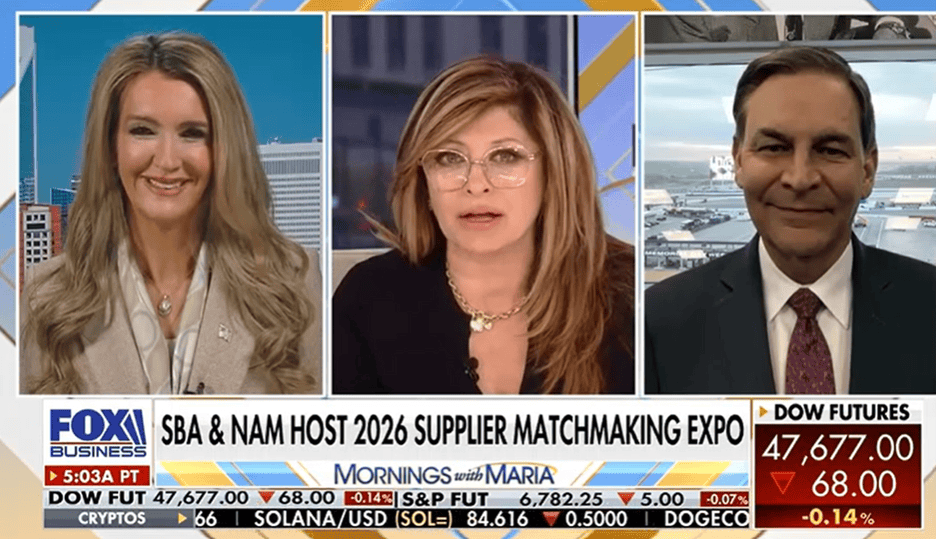
Watch NAM’s Jay Timmons and SBA Administrator Kelly Loeffler on Fox Business
Washington, D.C. – Today, the National Association of Manufacturers and the U.S. Small Business Administration host the inaugural 2026 Supplier Matchmaking Expo at Charlotte Motor Speedway in North Carolina. There, large manufacturers will connect with smaller suppliers, strengthening their U.S. supply chains and paving the way for more job creation and investment in American industrial dominance.
Ahead of the event, NAM President and CEO Jay Timmons and SBA Administrator Kelly Loeffler joined “Mornings with Maria” on Fox Business to discuss the state of manufacturing.
On Impact of H.R. 1 for Manufacturers
JAY TIMMONS: “I was here … in Charlotte where I got to see the benefits of H.R. 1. We were at Ketchie … the CEO of that company had signs all over her plant showing which machines were able to be purchased because of the tax reforms of 2017 and 2025. You put that together with regulatory modernization and energy development, and then you start putting together small manufacturers who can actually contribute to the supply chain and you’ve just got a supercharged economy. SBA Administrator Kelly Loeffler has been all over the road for the last 57 weeks, I think, pointing out how we need to really strengthen and supercharge the power and the might of small manufacturers here in the United States.”
On 2026 Supplier Matchmaking Expo
KELLY LOEFFLER: “We’re so proud to partner with the National Association of Manufacturers to bring large manufacturers like Ford, Siemens, Boeing, Lockheed and many others together with a half dozen federal agencies and then nearly 900 small businesses. And this is the energy that we see on the ground—that small manufacturers are seeing a ramp-up in orders. You saw that in the ISM, both the services and the manufacturing data, two consecutive months of expansion. What’s exciting about this is that’s a forward-looking metric, as is the small business optimism that we see in this sector. Seventy percent of companies expect revenue growth, half expect to expand. I’ve talked to manufacturers that expect to double, and we’ve seen the demand from large manufacturers that need their subcontractors, companies like Ford that use 5,000 small business manufacturers to help strengthen their supply chain. Those manufacturers need to be in America. Those are American jobs, and that’s why we’re so excited to host this event today in Charlotte.”
On Manufacturing Workforce Needs
TIMMONS: “There are about 400,000 open jobs in manufacturing right now, and what we’re seeing is a need for more highly specialized jobs on the technical side—technicians who can help us develop AI and infuse AI into our workforce. About 50% of small businesses right now use AI in their operations. That number will grow to about 80% by the year 2030. So, think in terms of jobs that we don’t even have an idea of what they look like today. Every generation … the job types in manufacturing change so substantially, and AI, I think, is going to take us in a whole different direction.”
LOEFFLER: “What we see on the ground is strong demand for the skilled workforce, and that’s what we’re working with small businesses on. They have millions of jobs open. This is what our mandate is now … to help create the skilled workforce of the future because those jobs are out there, as Jay said, and we need to make sure that our young people are ready to take those jobs on.”
-NAM-
The National Association of Manufacturers is the largest manufacturing association in the United States, representing small and large manufacturers in every industrial sector and in all 50 states. Manufacturing employs nearly 13 million men and women, contributes $2.95 trillion to the U.S. economy annually and accounts for 53% of private-sector research and development. The NAM is the powerful voice of the manufacturing community and the leading advocate for a policy agenda that helps manufacturers compete in the global economy and create jobs across the United States. For more information about the NAM or to follow us on Twitter and Facebook, please visit www.nam.org.
Manufacturing Institute Announces Recipients of 2026 STEP Awards

The Manufacturing Institute, the NAM’s workforce development and education affiliation, announced the 145 recipients of the 2026 STEP Ahead Awards on Monday. They will be honored at the STEP Ahead Awards Gala in April.
- The awards honor outstanding leaders in the industry at all career levels and all positions—from the shop floor to the C-suite—as they build the industry of the future and inspire the next generation of the workers.
Why it matters: With more than 400,000 openings in the sector today—and an expected 3.8 million new employees needed by 2033—the industry requires leaders and role models to show prospective workers all that it can offer.
STEP leaders say: “As chair of the STEP Ahead Awards, I’m honored to recognize distinguished leaders who are strengthening manufacturing excellence by investing in the future talent pipeline. With our industry facing a critical workforce challenge, real innovation will only come from empowering our workforces and nurturing the next generation of leaders through mentorship, sponsorship and serving as strong role models,” Biogen Executive Vice President and Head of Pharmaceutical Operations and Technology Nicole Murphy said.
- “It’s a privilege to serve as vice chair of the STEP Ahead Awards and to highlight those who are reimagining what’s possible in our industry. I’m proud to see the next generation of female and ally leaders shaping the future of manufacturing and technology and inspiring others to see STEM careers as both meaningful and attainable,” AstraZeneca Senior Vice President and Global Head of Pharmaceutical Technology and Development Dafni Bika said.
The MI says: “The STEP Ahead Awards are truly a celebration of the outstanding character and contributions of so many members of the manufacturing workforce. Our industry is so fortunate to have so many inspiring leaders and mentors who are cultivating fulfilling workplace cultures that encourage people to join, stay and grow our workforce,” said MI President Carolyn Lee.
What’s next: The 2026 STEP Ahead Awards Gala will take place April 23, 2026, at The Anthem in Washington, D.C. View the full list of awardees and learn more about the awards gala here.
ICYMI: Iowa Manufacturer Expands, Credits Pro-Growth Tax Law
Vermeer Corporation Announces Plan to Build New Facility, Create 300+ Jobs
Washington, D.C. – Vermeer Corporation, an industrial and agricultural equipment producer based in Pella, Iowa, is crediting the pro-growth tax provisions of H.R. 1 with supporting the company’s plan to build an all-new 300,000-square-foot facility in the Des Moines metro that will create more than 300 jobs.
Vermeer said in a company statement, “We’re grateful for the state of Iowa, the pro-business environment, the skilled workforce here and economic policies, like Working Families Tax Cuts, that have helped support Vermeer’s long-term growth.”
Last August, National Association of Manufacturers Executive Vice President Erin Streeter joined Rep. Mariannette Miller-Meeks (R-IA) for a Made in America Manufacturing Tour across Iowa’s 1st District, where they visited Vermeer’s facility in Pella. During the tour, Vermeer President and CEO and NAM Executive Committee member Jason Andringa said H.R. 1 “sets up manufacturers for a generation of continued growth and advancement.”
Streeter praised Rep. Miller-Meeks’ leadership during the tour.
“H.R.1 is a landmark win for manufacturing—delivering pro-growth policies that will strengthen our industry for years to come. Without bold leadership from lawmakers like Rep. Miller-Meeks, manufacturers could have been crippled by the largest tax hike in history—jeopardizing the progress we made after the 2017 Tax Cuts and Jobs Act. Iowa’s 1st Congressional District is the first in the state for manufacturing. We want to thank her for protecting 13,000 jobs and $1.2 billion in wages at more than 800 manufacturing companies in her district alone.”
Background
KEY FACTS: If Congress had failed to preserve tax reform in 2025, the U.S. would have risked:
- 5.9 million lost jobs;
- A $540 billion reduction in employee compensation; and
- A $1.1 trillion shortfall in U.S. GDP.
-NAM-
The National Association of Manufacturers is the largest manufacturing association in the United States, representing small and large manufacturers in every industrial sector and in all 50 states. Manufacturing employs nearly 13 million men and women, contributes $2.95 trillion to the U.S. economy annually and accounts for 53% of private-sector research and development. The NAM is the powerful voice of the manufacturing community and the leading advocate for a policy agenda that helps manufacturers compete in the global economy and create jobs across the United States. For more information about the NAM or to follow us on Twitter and Facebook, please visit www.nam.org.
Import Costs Edge Up as Export Prices Jump
U.S. import prices increased 0.2% in January, after a similar rise in December, with higher nonfuel prices more than offsetting lower prices for fuel in January. Over the past year, import prices declined 0.1%. Meanwhile, U.S. export prices rose 0.6% in January, with both higher nonagricultural and agricultural export prices driving the increase. Over the past year, export prices advanced 2.6%.
In January, U.S. import prices for manufacturing rose 0.8% over the year, with most of the industry experiencing price declines. Primary metal manufacturing experienced the most significant over-the-year U.S. import price increase in January, surging 26.1%. On the other hand, the greatest yearly decline in U.S. import prices occurred in beverage and tobacco product manufacturing, which fell 14.1% from January 2025. Meanwhile, U.S. export prices for manufacturing in January advanced 4.0% over the year, with primary metal manufacturing export prices exhibiting the largest rise (43.9%).
Fuel import prices fell 2.2% over the month in January, after declining 1.1% in December. Lower prices for petroleum drove the decrease, moving down 2.7%. Furthermore, prices for fuel imports plummeted 13.4% from January 2025. Meanwhile, natural gas prices jumped 36.4% over the year.
Nonfuel import prices increased 0.5% in January, after moving up 0.2% in December. Higher prices for nonfuel industrial supplies and materials, capital goods, automotive vehicles, consumer goods and foods, feeds and beverages drove the increase. The price index for nonfuel imports grew 1.2% over the past year and has not declined on a year-over-year basis since February 2024.
After no movement in December, agricultural export prices increased 0.2% in January. Over the past 12 months, agricultural export prices advanced 2.2%. Meanwhile, nonagricultural export prices rose 0.7% in January. Higher prices for capital goods, nonagricultural industrial supplies and materials, consumer goods and automotive vehicles led the gain. Over the past year, nonagricultural export prices advanced 2.7%.
U.S. Manufacturing Growth Weakest in Seven Months
The S&P Global Manufacturing PMI was 51.6 in February, down from the January reading of 52.4. New orders rose in February, but at a slower pace than the prior month. At the same time, exports declined for the eighth consecutive month as tariffs continued to drive up costs and hurt demand from Canada. Prices on inputs increased but at a slower rate than in January, while selling price inflation fell to a 14-month low. In sum, the rate of inflation remains elevated from a historical context in February but is lower than recent peaks.
Production rose at the weakest rate since September, and combined with marginal gains in sales, caused stocks of finished goods to remain unchanged following six months of accumulation. Employment gains were weak in February as backlogs of work declined. Meanwhile, vendor performance continued to worsen as a result of low stock availability, transportation delays and adverse weather.
Expectations of new product launches and business expansion plans led firm confidence to rise to its highest level in eight months in February. Despite the gain in optimism, uncertainty over the political environment and the tariff picture continued to be a drag on hiring and investment, and that uncertainty doesn’t seem likely to abate soon.
Global Manufacturing PMI Hits 44-Month High
In February, growth in global manufacturing activity strengthened from January, rising from 50.9 to 51.9, a 44-month high. Output and new orders both expanded as production rose at the fastest pace since December 2021 and growth in new orders hit a four-year high. New export orders increased as international trade volumes improved for the first time since March 2025 but continued to contract in the U.S and eurozone. Meanwhile, lead times continued to slow, lengthening for the 21st consecutive month. Employment grew for the second consecutive month, although gains were minimal.
India, Taiwan, the Philippines and Greece had the highest PMI readings in February. On the other hand, Mexico, Brazil and Russia were some of the larger nations to register declines in activity. The upturn in manufacturing occurred across consumer, intermediate and investment goods in February, with rates of expansion improving for the intermediate and investment goods sectors.
Meanwhile, input price pressures strengthened in February, jumping to a 39-month high, while output prices rose at a slightly slower rate. Forward-looking indicators remained positive, with business optimism hitting a 21-month high and climbing above long-run averages for the first time since March 2024. Notable improvements in Japan, China, the eurozone and the U.S. helped buoy this increased optimism.