
NAM Forge Your Path Series: Meet Osmundson Manufacturing Company President and CEO Heather Bruce
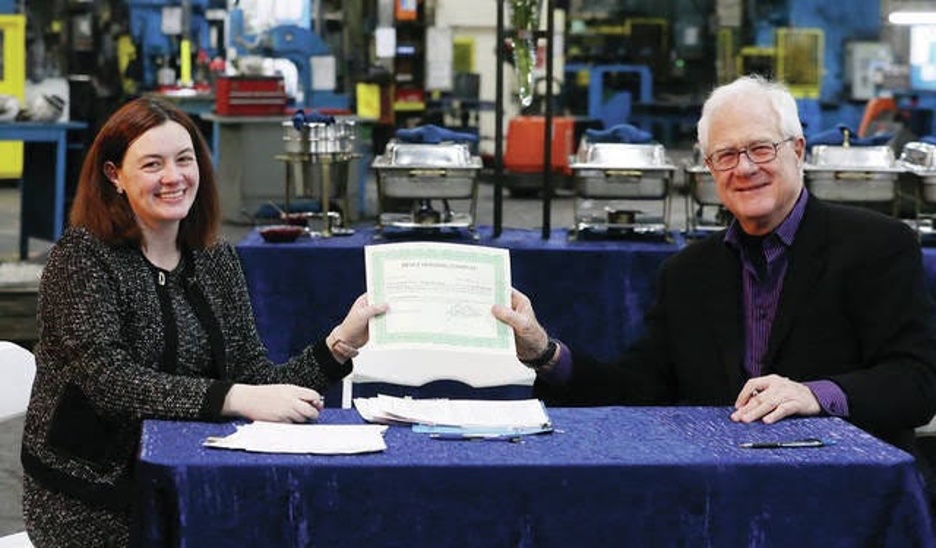
For Heather Bruce, leading a fifth-generation manufacturing company is as much about looking ahead as honoring what came before.
As president and CEO of Osmundson Manufacturing Company, she is carrying forward a more than 120-year legacy while challenging her company to evolve, diversify and find new opportunities for growth.
In the NAM’s latest “Forge Your Path” series, she shares the leadership lessons that have shaped her approach, why meaningful change happens “brick by brick” and what it takes to build a stronger company for the next generation.
Q: What is one leadership lesson or insight you haven’t widely shared that has been important to your or Osmundson’s success? How did you come to that realization, and how has it influenced your leadership?
Heather: “One of the biggest lessons I’ve learned is that you can honor a legacy without being bound by it.
Being the fifth generation of a 120-plus-year-old manufacturing company comes with an unusual responsibility. In a family business, it can be easy to believe that changing what worked for the generation before you means you don’t respect what they built. I’ve learned almost the opposite: every generation of Osmundson survived because someone was willing to change.
I’ve also learned that growth and preservation aren’t opposites. Growth creates opportunity for our people, and diversification creates stability for the company. Sometimes the best way to protect a legacy is to be willing to change it. Osmundson didn’t make it through five generations by doing everything the same way. At different points in our history, someone had to challenge conventional thinking, try something different and trust there was a better way.
For me, that has reinforced much of what my father taught me and what I have learned from other leaders I admire: respect where you came from, but don’t let the past dictate where you are going.”
Q: What quote or mantra defines your leadership approach, and how does it influence your decisions?
Heather: “‘Brick by brick, my fellow citizens, brick by brick.’ I usually follow that in my own head with ‘Rome wasn’t built in a day.’ Leadership has taught me that meaningful change takes patience, persistence and a willingness to keep moving forward even when the results aren’t immediate.
At Osmundson, my job isn’t simply to preserve what previous generations created; it is to make it stronger for the next generation. That means making difficult decisions, changing things that have existed for decades and still respecting the craftsmanship, people and values that got us here.
I also believe strongly in the principle that ‘leaders eat last.’ A leader I have long admired for putting that philosophy into practice is Haruka Nishimatsu, former president and CEO of Japan Airlines. During an incredibly difficult period for the airline, he shared in the sacrifices he was asking employees to make, including cutting his own compensation, giving up executive privileges and eating alongside employees in the company cafeteria. That example has stayed with me because leadership isn’t about saying, ‘You need to sacrifice.’ It’s saying, ‘We need to sacrifice, and I will go first.’
I try to carry that philosophy into my own leadership. If I am asking our people to work harder, embrace change, control costs or push through a difficult period, they should see that I am willing to do the same and usually more. I also ask not only, ‘Is this the right decision for Osmundson today?’ but ‘Does this make us stronger five, 10 or 20 years from now?’”
Q: What accomplishments at Osmundson are you most proud of and why?
Heather: “I am most proud that we are still here and that we haven’t had to become someone else to get here.
Over more than 120 years, Osmundson has made it through the Great Depression, two World Wars, the Vietnam era, the farm crisis of the 1980s, recessions, international trade disputes, supply chain disruptions and countless changes in agriculture and manufacturing. You don’t make it through all of that by standing still.
We have changed products, processes, technology, markets and leadership styles. But throughout those changes, we have held onto the craftsmanship, relationships and pride in what we make that have always been part of Osmundson.
I’m proud that today we are still an American manufacturer, still making products with our own people and still looking for ways to get better. For me, the accomplishment isn’t simply surviving for five generations. It’s continuing to evolve while knowing who we are.”
Q: Where do you see Osmundson in the next five years, and what do you hope to achieve?
Heather: “The next five years are about taking what Osmundson has become very good at over generations and asking, ‘Where else can we solve a problem?’ That means expanding beyond our traditional markets, investing in another manufacturing location, developing our people and taking the metallurgy, heat-treating knowledge, engineering and craftsmanship we are known for into new wear applications and markets.
I want Osmundson to be known not simply as a manufacturer of agricultural wear parts, but as a company people come to when they have a difficult wear problem that needs solving. We have generations of knowledge in how steel behaves, how it wears and how to make it perform, and there is a much bigger opportunity to apply that knowledge. Growth for the sake of being bigger isn’t the goal. I want us to grow in a way that creates opportunities for our employees, strengthens our relationships with customers and suppliers, diversifies the business and gives the next generation an even stronger company.
Ultimately, I don’t believe my responsibility is to hand the next generation the same Osmundson I received. My responsibility is to hand them a better one.”
Q: What are the past three books you’ve read or podcasts you’ve listened to that you would recommend to other leaders and why?
Heather: “‘Leaders Eat Last’ by Simon Sinek aligns closely with how I was raised to think about leadership and what I watched my father practice. Leadership isn’t about having the best title or sitting at the top of an organizational chart. It is about creating an environment where people trust their leaders and know that when things get difficult, their leader isn’t going to disappear. I believe leadership starts with taking care of your people and being willing to do what you are asking of them.
I probably appreciate ‘The One Minute Manager’ by Ken Blanchard and Spencer Johnson the most because it makes leadership simple: set clear expectations, recognize people when they are doing things right and address problems quickly when they aren’t. People deserve to know what success looks like and where they stand. I’ve found that simple, consistent communication is often much more effective than complicated management systems.
I also recommend ‘Extreme Ownership’ by Jocko Willink and Leif Babin. One of the most valuable leadership disciplines is taking ownership before assigning blame. When something isn’t working, my first questions are: What could I have communicated more clearly? What expectation wasn’t established? What system needs to change? Accountability absolutely matters, but it has to start at the top before you can genuinely expect it from everyone else.
The common thread among all three is something I strongly believe: leadership doesn’t have to be complicated. Take care of your people, make expectations clear, communicate directly and take ownership when things don’t go as planned.”
