Johnson & Johnson’s Ottava Is Set to Revolutionize Robotic Surgery
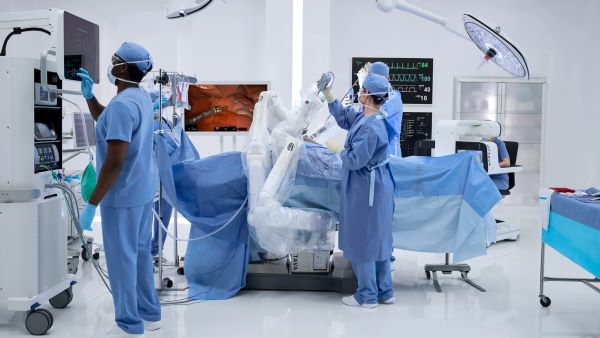
In July, Johnson & Johnson got some good news ahead of schedule: its Ottava surgical robot received Food and Drug Administration de novo authorization—approval granted when a device has no market equivalent (MedTech Dive).
A new approach: “J&J’s robot design differs from cart-based soft tissue surgical systems … with the integration of four ‘intelligent’ arms directly into the operating table, according to J&J’s Rocco De Bernardis, global president of Ottava.”
What’s new: The de novo approval “means Ottava is very different versus everything else that exists,” he said. “What we did was to get rid of booms and carts” and have only four robotic arms that “can [be] store[d] under the table.”
- The arms are long and flexible enough to allow for even “the most complex soft tissue robotic procedures” to be performed.
- Ottava is 30% to 50% smaller than other robotic systems so “it can fit pretty much in every operating room around the world.”
About the launch: Over the next 12 to 18 months, working with U.S. institutions that “are experts in robotic surgery,” Johnson & Johnson will deploy Ottava in general surgery, De Bernardis said.
For surgeons, by surgeons: During Ottava’s development, Johnson & Johnson incorporated surgeons’ suggestions for improvement, including synchronized table motion.
- Surgeons “use gravity by changing the position of the table and the patient on it during the procedure,” De Bernardis continued. “With the advent of robotic systems, that became much more complicated. … We made this capability of using gravity during the procedure native into the system.”
For hospitals: “Clinical value is going to come from Ottava. Any operating room can be a robotic operating room. That’s very important for hospitals. We’re able to set up the system by a press of a button.”
Photo credit: Johnson & Johnson