
Trading to Win
Overview
Trade Policy That Keeps Manufacturers Building in America
Manufacturers in the United States compete and win when trade policy expands market access, secures reliable supply chains and rewards investment at home. Explore how the NAM is delivering on that promise—strengthening the United States-Mexico-Canada Agreement, advancing a U.S. Manufacturing Investment Accelerator, building a comprehensive critical minerals strategy and pressing federal agencies to get tariff policy right.
U.S. Investment Accelerator
U.S. Manufacturing Investment Accelerator Program
To give manufacturers a runway of predictable access to critical materials and leading technologies from reliable suppliers that will accelerate the long-term investments needed to maintain America’s global edge, the NAM is proposing a U.S. Manufacturing Investment Accelerator Program.
Two Tools to Keep Manufacturers Building in America
A Manufacturing Tariff Speed Pass
The administration should implement a general licensing system that grants preapprovals for duty-free imports of inputs and materials necessary for manufacturing activities in the U.S.
How It Works: Self-Certification Under a “General License”
- General licenses would provide preexisting approval for any company meeting the criteria to import qualifying items free of duty.
- Use would be self-determined by eligible parties, subject to U.S. Customs and Border Protection verification.
- The president can direct the Treasury to implement the program under existing authorities.
What Qualifies for a General License?
- Materials, equipment, machinery, and parts used in manufacturing or maintenance.
- Essential raw materials, chemicals, and other inputs in limited supply but needed for U.S. manufacturing.
- Materials transferred intercompany and used for further processing in the U.S.
- Materials for R&D in the U.S.
A Manufacturing Investment Accelerator Rebate
The administration should provide a rebate to offset tariff costs when dollars are spent to expand or maintain manufacturing investments in the U.S. The rebate should be available on a rolling basis for actual dollars spent after April 5, 2025.
What Qualifies for a Rebate?
- Dollars spent on new greenfield or brownfield investments.
- Dollars spent on expanding or upgrading existing capacity, including capital improvements and maintenance.
- Dollars spent to add full-time manufacturing employment.
- Dollars spent on R&D in the U.S.
USMCA
The Promise of the USMCA
President Trump’s USMCA succeeded in shifting manufacturing imports away from China to North America. In this new phase of U.S. trade policy, strengthening the United States–Mexico–Canada Agreement will be critical in helping North America restore balance and combat disruptive, problematic trade practices coming out of other countries, specifically China.
The Most Pro-Manufacturing Trade Agreement in History
North America accounts for one-third of global GDP—nearly double China’s share. The USMCA is the foundation that keeps it that way.
Figures: NAM, Strengthening the USMCA report.
Coproduction Across North America
Four Sectors. One Integrated Industrial Base.
The Automotive Industry Drives North American Trade
Decades of integration across the U.S., Canada, and Mexico have built the world’s most resilient auto industry—and it’s anchored in America.
North American Aerospace Delivers Aviation Dominance
U.S.-led R&D, certification, and final assembly—reinforced by Canadian and Mexican specialization—keeps American aerospace globally competitive.
From Design to Assembly: North America Is the Semiconductor Epicenter
U.S. design and fabrication, Canadian critical minerals, and Mexican assembly & packaging combine into a coordinated, just-in-time semiconductor pipeline.
North American Chemistry Enables Manufacturing Dominance
Chemistry is the upstream backbone for every other sector on this page—from the auto on your driveway to the chip in your phone.
In Partnership With




At Nearly $600 Billion in Sales, Canada and Mexico Buy More U.S. Manufactured Goods than the Next 10 Partners Combined
Between 2019 and 2025, U.S. Goods Imports from Mexico Grew 50% While Imports from China Dropped 31%
Goods Imports in millions of USD
For Most Manufacturing Sectors, U.S. Exports Grew Faster to Mexico and Canada Than to the Rest of the World
Percentage Growth from 2014 to 2025
Manufacturers’ Principles for Strengthening the USMCA
U.S. manufacturing competitiveness depends on the preservation of a robust, long-term, regional USMCA. As policymakers look to preserve and strengthen this historic agreement, manufacturers support improvements that enhance the benefits of the USMCA for the sector and secure manufacturing dominance in America.
1. Make Process Improvements
The parties should simplify and digitize customs documentation to ensure that manufacturers of all sizes who make things across North America can maximize the benefits of the USMCA.
2. Strengthen Protections
The deep levels of cross-border investment that power North American manufacturing co-production must be better safeguarded, including against expropriation and unfair treatment.
3. Secure Critical Manufacturing Inputs
North America is uniquely advantaged and can better leverage the region’s critical mineral assets through duty-free trade, regulatory alignment and joint support for investing and scaling projects.
4. Reinforce North American Energy Security
Through coordinated permitting reforms, duty-free trade in energy and resolution of nontariff barriers in Mexico’s energy market, we can secure the energy needed to power manufacturing expansion across the region.
5. Promote AI Leadership
The parties should continue to lead the world with strong digital trade provisions and a common AI action plan, including promotion of a North American AI technology stack.
6. Level the Playing Field
Common concerns regarding unfair advantages for nonmarket economies can be addressed through customs and investment screening cooperation among the parties and through stronger USMCA provisions to discipline the behaviors of state-owned enterprises.
7. Enforce the Contract
With trade at these levels of volume and a global economy in perpetual motion, bilateral irritants will arise. The parties should resolve to address them quickly, routinely and meaningfully, including through dispute settlement as appropriate, to ensure commitments are met under the agreement.
8. Assure Continuity with Feedback Loops
North American manufacturing is built on a network of long-term relationships with qualified suppliers. Reinstating the institutional structures of the USMCA to promote smooth operation of the agreement should be the norm—and include the private sector as participants.
Critical Minerals
A Comprehensive Critical Minerals Strategy for Manufacturers in America
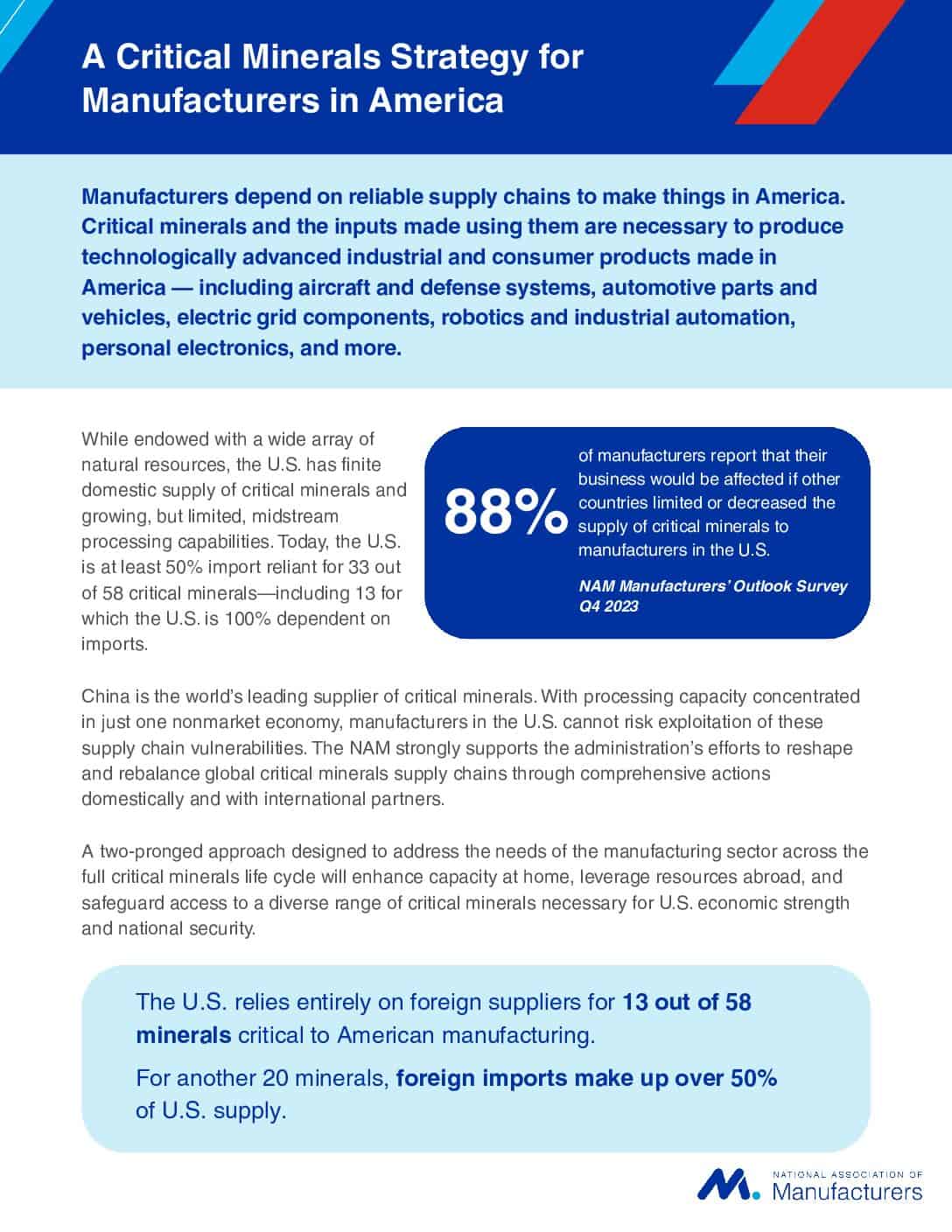
In a letter to the U.S. Trade Representative, the NAM has put forward a comprehensive critical minerals strategy to expand access to essential inputs, strengthen supply chain resilience and help manufacturers compete and grow. That strategy has two key components:
- First, policymakers should strengthen domestic critical minerals capacity by enacting comprehensive permitting reform, restoring strategic incentives for extraction and processing, investing in recycling, recovery and substitution technologies and expanding workforce development programs. This will help manufacturers access the critical inputs they need, reduce supply chain vulnerabilities and support more investment here at home.
- Second, the U.S. should advance an international critical minerals strategy that leverages partnerships with allies, unlocks project financing, secures stronger protections and offtake opportunities for U.S. investors, reduces tariff barriers on critical inputs and machinery and counters nonmarket distortions such as export restrictions and unfair state-backed advantages. This will help diversify supply chains, rebalance the global critical minerals market and ensure manufacturers can access the minerals they need to make more in America.
Percentage of Global Production Controlled by China
Source: U.S. Geological Survey, “2026 USGS Mineral Commodity Summaries,” February 2026. World Critical Mineral Stats visualization
U.S. Import Reliance by Mineral
% of domestic demand dependent on imported sources
U.S. Geological Survey, “Mineral Commodity Summaries 2026,” March 2026. Figure 2 – 2025 U.S. net import reliance
Policy Recommendations
Key Policy Actions
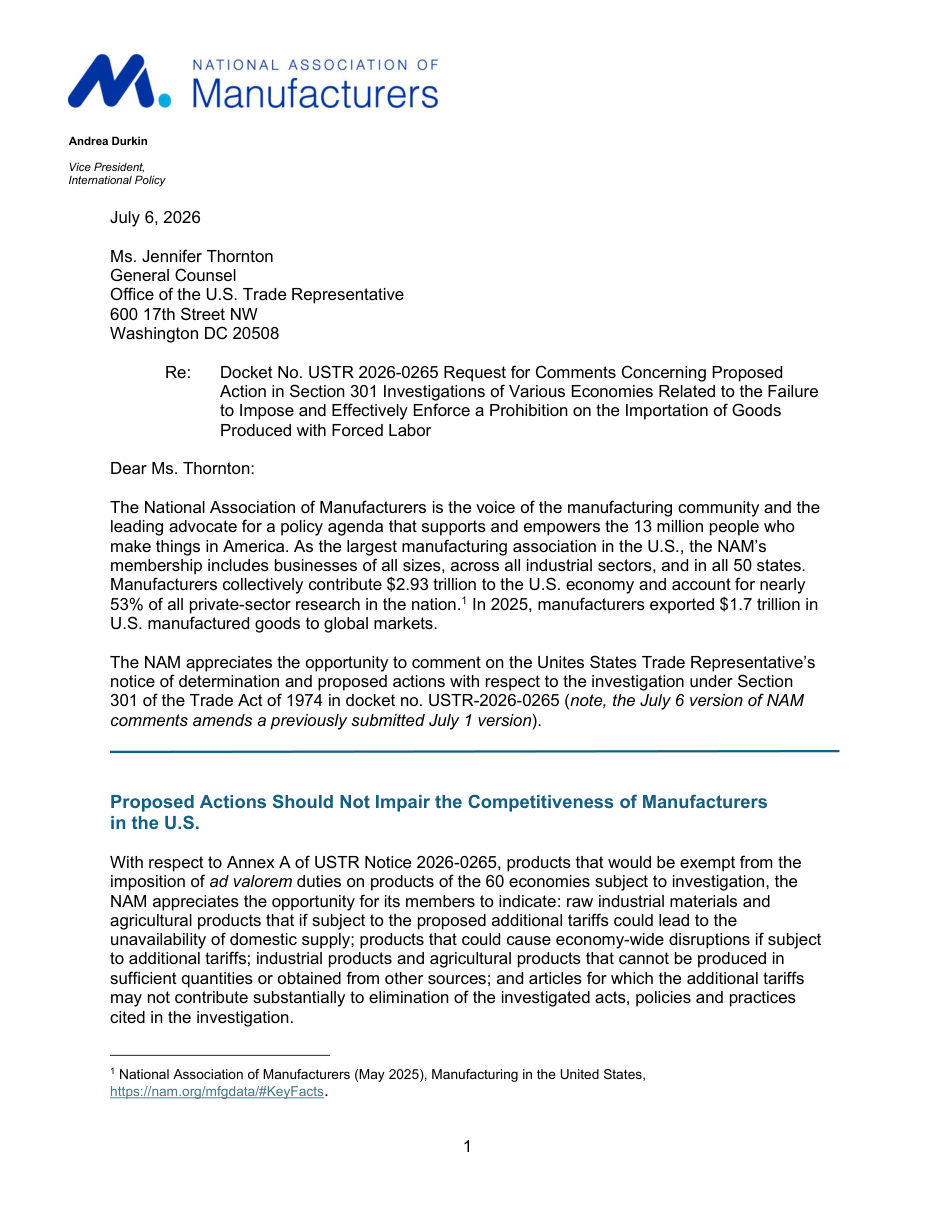
Section 301 Investigations Related to the Importation of Goods Produced with Forced Labor
The NAM's amended comments (July 6, 2026) to USTR on proposed actions in the Section 301 investigations of 60 economies related to enforcing prohibitions on goods produced with forced labor. The NAM urges that any actions avoid impairing the competitiveness of manufacturers in the U.S., supports the proposed Annex A exemptions for critical inputs, and recommends alignment with reciprocal trade agreement commitments and tariff unstacking.
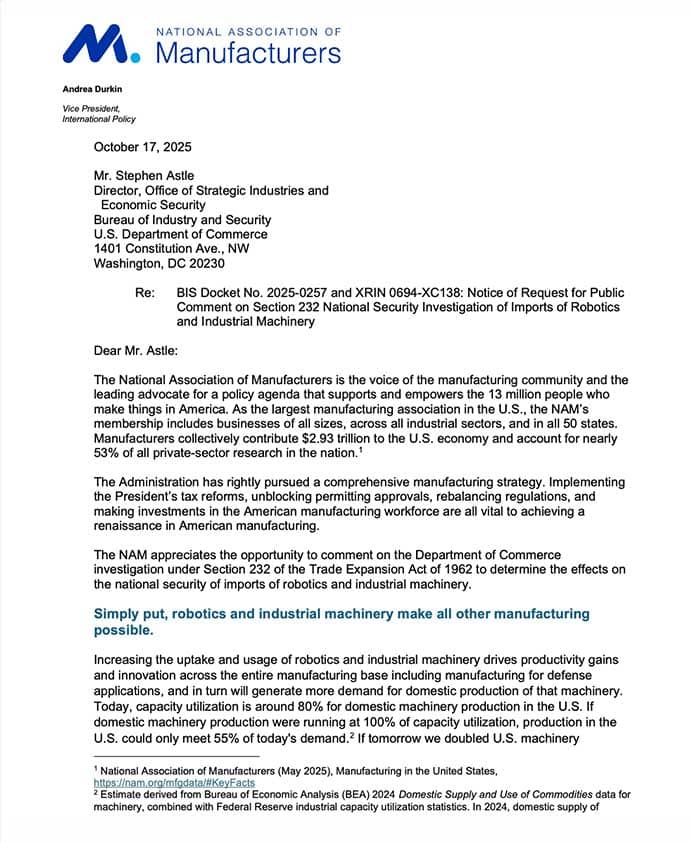
Section 232 Robotics and Industrial Machinery Submission Final October 17 2025
NAM warns that Section 232 tariffs on robotics and industrial machinery would raise costs, disrupt manufacturing growth, and limit innovation, urging transparent, targeted policies that strengthen U.S. competitiveness through trade partnerships and domestic investment.
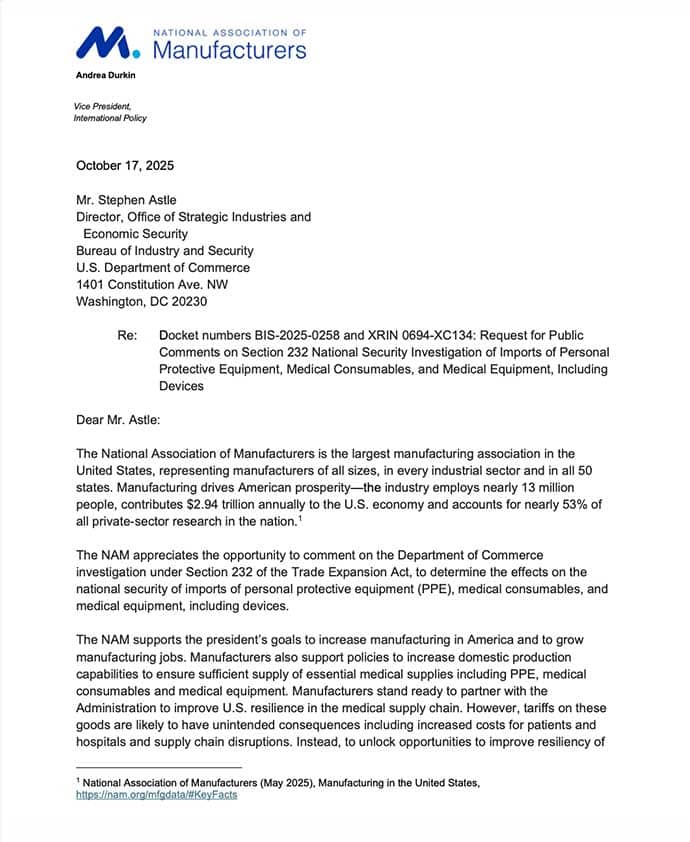
Section 232 Medical Technologies Submission Final October 17 2025
NAM cautions that Section 232 tariffs on medical technologies would raise costs and disrupt care, urging transparent, targeted policies that strengthen U.S. manufacturing and safeguard access to essential supplies.
Read our letter to the U.S. Trade Representative (USTR) on the operation of the USMCA
On behalf of the National Association of Manufacturers, I respectfully submit the attached comments regarding the operation of the Agreement between the United States, Mexico and Canada (USMCA).
Section 232 National Security Investigation of Imports of Processed Critical Minerals
NAM submitted comments to the U.S. Department of Commerce on the Section 232 investigation into critical mineral imports, emphasizing their role in U.S. manufacturing, energy, and defense. NAM urged against tariffs, citing risks to supply chains and competitiveness.
Section 301 Investigations of Structural Excess Capacity in Manufacturing Sectors
The NAM's comments to USTR on the Section 301 investigations into structural excess capacity and production in manufacturing sectors, urging that the economies under investigation be considered on a differentiated basis: China's industrial subsidization is materially unique in nature, pervasiveness and scale, driving uneconomic investment and anti-competitive practices in global markets.
Comments on Section 232 National Security Investigation of Imports of Pharmaceuticals
NAM submitted comments to the U.S. Department of Commerce on the Section 232 investigation into pharmaceutical imports, urging against broad tariffs. NAM emphasized the industry's vital role in U.S. innovation, economic strength, and national security.
Comments on Section 232 National Security Investigation of Imports of Semiconductors
NAM submitted comments to the U.S. Department of Commerce on the Section 232 investigation into semiconductor imports, emphasizing the chips’ essential role in U.S. manufacturing, innovation, and national security. NAM urged against tariffs, advocating instead for policies that promote domestic investment, support global market access, and strengthen alliances to secure semiconductor supply chains.
Section 301 Investigation of Brazil’s Acts, Policies and Practices
The NAM's comments to USTR on proposed actions in the Section 301 investigation of Brazil covering digital trade and electronic payment services, preferential tariffs, anti-corruption enforcement, intellectual property protection, ethanol market access and illegal deforestation. The NAM urges exemptions for industrial inputs that manufacturers in the U.S. cannot source domestically in sufficient quantities.
Comments on “Most Favored Nation” Pricing: Foreign Nations Freeloading on American-Financed Innovation
The NAM's comments to USTR on foreign nations freeloading on American-financed biopharmaceutical innovation (USTR-2025-0011). The NAM supports action against discriminatory foreign price controls and reimbursement practices that undervalue U.S. medicines, and urges USTR to secure fair market access and strong IP enforcement abroad—paired with domestic reforms—rather than impose U.S. price controls that would undercut lifesaving innovation.
NAM Submission to USTR Reciprocal Tariff FRN March 11 2025
The NAM submitted comments to the USTR offering approaches to new trade negotiations to strengthen America’s economic might in the world, while preserving manufacturers’ ability to access inputs critical to expanding manufacturing at home.
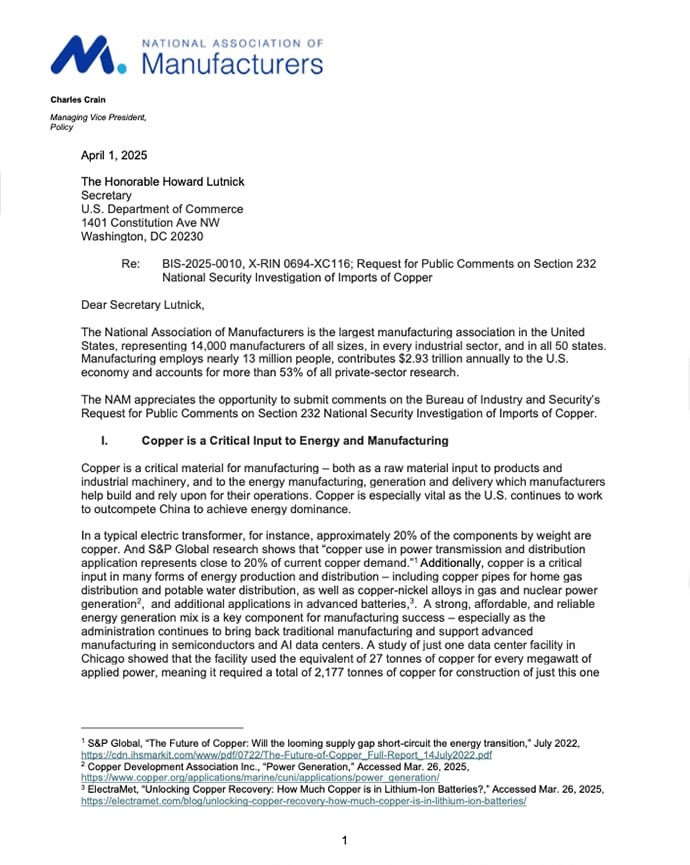
Comments on Section 232 National Security Investigation of Imports of Copper
NAM submitted comments to the U.S. Department of Commerce on the Section 232 copper import investigation, highlighting copper’s essential role in manufacturing and energy—from transformers to data centers—and urging tariff-free access amid supply gaps.
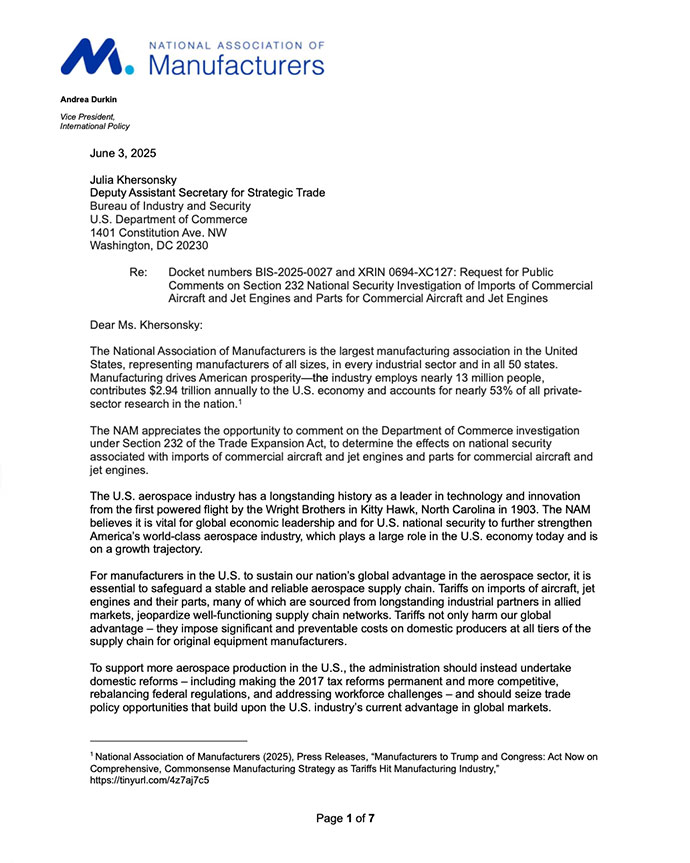
Comments on Section 232 National Security Investigation of Imports of Commercial Aircraft and Jet Engines and Parts
The NAM urges the administration to reject proposed tariffs on aerospace imports, warning they would raise costs, disrupt supply chains, and hurt U.S. competitiveness. Instead, it advocates for tax, regulatory, and workforce reforms to strengthen domestic manufacturing and maintain America’s aerospace leadership.
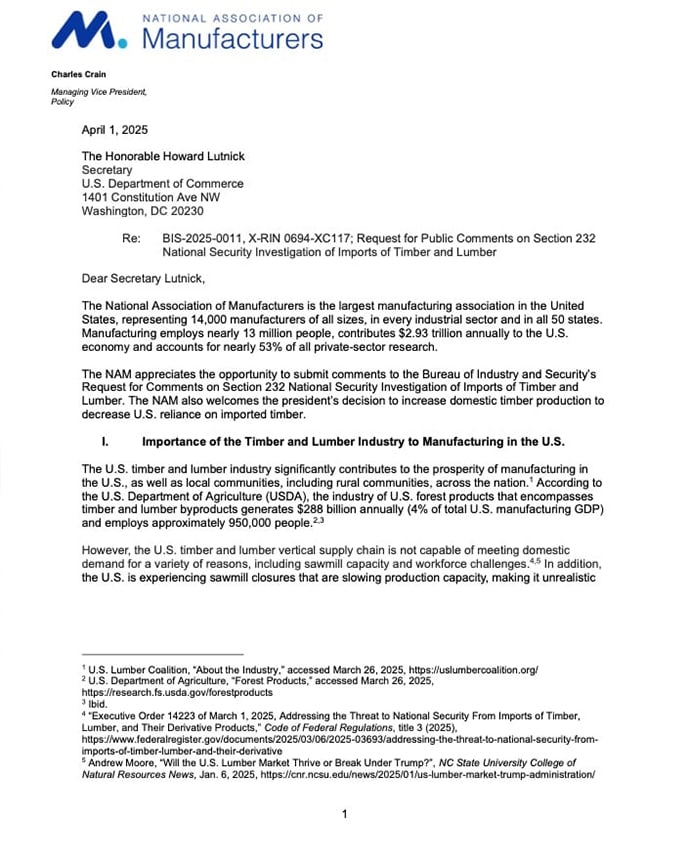
Comments on Section 232 National Security Investigation of Imports of Timber and Lumber
NAM emphasized the industry's importance to U.S. manufacturing and warned that new tariffs could raise costs and disrupt supply chains.
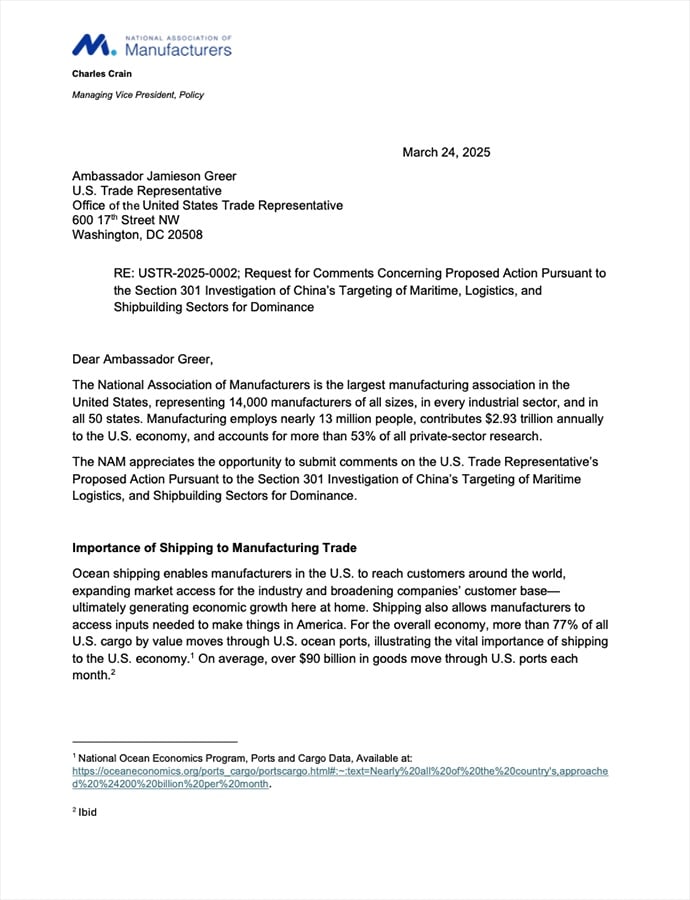
Investigation of China’s Targeting of Maritime, Logistics, and Shipbuilding Sectors for Dominance
The NAM submitted comments to USTR opposing proposed port fees that would raise costs for U.S. manufacturers. While supporting efforts to counter China’s unfair shipbuilding practices, NAM urges targeted solutions that don’t disrupt supply chains or burden American industry.
2026 Special 301 Review Comments on Intellectual Property Protections
The NAM encourages the administration to leverage ongoing negotiations to achieve bilateral agreements with stronger IP protections that resolve longstanding regulatory and enforcement gaps.
NAM Section 232 Metal Inclusion Information Collection Process Submission September 26 2025
NAM comments on stakeholder input and improvements the BIS Section 232 inclusion process, emphasizing the need for transparency and a legally sound review of requests, while safeguarding manufacturers’ access to essential inputs.
Comments on the Design of a Plurilateral Agreement on Trade in Critical Minerals
The NAM's comments informing USTR's approach to plurilateral negotiations on trade in critical minerals and policy actions to strengthen the resilience of critical minerals supply chains, positioning U.S. investors for success and leveraging the collective advantages of international partners across the critical minerals life cycle.
The U.S.-Mexico-Canada Agreement: Evaluating North American Competitiveness
NAM submitted testimony for the Senate Finance Committee hearing, “The U.S.-Mexico-Canada Agreement: Evaluating North American Competitiveness,” underscoring USMCA’s role in strengthening North American supply chains, expanding market access and bolstering the global competitiveness of the 13 million Americans who make things in the United States.
What Manufacturers Are Saying on Tariffs
The Boston Globe
Trump’s first 100 days
"[I] think all those things combined with almost no notice, you have no ability to react to that and you have no ability to plan your business." – Mark Shiring, President and CEO of ebm-papst Americas, Farmington, CT
NewsNation
NAM's Timmons on NewsNation
"[Manufacturers are] concerned because we don't really have the blueprint yet. Now, the good news is the President says that he is going to be focusing on getting 90 different deals done in the next 90 days."
York Dispatch
Local manufacturer casts wary gaze toward tariffs
“[W]e're seeing increases [in metals] that will eventually get passed along to customer.” – Craig Souser, President and CEO, JLS Automation, York, PA
Cincinnati Enquirer
Cincinnati's trade-dependent $199B economy braces for tariffs
"If it drags out, it could be disruptive." – Jeremy Rosenback, President, Republic Wire, Hamilton, OH
NAM.org News
Timmons Talks Trade, Tax and Regulations in NYC Morning Media Swing
“But we have to understand that 95% of the world’s customers live outside the borders of the United States. So the more we make here, the more we can sell abroad, but not everything, unfortunately, can be made here. [W]e want to make as much as we can here in the United States. There’s no question about that.”
CBS 10WBNS
Central Ohio company feeling the impacts of tariffs
"We're talking to our suppliers and our customers on what it means and we're scrambling to find out as quickly as possible, country by country, material by material … It's just a lot to get your arms around in a very short period of time." – Brad Wasserstrom, President, Wasserstrom Company, Columbus, OH
Detroit News
Dardas: Tariffs threaten American manufacturers
"The issue at hand is trade policy — specifically, the tariffs that have been imposed or are being proposed. While the intention behind these tariffs may be to protect American interests, the reality is far more complex. For companies like ours, these tariffs are not just a tax; they are an existential threat." -Chuck Dardas, President & COO, AlphaUSA, Livonia, MI
NPR
Drowning in Tariffs, American businesses try to stay afloat
"There's just so much unknown right now, and I think that's the most difficult thing–to make decisions for your company financially when you just don't know all the pieces to the puzzle." – Lisa Winton, CEO and co-owner, Winton Machine, Suwanee, GA
NAM Survey on Tariff Impacts
Read the Full Report
Explore the data behind North American manufacturing’s $29B-per-year USMCA dividend—and what’s at stake if the agreement falters.
