Expectations Index Falls Below Recession Threshold
Consumer confidence declined seven points in February to 98.3. The Consumer Confidence Index, which fell for the third consecutive month, exhibited the largest monthly decrease since August 2021. The index is now at the bottom of the range that has prevailed since 2022.
The Present Situation Index, reflecting current business and labor market conditions, fell 3.4 points to 136.5. Meanwhile, the Expectations Index, which reflects consumers’ short-term outlook for income, business and labor market conditions, dropped 9.3 points to 72.9 and fell below the recession signal threshold of 80 for the first time since June 2024.
Of all components, only consumers’ assessments of current business conditions improved, and only slightly, with 19.6% of consumers saying business conditions were “good,” up from 18.5% in January. On the other hand, consumers’ outlook for future business conditions turned negative. Views of the current labor market situation softened, with 33.4% of consumers saying jobs were “plentiful,” while 16.3% said jobs were “hard to get.” Consumers’ pessimism about future labor market conditions worsened to a 10-month high, with a higher percentage anticipating fewer rather than more jobs to be available in the next six months. February’s drop in confidence was strongest for consumers between the ages of 35 and 55.
As inflation pressures have heated up in recent months, inflation expectations likewise ticked up from 5.2% to 6.0% in February. Meanwhile, expectations for higher interest rates rose, with more than half of consumers (51.7%) expecting higher rates in the next 12 months. Consumers’ views of their current financial situation softened from January, following a series high, while expectations for a recession in the next 12 months increased to a nine-month high. Nevertheless, buying plans for homes improved, perhaps linked to a decrease in mortgage rates, but plans to buy new cars and other big-ticket items declined. Mentions of trade and tariffs in written responses sharply increased to levels not seen since 2019, likely influencing inflation expectations.
How FAME Supercharged a Mom’s Manufacturing Career
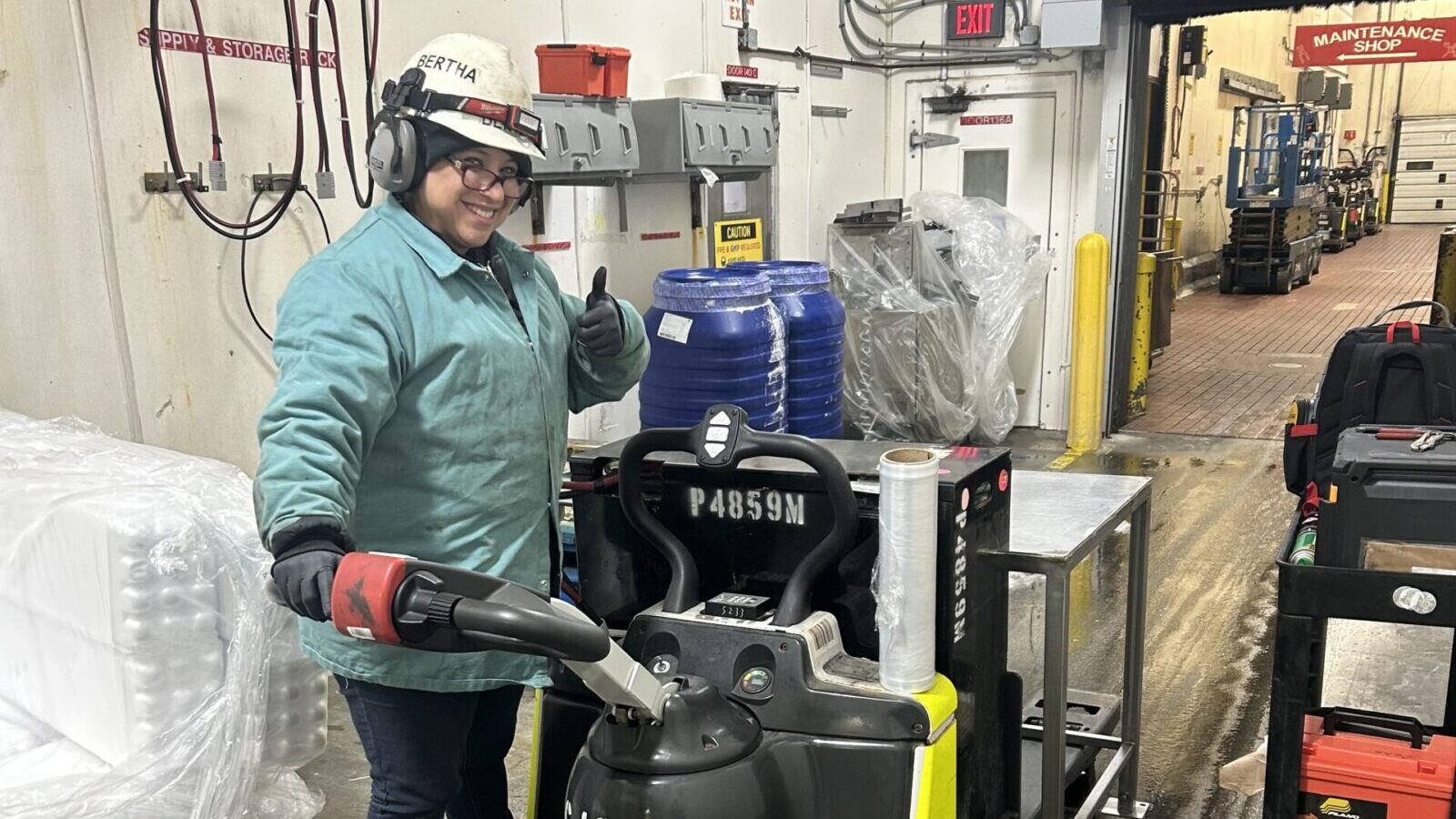
Bertha Ostiguin thought for years about going back to school. She had left the workforce to be a stay-at-home mom, and when she started working in production at H-E-B, she was still raising two boys at home. The idea of working part time while also studying and raising her kids felt daunting. But about six years into her manufacturing career at H-E-B, she joined the Advanced Manufacturing Technician program through TX FAME – Alamo in Alamo, Texas—more than 25 years after she was last in school.
“Honestly, I was scared that I wasn’t going to be able to make it,” said Ostiguin. “But it has been one of the best choices I’ve made. … I love it, I love what it does, and I cannot talk enough about it.”
The program: Founded in 2010 by Toyota and operated today by the Manufacturing Institute—the workforce development and education affiliate of the NAM—FAME aims to help students become highly skilled, sought-after workers capable of meeting the needs and challenges of the modern manufacturing sector.
- It provides current and aspiring workers with on-the-job training and classroom education, leading to an associate’s degree and the FAME certificate.
The opportunity: While Ostiguin was already several years into a manufacturing career, her experience at FAME has helped to expand her skillset, allowing her to advance her career at H-E-B and set herself up for greater success throughout her working life.
The benefits: In addition to teaching specific qualifications and in-demand technical skills, FAME helps to provide participants with the soft skills and professional behaviors they’ll need to succeed in today’s workforce, like communication. According to Ostiguin, it made her a better mentor to other people at work.
- “As I’m learning these things, I’m also teaching the young guys,” said Ostiguin. “And I would tell them, from my experience, why all this makes a difference.”
A model for others: In an industry that often has more men than women, Ostiguin saw early on that she was setting an example for others. She promised herself that she was going to finish the program—not just for herself and her sons, but for other women in manufacturing who might follow her lead. Ultimately, Ostiguin became the first woman from H-E-B to complete the FAME program, at the top of her class.
- “I started seeing the impact it was having for females, and how it wasn’t just about me anymore—it was about the bigger picture,” said Ostiguin.
A word of advice: Ostiguin is proud of what she has accomplished and encourages others to take advantage of opportunities to increase their knowledge and improve their skills.
- “Absorb as much as you can, and ask the questions that you have to ask,” said Ostiguin. “That’s the only way we’re all going to learn.”
From the MI: “FAME isn’t just transforming careers—it’s strengthening companies,” said MI President and Executive Director Carolyn Lee. “Bertha’s journey shows how investing in workforce development creates highly skilled employees who bring immediate value to their employers and themselves, creating a winning combination for long-term success.”
Lilly: 2017 Tax Reform Makes Four New U.S. Manufacturing Sites Possible
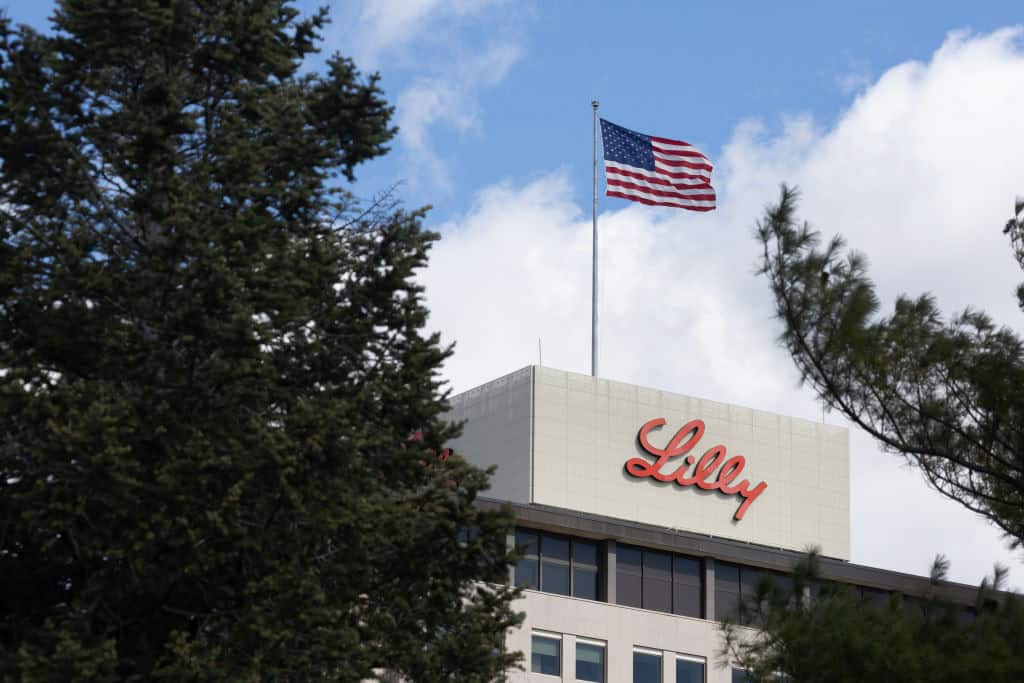
Biopharmaceutical company Lilly will build four new manufacturing sites across the U.S., it announced Wednesday at a Washington, D.C., press conference. The event was attended by NAM President and CEO Jay Timmons, Commerce Secretary Howard Lutnick, National Economic Council Director Kevin Hassett, Indiana Sen. Todd Young and Lilly Executive Vice President and President of Manufacturing Operations (and NAM board member) Edgardo Hernandez, among others.
What’s going on: Three of the planned manufacturing campuses will focus on producing active pharmaceutical ingredients, reshoring “critical capabilities of small molecule synthesis and further strengthening Lilly’s supply chain,” the company said in a press release. The fourth site will “extend [Lilly’s] global parenteral manufacturing network for future injectable therapies.”
- The investment in the four sites will bring Lilly’s total U.S. capital expansion commitment to more than $50 billion since 2020.
- Lilly—which in recent years has made $23 billion worth of investments in new research and manufacturing sites in the American South and Midwest—is in talks with several states about building the facilities there, but it is accepting additional expressions of interest from states until March 12.
The anticipated benefit: The four sites are expected to create more than 3,000 permanent skilled jobs and more than 10,000 construction jobs during building, according to the company.
The tax reform factor: Lilly’s planned expansion reflects “decades of research and dedication,” Timmons said at the event announcing the investment. It “is the culmination of sustained planning made possible by the certainty created through smart public policy—particularly the 2017 tax reforms that President Trump … championed back at a meeting of the NAM Board of Directors in September 2017.”
- Many of those manufacturing-critical reforms have been allowed to expire, however, and others will expire at the end of the year—unless Congress acts, and soon, Lilly Chair and CEO David Ricks said.
- “The Tax Cuts and Jobs Act legislation passed in 2017 during President Trump’s first term in office has been foundational to Lilly’s domestic manufacturing investments, and it is essential that these policies are extended this year.”
Keep the momentum going: Lilly’s announcement shows other manufacturers “exactly why [they] have reason for optimism and confidence,” Timmons went on. “But to keep this momentum going—to encourage more groundbreaking investments, more job creation and more life-changing innovation—a comprehensive manufacturing strategy must become the reality … because when manufacturing wins, America wins.”
Timmons to Congress: Maintain Momentum with Tax Reform Preservation

The House late Tuesday approved a Republican budget blueprint for President Trump’s tax-cut and border-security agenda (Reuters, subscription).
- NAM President and CEO Jay Timmons called the move “a historic, pivotal step to[ward] advanc[ing] a comprehensive reconciliation package that will preserve” critical pro-manufacturing tax reforms and unleash “American energy dominance.”
What’s going on: “The measure is a preliminary step to extending Trump’s 2017 tax cuts later this year,” Reuters reports. “Tuesday’s vote sent the budget resolution to the Senate, where Republicans are expected to take it up.”
- The plan—which calls for $4 trillion to $4.5 trillion in tax cuts and $1.5 trillion to $2 trillion in spending reduction over 10 years—also includes measures to increase domestic energy development and production.
Why it’s so important: Congress must capitalize on the momentum of the budget resolution’s passage by preserving the crucial tax reform measures from President Trump’s 2017 Tax Cuts and Jobs Act, Timmons continued—because “[e]very day we wait means jobs and opportunity lost.”
- “As part of the comprehensive, commonsense manufacturing strategy that America needs, protecting tax reform will strengthen our industry and our communities. It’s time to continue this momentum and act now to Make America Great for Manufacturing Again. When manufacturing wins, America wins.”
What’s next: House Speaker Mike Johnson (R-LA) has said he anticipates passing the tax, energy, border-security and defense items via reconciliation by the first week of April.
Tax Reform Keeps Humtown Humming
“Humtown is more than just a business. It’s a legacy,” says CEO Mark Lamoncha. The 60-year-old Columbiana, Ohio–based metal casting company has had three generations of Lamoncha leaders, starting with Mark’s father, Russell, who founded it as a small pattern shop in 1959. Today, Humtown is able to keep that legacy alive—and growing—in large part due to tax policies that support innovation, investment and job creation.
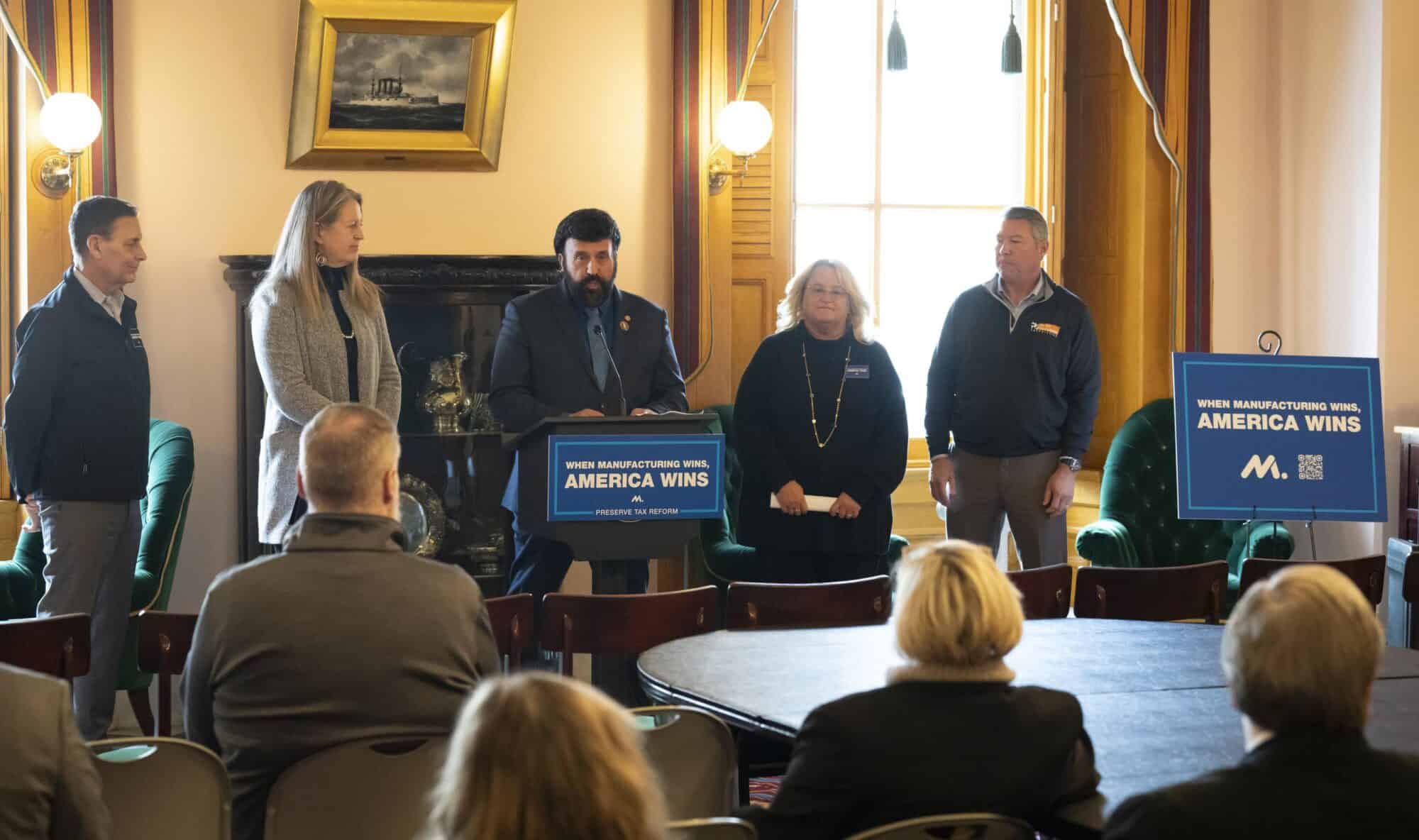
The benefits: When tax reform introduced full expensing for capital expenditures and research and development in 2017, Humtown reinvested its tax savings in expanding its operations, hiring more workers and purchasing more equipment, Lamoncha told attendees at an event at the Ohio Statehouse, part of the NAM’s 2025 Competing to Win Tour.
- “Since the 2017 tax reform, Humtown has invested over $9 million in capital expenditures related to 3D printing and averages around $100,000 annually in R&D costs,” said Lamoncha, noting that a single 3D printer can cost upward of $1 million.
- “Under the 2017 tax reform, we were able to deduct 100% of those costs, generating around $1.6 million in accelerated tax savings. That amount alone allowed us to purchase another 3D printer,” he added.
- These investments represent a huge benefit not only to Humtown, but to the larger supply chain it serves. Thanks to 3D-printing toolingless technology, Humtown recently fulfilled an urgent order of essential parts from an EV manufacturer, which traditional tooling would not have produced in time. The result: “Their new product launched 22 weeks ahead of schedule—proving that smart tax investments drive real-world innovation and success,” said Lamoncha.
The threat: As these and other tax provisions get phased out, Humtown is facing a painful increase in costs. Already, it is paying an additional $365,000 in taxes, which is “cutting back on our ability to reinvest in our team, new equipment and our growth plans,” said Lamoncha.
- But the cost for the manufacturing economy is much greater, he pointed out. “Every day Washington delays a tax deal, businesses are forced to second-guess investments, hold back on hiring and rethink expansion plans. For a small or medium-sized manufacturer, that’s the difference between adding a new production line or standing still—and, for some, staying in business.”
The wider community: The threat to tax reform will not only harm Humtown, but prevent it from investing further in partnerships that benefit its entire community.
- Humtown partners with Youngstown State University to educate students in grades 4–12 about 3D printing. The company houses a 3D sand printer purchased through the Ohio Third Frontier Grant program that is used mainly for educational programming.
- In this “hands-on, peer-led learning experience,” students are taught both digital file creation and manufacturing processes, and then lead their peers through the factory as “career ambassadors,” Lamoncha explained. (Watch one 9th grade group’s experience here.)
- Initiatives like these prepare young people for stimulating, high-paying careers in manufacturing, while ensuring manufacturers have enough young workers to keep growing in the decades to come.
The bottom line: “[V]isionary leaders like Jay Timmons and the NAM team are fighting to restore U.S. manufacturing—moving us from just 10% of GDP back to 25% or more. But let me be clear: this won’t happen unless we align state and federal policies to make America the best place in the world to build, create and manufacture,” said Lamoncha.
- “We have the talent. We have the technology. And we have the opportunity. Now, we need the commitment.”
Building Permits Hold Steady, But Decline Year-Over-Year
Building permits inched up 0.1% in January but fell 1.7% over the year. Permits for single-family homes in January stayed the same from December but declined 3.4% over the year. Meanwhile, permits for buildings with five or more units fell 1.4% from December but rose 0.2% over the year.
In January, housing starts plunged 9.8% from December and slipped 0.7% from January 2024. Additionally, starts for single-family homes fell 8.4% from December and 1.8% from January 2024. Meanwhile, starts for buildings with five or more units decreased 11.0% from December but improved 2.3% over the year.
On the other hand, housing completions increased 7.6% over the month and 9.8% over the year. Single-family home completions grew 7.1% from December and 8.9% from January 2024. Completions for buildings with five or more units grew 10.1% over the month and 11.8% from one year ago.
Median Home Prices Climb Across All U.S. Regions
Existing home sales decreased 4.9% in January, but improved 2.0% from January 2024, the fourth consecutive monthly year-over-year increase. Housing inventory grew to 1.18 million units, reflecting a 3.5% rise from December and a 16.8% jump from last year. The median existing home price was $396,900, up 4.8% from last year, with all four U.S. regions reporting price increases.
Single-family home sales fell 5.2% in January, with the median price increasing 5.0% from January 2024 to $402,000. Condo and co-op sales slipped 2.4% to 400,000 units in January, identical to the sales level from the previous year. Meanwhile, the median price rose 2.9% from the prior year to $349,500.
Homes were typically on the market for 41 days in January, up from 35 days in December and 36 days in January 2024. First-time buyers made up 28% of sales in January, down slightly from 31% in December but unchanged from January 2024. All-cash sales accounted for 29% of transactions in January, up from 28% in December but down from 32% in January 2024. Meanwhile, investors or second-home buyers represented 17% of homes purchased in January, up from 16% in December and the same as January 2024. Distressed sales, including foreclosures and short sales, represented 3% of purchases in January, virtually unchanged from December and the previous year.
Supply Chains Busy and Delays Persist
The S&P Global Flash U.S. Manufacturing PMI rose slightly from 51.2 in January to 51.6 in February, the sharpest increase since June. Factory production grew for the second consecutive month and at the steepest rate in nearly a year. On the other hand, growth in new orders and employment weakened. Meanwhile, supplier delivery times lengthened for the fifth consecutive month but at the slowest rate since October, indicating busier supply chains.
Overall business sentiment slumped to its lowest point since December 2022, with the exception of last September amid preelection uncertainty. After a post-election boost, optimism has again deteriorated in response to uncertainty regarding federal spending cuts and tariffs. Businesses also expressed concern about higher prices amid manufacturing seeing the largest monthly gain in raw material prices since October 2022. On the other hand, optimism in manufacturing remained elevated compared to recent standards, though it fell from January’s 34-month high.
Rising Inflation Concerns Add to Consumer Uncertainty
Consumer sentiment fell for a second month in a row in February, declining nearly 10% from January to an index reading of 64.7. All five components fell this month, led by a 19% drop in buying conditions for durables due to looming tariff anxiety. Both views of personal finances and the short-run economic outlook declined around 10%, while the long-run economic outlook decreased 6%, the lowest reading since November 2023. Sentiment fell for Democrats and Independents but was unchanged for Republicans, revealing ongoing political division and disagreement about new economic policies.
Year-ahead inflation expectations rose from 3.3% to 4.3% in February, the highest reading since November 2023 and well above the pre-pandemic range of 2.3–3.0%. Long-run inflation expectations also edged up from 3.2% to 3.5%, the largest monthly increase since May 2021. Like the trends in broader sentiment, concerns about future inflation trends rose for Independents and Democrats but fell slightly for Republicans.
Philadelphia Manufacturing Growth Slows in February
In February, Philadelphia’s regional manufacturing activity continued to expand but at a slower rate than in January. The index for current general business activity fell from 44.3 to 18.1 but remains above the index’s long-run nonrecession average. Nearly 41% of firms reported increased activity this month, while 22.5% saw decreases in February compared to just 6.6% reporting declines in January. Meanwhile, 34.7% experienced no change. The indexes for new orders and shipments both dropped to 21.9 and 26.3, respectively, but remained above their long-run averages. Additionally, employment expectations remained positive but fell from 11.9 to 5.3. The average employee workweek index dropped from 20.5 to 2.9.
Both price indexes rose to the highest readings in over two years and remain above their long-term averages. The prices paid index increased nearly nine points to 40.5, the highest reading since October 2022, and the prices received index rose more than three points to 32.9. As has been the case for many months, the prices received index remains lower than the prices paid index, indicating manufacturers were absorbing a sizable portion of those higher costs paid.
Looking ahead, all future indicators decreased. The index for future general business activity fell from 46.3 in January to 27.8 in February. A higher proportion of firms (18.5%) expect decreases in activity, compared to last month’s reading of 7.2%, but nearly half (46.3%) still expect activity to improve. Additionally, the future new orders and shipments indexes declined roughly 24 points, to 33.1 and 36.5, respectively. While still positive, the index for future employment dropped from 40.4 to 23.7. The capital expenditures index decreased 25 points to 14.0, the lowest reading since August 2024. The future prices paid index fell nine points to 58.6, while the future prices received index fell eight points to 46.1, indicating manufacturers remain concerned about future costs rising but not as much as before.