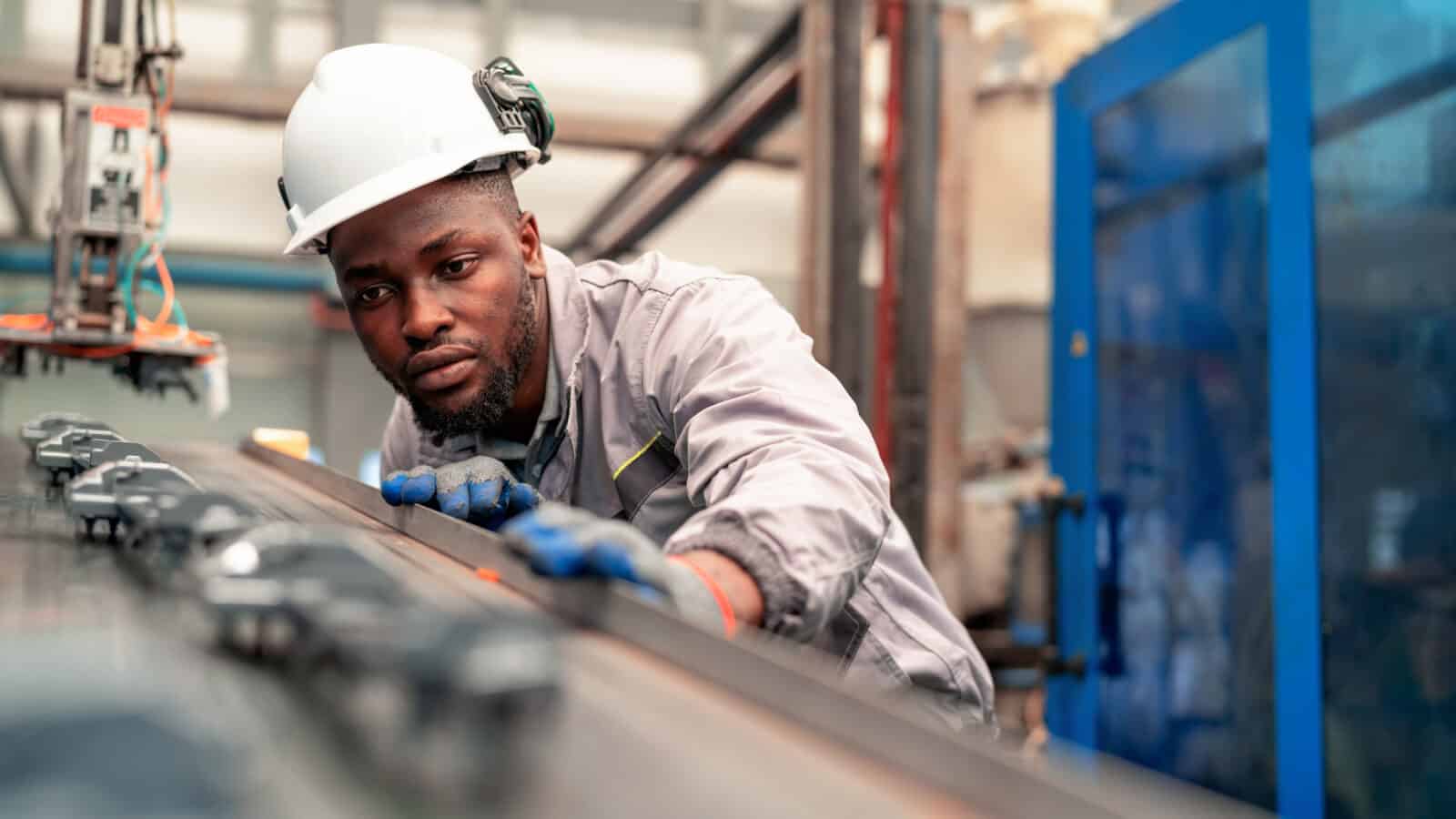
MI to Develop AI Skills for the Manufacturing Workforce
The Manufacturing Institute—the 501(c)3 workforce development and education affiliate of the NAM—will develop artificial intelligence skills training programs for manufacturing workers and the expansion of employer-led apprenticeship programs via the MI’s Federation for Advanced Manufacturing Education. This work is made possible by funding from Google.
New courses: The MI will develop two new courses for operations workers: AI 101 for Manufacturing and AI for Advanced Manufacturing Technicians.
- The 101 course will contextualize existing AI training from Google specifically for the manufacturing environment. At no cost, this training will be available to manufacturing companies and their employees through an online learning platform and to education partners that are preparing individuals to enter the manufacturing workforce.
- The AI for Advanced Manufacturing Technicians course will be a brand-new offering developed by the MI and integrated into FAME.
More FAME: The funding will also enable the MI to launch new FAME chapters in at least 15 new regions, while developing and embedding the AI for Advanced Manufacturing Technicians course across all FAME chapters.
- The FAME program is a proven model for training advanced maintenance technicians and building durable talent pipelines for manufacturers today in 46 hubs across the country.
- Google.org is also supporting the mikeroweWORKS Foundation’s provision of Work Ethic Scholarships to FAME students, which will offer financial assistance to eligible participants completing their manufacturing programs.
The MI says: “So much of the narrative around AI and the workplace is fear-based. One thing we’ve learned in manufacturing time and again is that as new technologies are introduced, it is essential to ensure our workers build the skills needed to engage,” said MI President Carolyn Lee.
Google says: “Google.org wants the manufacturers who build our world to have access to the best technology for the job,” said Google.org Global Head Maggie Johnson.
- “We’re proud to support the Manufacturing Institute’s efforts with our funding and technological expertise. This initiative will bring hands-on AI skills to the shop floor, helping manufacturing students and workers shape this new era of American innovation.”
In the news: The announcement of the funding was covered in a Fox Business exclusive and later publicized in Axios and by several local Fox and NBC stations.
Learn more: Learn more about the MI’s training and join its email list to stay updated as the MI progresses in this work.
NAM Endorses Rep. Smucker’s Commonsense Immigration Reform
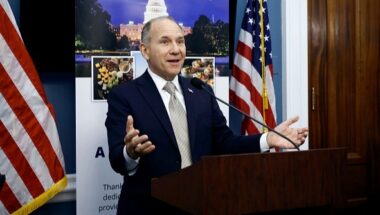
The Essential Workers for Economic Advancement Act, introduced by Rep. Lloyd Smucker (R-PA), “gets it right” regarding immigration reform and workforce development, the NAM said this week as it endorsed the legislation.
What’s going on: “Our industry is evolving by the minute, and with over 400,000 open jobs on our shop floors, we need more people, not fewer—with more skills, not less—from across our great country and from beyond our borders,” NAM President and CEO Jay Timmons said.
- “That’s why we are proud to support Rep. Smucker’s legislation. By making sure our nation’s immigration system matches the needs and ambitions of America’s manufacturers, the Essential Workers for Economic Advancement Act … will drive even more skilled workers to our shop floors.”
About the bill: The measure, which Rep. Smucker first introduced in March 2022 and reintroduced last year, would plug a hole in the immigration system: there are visas for high-skilled workers (e.g., the H-1B used by many engineers and scientists), and there are visas for seasonal labor (H-2A for agricultural workers and H-2B for nonagricultural). However, there are no visas for the bulk of the year-round manufacturing workers whose jobs do not require a bachelor’s degree but who are “essential” to production operations.
- “The act would address critical workforce shortages while safeguarding employment opportunities for American workers,” a statement from Rep. Smucker’s office reads.
The response: “I thank the National Association of Manufacturers for supporting my commonsense, bipartisan and market-driven solution that addresses workforce shortages in key industries while ensuring American workers are prioritized,” Rep. Smucker said.
Up next on immigration reform: Later this week, Reps. Maria Salazar (R-FL) and Veronica Escobar (D-TX) will host the NAM and manufacturing leaders from across the country for a roundtable on immigration reform.
Share Your Strategies at the MI Workforce Summit
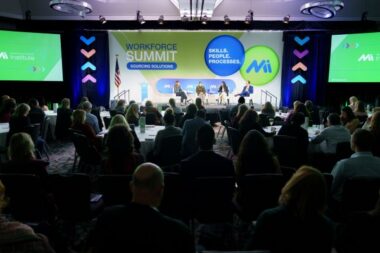
The Manufacturing Institute, the NAM’s workforce development and education affiliate, recently announced the dates for its industry-influencing Workforce Summit—and it is inviting manufacturing and education leaders to submit their own strategies for shaping the next generation of manufacturing talent.
When and where: The fifth annual Workforce Summit—whose theme is “Skills at Scale: Delivering America’s Competitive Advantage”—will take place Oct. 26–28 at the Indianapolis Marriott Downtown in Indianapolis, Indiana.
- Sign up here to be notified when registration goes live.
Send your workforce leaders: Manufacturers from all sectors and of all sizes are invited to contribute to the Workforce Summit by sending their workforce leaders to attend—or better yet, having them host breakout sessions about their own talent innovations. Proposed sessions should showcase proven strategies, including:
- Upskilling programs and frontline leadership training models;
- Cutting-edge training approaches for new technology adoption;
- Creative recruitment strategies and skills-based hiring;
- Impactful community partnerships for recruitment, training and retention;
- Building strong workplace culture;
- Engaging applied learning experiences; and
- Interactive formats that spark participation problem solving and practical skill building.
Where to start: To learn more about how to submit a proposal for a session, go here. The deadline for submissions is April 30 at 5:00 p.m. EDT.
MLC Announces Finalists for Manufacturing Leadership Awards
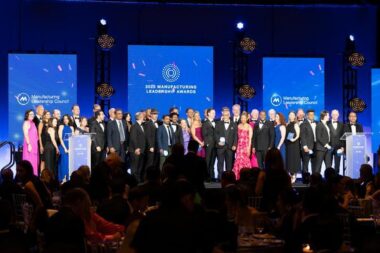
The Manufacturing Leadership Council, the digital transformation division of the NAM, has announced the finalists for the 2026 Manufacturing Leadership Awards, which honor world-class manufacturers and individual leaders for outstanding achievements in digital transformation.
- The finalists represent excellence across nine project categories and two individual categories, reflecting the breadth, depth and momentum of digital innovation underway throughout the manufacturing sector. A complete list of finalists is available here.
Partners in Collaborative Innovation: In addition, the MLC unveiled the 2026 Partners in Collaborative Innovation, which recognizes technology and consulting organizations that play a vital role in advancing Manufacturing 4.0 throughout the industry.
- The recipients are organizations that support manufacturers on their digital transformation journeys through thought leadership, technology, research and ecosystem-building.
The gala: Category winners will be announced at the Manufacturing Leadership Awards Gala on June 24 at the Fairmont Princess in Scottsdale, Arizona.
- In addition to category winners, the gala will also recognize recipients of the Future of Manufacturing Award, Small/Medium Enterprise Manufacturer of the Year, Large Enterprise Manufacturer of the Year and Manufacturing Leader of the Year. The gala takes place at the conclusion of Rethink: Accelerating Digital Transformation in Manufacturing.
New leadership: Earlier this week, the announced the appointment of Ron Castro, vice president and chief supply chain officer at IBM, as chairman of the MLC Board of Governors, and Will Bonifant, group vice president and chief supply chain officer at Hormel Foods, as vice chairman.
- The MLC Board of Governors is a distinguished advisory body composed of senior manufacturing executives who provide strategic guidance to the council on its critical issues agenda, research initiatives and programs designed to help manufacturers advance on their Manufacturing 4.0 journeys.
The last word: “In an era defined by rapid technological change and continued business uncertainty, manufacturers are demonstrating that digital transformation remains a powerful driver of resilience, competitiveness and long-term growth,” said MLC Founder, Vice President and Executive Director David Brousell.
Solar and Wind Production Skyrocketed Over Past 20 Years

U.S. wind and utility-scale solar projects generated a record 17% of U.S. electricity in 2025—an enormous jump from their share of less than 1% in 2005 (Energy Information Administration).
- Adding in small-scale solar, the two sources’ net total generation came to 19%.
A solar expansion: The data also reveals the astronomical growth trajectory of solar power, which has grown every year since 2006.
- “In 2025, utility-scale solar power generation totaled 296,000 GWh, 34% more than in 2024.”
- Wind power also grew, though more slowly, generating 3% more electricity in 2025 than in 2024.
Dispatchable sources: Dispatchable generation sources, which can produce electricity without depending on the variability of sunshine or blowing wind, still make up the majority of U.S. electricity production.
- Together, gas, coal and nuclear power accounted for 75% of U.S. utility-scale electricity generation in 2025.
All-of-the-above energy: “These data points demonstrate the importance of the NAM’s all-of-the-above energy strategy to power manufacturing growth in America,” said NAM Vice President of Domestic Policy Chris Phalen.
- “As energy demand continues to grow, the U.S. must invest in many sources of energy and lift burdensome permitting requirements to ensure more energy projects and electricity infrastructure get built.”
- “A permitting system that costs manufacturers at least $8 billion per year is hindering investments across all energy sources—and is constraining manufacturers’ ability to invest and hire in America. Congress must act now to support manufacturing and all forms of American energy dominance by passing comprehensive permitting reform this year.”
What American Manufacturing Needs for Another 250 Years
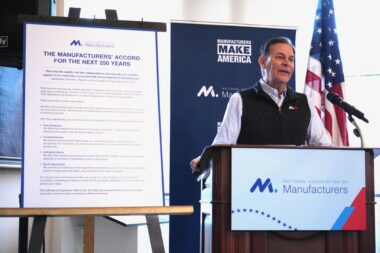
As America celebrates its semiquincentennial, manufacturers are looking ahead to the next 250 years, according to NAM President and CEO Jay Timmons.
What’s going on: “Manufacturing made America what it is,” Timmons said during a recent interview with Pennsylvania Manufacturers’ Association President and CEO David Taylor, which aired last week on that organization’s “PMA Perspective” news program.
- “The greatness of America has been really embedded in the ability of our people to create, to build. … As we set the stage for the next 250 years … we want to make sure that our federal legislators are focused on a comprehensive manufacturing strategy.”
- The interview, which took place during the NAM’s recent 2026 State of Manufacturing Tour, was held at historic Carpenters’ Hall in Philadelphia, the site of the First Continental Congress in 1774.
Four pillars of success: The tour stop in Philadelphia, the United States’ first capital, “pointed out how important our foundational ideas are to creating the environment for success for manufacturing in the years to come,” Timmons said.
- “And that’s why we want to renew that commitment with our Manufacturers’ Accord for the Next 250 Years to focus on those four pillars that made America exceptional: free enterprise, competitiveness, individual liberty and equal opportunity.”
What manufacturers need: To continue its success for at least another 250 years, American manufacturing needs several things, Timmons told Taylor, some of which the administration has delivered already. These include the following:
- A favorable tax environment: The “strengthening of [tax] reforms in 2025 was really the rocket fuel that manufacturers needed to give us a boost in terms of investment, job creation and wage growth.”
- Permitting reform: “[W]hile we have a commitment to energy dominance, we still have an issue with getting projects off the ground.”
- Immigration reform: “We … need to look at a credible system of [legal] immigration” to help fill open manufacturing jobs.
- Workforce development: “We have an obligation to make sure that our workers are trained appropriately in [new] skills,” such as interacting with artificial intelligence.
The last word: “[E]very single person has a voice in this choir,” Timmons concluded.
- “And we need citizens, business leaders [and] everyday folks to call their members of Congress … to say, ‘We want this country to come together for the good of the American people and work on policies that will reduce the cost of doing business in the United States and make us more competitive.’”
Rockwell’s Moret Looks Forward to Guiding the NAM

Blake Moret has big plans for his tenure as NAM Board Chair (Milwaukee Business Journal, subscription).
What’s going on: The Rockwell Automation Chairman and CEO “looks forward to chairing the National Association of Manufacturers during a period of economic uncertainty and rapidly changing technology—most notably artificial intelligence.”
- Moret, who recently confirmed that Rockwell’s new approximately 1-million-square-fooot plant will be built in New Berlin, Wisconsin, took on the role at the NAM because of his strong belief in the importance of manufacturing.
- “[M]anufacturing is at the absolute core of the American economy,” he told the Milwaukee Business Journal. “It’s important that it’s successful.”
Permitting reform: One of the NAM’s top advocacy issues is permitting reform—and getting it done is a passion Moret shares.
- “Streamlining permitting and making sure that the regulations are necessary, that they don’t add unnecessary delays in new investment. … There is certainly permitting with respect to the environment that is absolutely needed. But there’s also a lot of streamlining and efficiencies that can be introduced to get these new projects done.”
Overcoming challenges: Moret said, “A chief hurdle for manufacturing in the U.S. today is the uncertainty surrounding tariffs and the workforce shortage.” But he has recommendations.
- “A stable environment [on tariffs] would unleash more spending,” Moret said.
- On the labor pool: “Rockwell has the Academy of Advanced Manufacturing for training returning veterans for technician-level jobs. The NAM has a similar program,” he said, referring to the Federation for Advanced Manufacturing Education (FAME), a program founded in 2010 by Toyota and now run by the NAM’s 501(c)3 workforce development and education affiliate, the Manufacturing Institute.
- “First, attract new entrants to fill jobs but also have the capabilities to interact with the technology. That’s really the winning hand,” Moret advised.
AI moves: Moret is a big believer in the importance of artificial intelligence, and Rockwell is making AI investments in its facilities worldwide. What’s next?
- “[E]ducating policymakers is really important,” he told the Journal. Those “who are considering existing and proposed rules need to understand how AI can be used. Also, understanding what the risks are—there is obvious risk to workforce disruption and cybersecurity. The bad guys use AI as well as the good guys. Just being able to present that from a manufacturer’s point of view will be an important role.”
Manufacturing Institute Address Spotlights Workforce

In the Manufacturing Institute’s State of the U.S. Manufacturing Workforce Address, MI President Carolyn Lee had a clear message for industry leaders: “Workforce is not a side issue. It is the strategy.”
An exciting moment: Speaking at NTT Data’s North American headquarters in Dallas, Lee observed that manufacturers have an exciting opportunity before them.
- “Across the country, people are rethinking the way they approach learning. They’re reimagining the way to build a career. More and more, they are turning to other pathways as launchpads to their future,” she said.
- “Young people today have started to see more value in a different kind of job. A recent Harris poll found that the share of Gen Z-ers interested in blue-collar careers stood at 50%—more than twice as high as Americans overall.”
- “So as more young people seek out skilled pathways, we must seize the opportunity to ensure they see manufacturing as a sector in which they apply those skills for a durable career,” she continued.
Cultivating the right skills: Lee pointed out that these young people interested in the manufacturing industry must be equipped with the skills to succeed in it. She urged manufacturing companies to design and sustain strategies that will build this new workforce.
- “When manufacturers open their doors to students, parents and educators—through plant tours, classroom visits or MFG Day events—they do more than promote their companies. … For many young people, that first exposure is the moment they realize there is a home for them in this industry; that manufacturing is a place where they can build, solve and contribute,” she said.
- “But an employer’s role doesn’t stop here. It must continue through partnerships with high schools, community colleges and universities; through internships, mentorships and apprenticeship programs that blend classroom instruction with paid, hands-on learning.”
- If all these steps are taken, students will “see a pathway forward—not just a first job, but a future,” Lee added.
MI in action: Lee highlighted the MI’s groundbreaking work in expanding talent pipelines and increasing access to rewarding manufacturing careers.
- “For example, through Heroes MAKE America, we are turning military excellence into manufacturing careers. We’ve expanded from entry-level on-site training and networking to offering in-demand high-skilled training. We’ve built and launched the Manufacturing Readiness Badge program, which translates military experience into validated, industry-recognized skills that manufacturers understand.”
- She also spotlighted the “rapid growth of the MI’s FAME program—the nation’s premier ‘earn and learn’ apprenticeship model for manufacturing. Since the MI took over stewardship of FAME from Toyota six years ago, FAME has more than doubled in size. Today, it includes nearly 500 companies across 17 states, boasting an incredible 85% job placement rate with sponsoring employers.”
The promise of AI: On the subject of AI, Lee observed that “people who can leverage new technologies into the way they operate—who can use it to help them solve problems, make better decisions and get more done—will succeed in the job market and power the future.”
- [A]s AI evolves the way work is done, it’s opening doors to roles and opportunities we’re only beginning to see,” she continued. “Just as past technological shifts have changed the workplace, they’ve also created new paths for people to grow and contribute.”
- “That reality makes workforce development and upskilling urgent—and essential. In order for America to dominate AI and leverage these technologies to their fullest potential, we need to ensure our manufacturing workforce is ready with the right skills.”
A call to action: Lee ended her speech by invoking the history of American manufacturing and its record of increasing our nation’s security and prosperity.
- “Manufacturing has never waited for permission to lead. We build opportunities. We solve challenges. And we know from our history—from the factories that powered the Industrial Revolution to the assembly lines that mobilized an arsenal of democracy, from the boom that built the middle class to the advanced production that created the modern economy—when manufacturing steps up, America moves forward.”
- “Today, we have an opportunity again to share what leadership looks like—by putting people at the center of progress and by building a workforce ready not just for today, but for what comes next.”
- “When manufacturing leads, America works.”
Centrus, Fluor Partner to Expand Ohio Uranium Enrichment Site
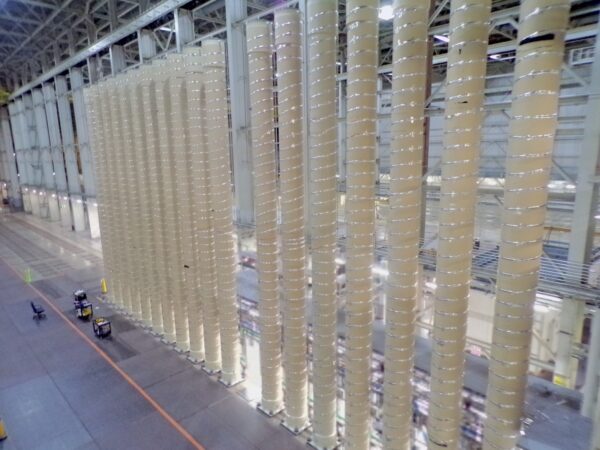
The subsidiary of U.S. uranium enrichment company Centrus has contracted with engineering firm Fluor for the multibillion-dollar expansion of its uranium enrichment facility in Piketon, Ohio (Centrus).
What’s going on: American Centrifuge Operating LLC—the wholly owned daughter company of Bethesda, Maryland–based Centrus—has engaged Fluor “to serve as its engineering, procurement and construction (EPC) contractor as Centrus proceeds with its previously announced” Ohio facility buildout.
What it will entail: “Under the multiyear contract, Fluor will lead engineering and design of the expanded capacity in Ohio, manage the supply chain and procurement of key materials and services, oversee construction at the site and support the commissioning of the new capacity.”
About the undertaking: The Piketon project includes substantial production of Low-Enriched Uranium (LEU) “to address [the] commercial LEU enrichment contingent backlog of $2.3 billion and growing demand from existing reactors.”
- Centrus will also build “12 metric tons of High-Assay, Low-Enriched Uranium (HALEU) annual capacity for next-generation reactors.”
Related news: In January, Centrus announced that it had been selected by the Department of Energy for a $900 million task order to expand its enrichment and centrifuge manufacturing capabilities at Piketon and its facility in Oak Ridge, Tennessee.
- The company said later last month that it would invest more than $560 million to turn its Oak Ridge centrifuge factory into a “high-rate manufacturing” site.
The NAM’s take: “Current and future energy demand requires a strong domestic nuclear fuel supply chain,” said NAM Senior Director of Energy and Resources Policy Mike Davin.
- “The expansion of Centrus’ Ohio enrichment facility—and the news of the company’s partnership with Fluor to make the project happen—is a win for manufacturing and the U.S. in general.”
NAM to FDA: Expand Nonprescription Drug Access to Cut Manufacturers’ Health Care Costs

Greater access to nonprescription drugs can reduce health care costs for manufacturers and improve quality of life for their employees, the NAM told the Food and Drug Administration this week.
What’s going on: The FDA put out a request for information on how to increase access to nonprescription drugs. The NAM shared manufacturers’ longstanding commitment to providing health benefits to their workers as both an effective tool to attract and retain employees and to maintain a healthy and productive workforce. It also explained how rising health care costs have been a great challenge for the industry.
- Expanding access to over-the-counter medications—which are typically affordably priced, widely available and can be purchased and taken as soon as they are needed—can save time and money for employers and employees alike.
The benefits: “Prescription drugs require doctor’s visits, which involve not just the time spent at the appointment itself, but also the time needed to schedule an appointment or locate an in-network provider if a patient does not already have one, as well as the financial cost of a copay or coinsurance,” the NAM said, explaining why people need access to OTC drugs, in addition to prescriptions.
- “Manufacturing workers taking time off from work to see a doctor reduces workplace productivity at a time when the industry is already facing a manufacturing worker shortage. OTC drugs can help workers to recover more quickly and return to work sooner.”
What else should be done: Manufacturers commend the administration for its efforts to expand access to OTC medications. The NAM recommended several steps the FDA can take to increase access, including:
- Rebalance regulations and reduce unnecessary burdens in the nonprescription drug regulatory process;
- Broaden the risk/benefit assessment for nonprescription drugs to include the consideration of benefits beyond those to the individual patient, such as to population health, the health care system overall and the economy;
- Broaden the FDA consideration of which drugs can be switched from prescription to nonprescription;
- Include specialized care professionals and patient advocates on advisory councils; and
- Maintain the three-year exclusivity incentive for some prescription to OTC drug switches that require significant financial investment.
The last word: “Increased access to nonprescription drugs is crucial for manufacturers as providers of employer-sponsored insurance, and for manufacturers of consumer health care products, who strive every day to improve the health and lives of Americans,” said NAM Vice President of Domestic Policy Jake Kuhns and NAM Director of Health Care Policy Jess Wysocky.