
Study: Tax Policy’s Harm Will Grow

The economic impact of allowing a stricter interest deductibility limitation to remain in effect could be devastating, according to a new EY analysis prepared on behalf of the NAM.
What’s going on: Failure to reverse the stricter limitation that went into effect in 2022 could result in the following losses in the U.S., according to the study:
- 867,000 jobs
- $58 billion in employee compensation
- $108 billion in gross domestic product
More costly every year: Those figures have roughly doubled since the 2022 EY analysis released last year.
- Last year, EY estimated that leaving the stricter limitation in place would result in 467,000 lost jobs, $23.4 billion in lost employee pay and $43.8 billion in lost GDP.
The background: Prior to 2022, companies could deduct interest of up to 30% of their earnings before interest, tax, depreciation and amortization (EBITDA).
- However, since 2022, the deduction has been limited to 30% of earnings before interest and tax (EBIT), a significant change that disproportionately affects manufacturers, given their capital-intensive investments.
What can be done: “A stricter interest expense limitation restricts manufacturers’ ability to invest in new equipment and create jobs,” said NAM Managing Vice President of Policy Chris Netram.
- “Even more, the study finds that manufacturers and related industries bear 77% of the burden of this policy. Congress must act by year’s end to restore a pro-growth interest deductibility standard and allow manufacturers to continue to invest for the future.”
NAM in the news: POLITICO Pro’s Morning Tax newsletter (subscription) covered the study’s release.
Further reading: Visit the NAM’s interest deductibility page to learn more about this issue and how the NAM is taking action.
NAM Study: Stricter Interest Expense Limitation to Cost Nearly 900,000 Jobs
Harmful Limit Disproportionately Impacts Manufacturing Sector
Washington, D.C. – The National Association of Manufacturers released a new analysis on the impact to the U.S. economy of Congress’ failure to reverse the stricter interest expense limitation that took effect in January 2022.
The jobs impact of the stricter limitation has nearly doubled over the past year given congressional inaction to ensure a pro-growth interest deductibility standard as interest rates have continued to rise. The data show that limiting manufacturers’ ability to deduct interest on debt-financed investments, over the long run, could cost the U.S. economy up to:
- 867,000 jobs;
- $58 billion of employee compensation; and
- $108 billion in GDP.
“A stricter interest expense limitation restricts manufacturers’ ability to invest in new equipment and create jobs. This analysis clearly shows that failing to reverse this damaging change will cut close to 900,000 jobs and billions of dollars of employee pay and harm economic growth. Even more, the study finds that manufacturers and related industries bear 77% of the burden of this policy,” said NAM Managing Vice President of Policy Chris Netram. “Congress must act by year’s end to restore a pro-growth interest deductibility standard and allow manufacturers to continue to invest for the future.”
Background:
Prior to 2022, the interest expense limitation was calculated based on a company’s earnings before interest, tax, depreciation and amortization (EBITDA). Last year, a stricter limitation based on a company’s earnings before interest and tax (EBIT) took effect. By excluding depreciation and amortization from the calculation, the stricter limitation increases the tax burden on manufacturers that make investments in long-lived capital equipment.
To view the full analysis click here.
-NAM-
The National Association of Manufacturers is the largest manufacturing association in the United States, representing small and large manufacturers in every industrial sector and in all 50 states. Manufacturing employs nearly 13 million men and women, contributes $2.91 trillion to the U.S. economy annually and accounts for 55% of private-sector research and development. The NAM is the powerful voice of the manufacturing community and the leading advocate for a policy agenda that helps manufacturers compete in the global economy and create jobs across the United States. For more information about the NAM or to follow us on Twitter and Facebook, please visit www.nam.org.
NAM, Rep. Stauber Talk R&D, Workforce
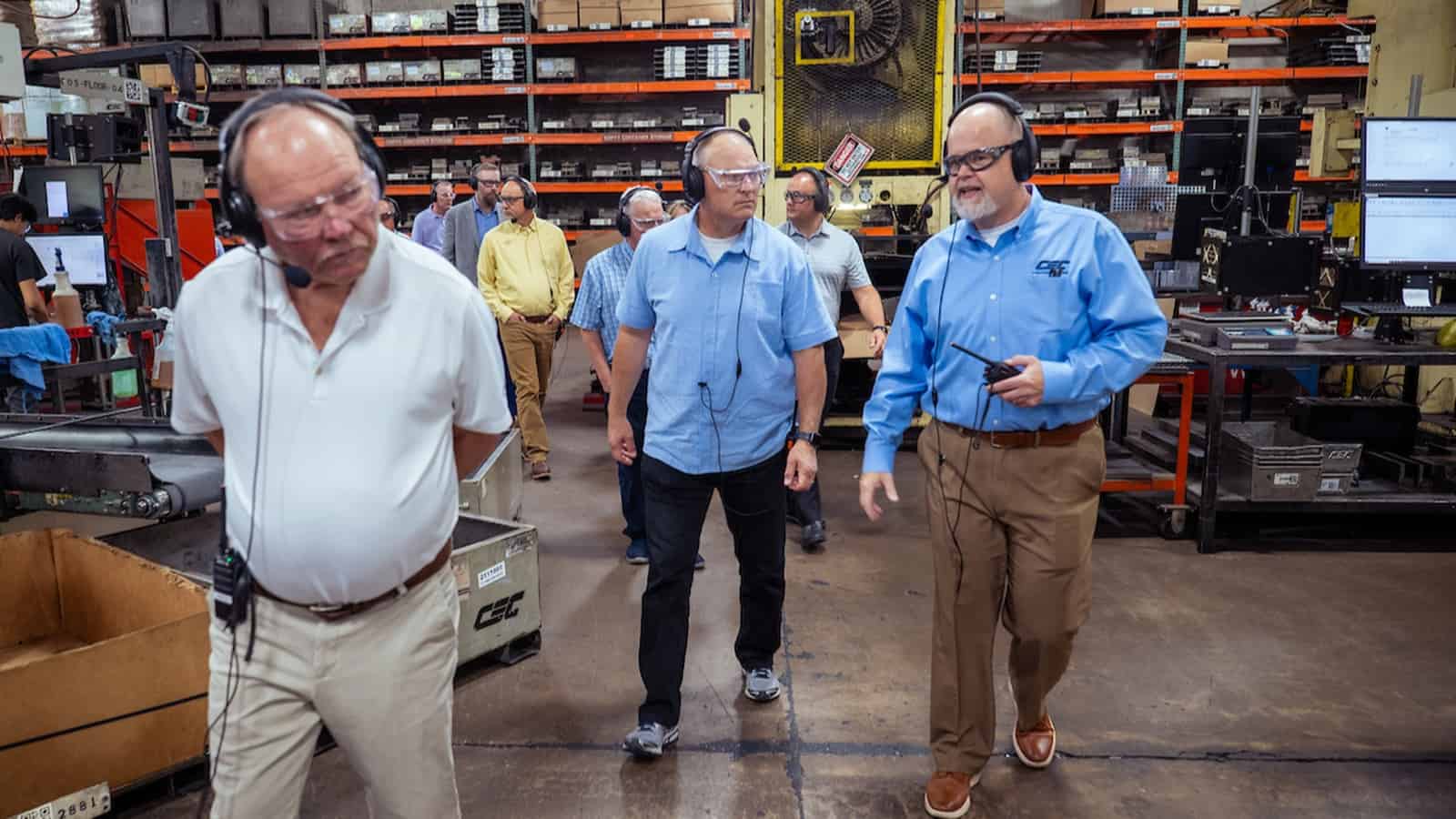
Permanent restoration of R&D expensing is a top priority for manufacturers in Minnesota and the U.S. in general. That’s why Rep. Pete Stauber (R-MN) plans to sign onto the American Innovation and R&D Competitiveness Act as a cosponsor, he recently told the NAM.
What’s going on: Rep. Stauber discussed the importance of competitive R&D tax policy, along with the regulatory onslaught targeting manufacturers and the need for permitting reform, during a recent NAM-organized facility tour of Clow Stamping Co. in Merrifield, Minnesota.
- “Full expensing for R&D costs in the year in which they are incurred is essential for innovation and competition,” Rep. Stauber told the group, which included Pequot Tool & Manufacturing CEO Karlo Goerges in addition to NAM representatives and Clow Stamping leadership. “It’s imperative that it be reinstated as soon as possible.”
- The American Innovation and R&D Competitiveness Act would restore immediate R&D expensing permanently for small businesses.
- “Full R&D expensing was instrumental in our growth until the law changed last year,” said Clow Stamping owner Reg Clow. “It’s definitely having an impact on us. Our expenses have gone way up.”
Workforce woes: Clow is nearing the end of a $20 million facility expansion that will add 107,000 square feet of floor space and at least 60 jobs—but finding enough workers to fill those jobs won’t be easy.
- By implementing automation in its shipping and receiving departments, the company will be able to both increase its shipping output without additional workers and channel its current hiring efforts toward filling open positions with the production departments, Clow said.
- This is a short-term solution, however, and manufacturers like Clow Stamping need policymakers’ help to ensure the industry has enough skilled workers for the decades to come.
- During the facility visit, the group discussed the importance of educating younger generations about the many opportunities available in manufacturing, via initiatives like Creators Wanted. This award-winning perception campaign undertaken by the NAM and its 501(c)3 workforce development and education affiliate, the Manufacturing Institute, aims to recruit 600,000 new manufacturing workers by 2025.
The last word: “Manufacturers account for more than 55% of all private-sector R&D spending in the United States,” said NAM Managing Vice President of Policy Chris Netram.
- “Policies that encourage this innovation will allow the industry to continue to drive our economy forward. The NAM thanks Rep. Stauber for his support of the American Innovation and R&D Competitiveness Act and calls on Congress to swiftly pass this bill.”
SCOTUS Affirms Manufacturers’ Call for Skilled Worker Support Program
Washington, D.C. – Following the U.S. Supreme Court’s denial of cert to reconsider the D.C. Circuit’s decision affirming the validity of Optional Practical Training extension for STEM graduates, a program that expands access to hundreds of thousands of skilled workers for manufacturers and other American businesses, National Association of Manufacturers Chief Legal Officer Linda Kelly released the following statement:
“Today’s decision ends a years-long legal battle, and the NAM Legal Center is proud to have fought to preserve the STEM OPT program, which will aid manufacturers in filling critical, skilled positions. Thanks to the NAM Legal Center’s efforts, the STEM OPT program will remain a vital talent pipeline, providing opportunities for those graduates in science, technology, engineering and math to enhance their education through hands-on work.
Background: In 2018, after an anti-immigration activist group brought a lawsuit against the Department of Homeland Security seeking to invalidate the entire STEM OPT program, the NAM and two other business groups moved to intervene as defendants in the case. The U.S. District Court for the District of Columbia ruled in the NAM’s favor in 2020, holding that DHS acted within its statutory authority and in accordance with the Administrative Procedure Act by continuing the STEM OPT program, a decision the D.C. Circuit affirmed in 2022. Today’s decision by the Supreme Court not to hear the case maintains the Circuit Court’s ruling and preserves the STEM OPT program.
-NAM-
The National Association of Manufacturers is the largest manufacturing association in the United States, representing small and large manufacturers in every industrial sector and in all 50 states. Manufacturing employs nearly 13 million men and women, contributes $2.91 trillion to the U.S. economy annually and accounts for 55% of private-sector research and development. The NAM is the powerful voice of the manufacturing community and the leading advocate for a policy agenda that helps manufacturers compete in the global economy and create jobs across the United States. For more information about the NAM or to follow us on Twitter and Facebook, please visit www.nam.org.
NAM to Congress: Advance R&D Tax Fix Now
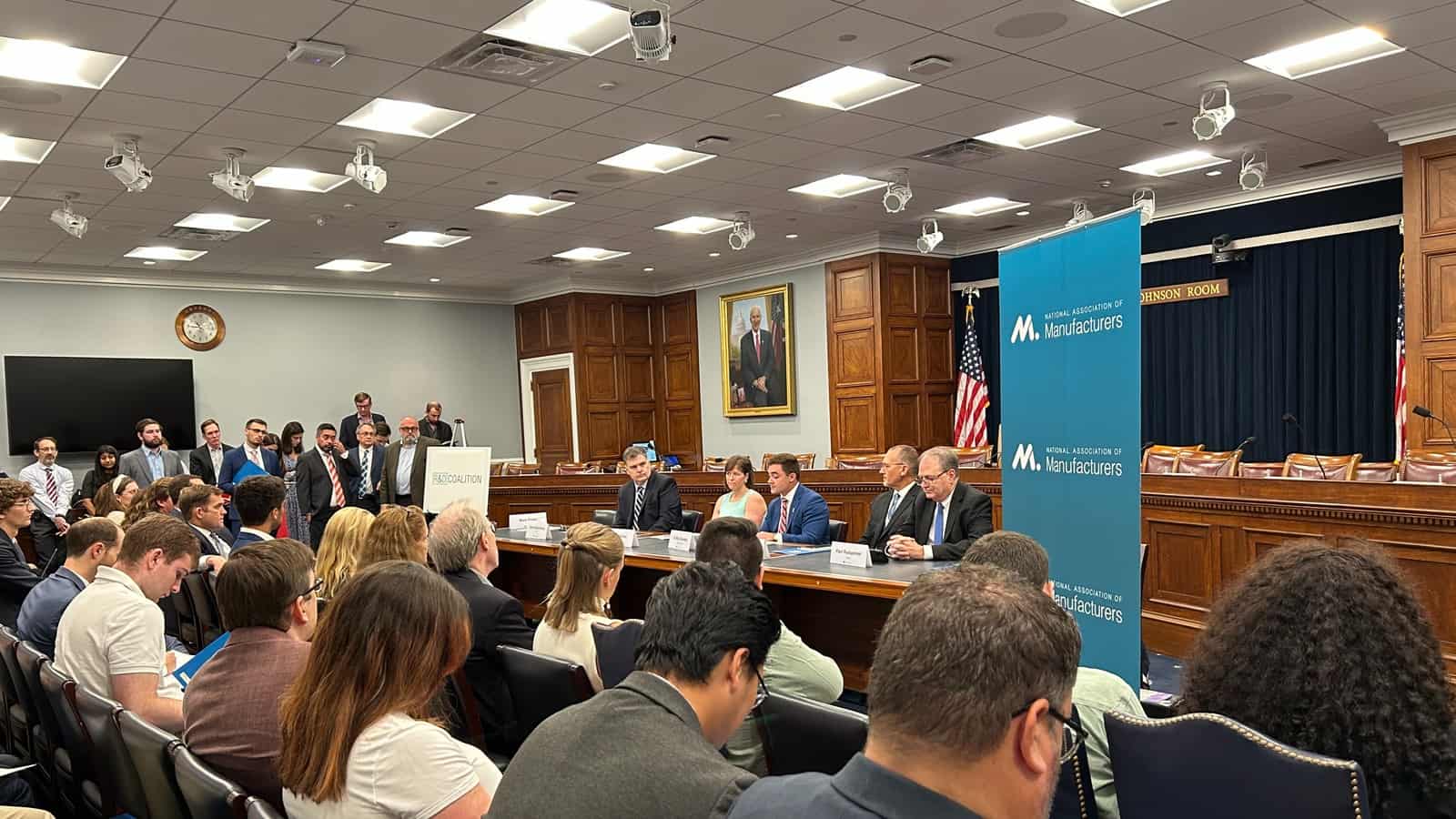
To restore a U.S. tax landscape that promotes manufacturing competitiveness, Congress should act quickly in advancing bicameral, bipartisan legislation that would ensure the tax code once again supports innovation.
That was the message from the NAM and several manufacturers to lawmakers last week.
What’s going on: The NAM and company leadership from manufacturers Westminster Tool and Brewer Science visited Capitol Hill last week to brief legislators on a harmful change to the tax treatment of research and development.
- The briefing was held by the NAM-led R&D Coalition in cooperation with the offices of Reps. John Larson (D-CT) and Ron Estes (R-KS) and Sens. Maggie Hassan (D-NH) and Todd Young (R-IN).
- Larson and Estes introduced the American Innovation and R&D Competitiveness Act in the House, while Sens. Hassan and Young introduced the American Innovation and Jobs Act in the Senate. These are the measures manufacturers are urging legislators to pass.
Why it matters: “We paid $26,679 per full-time employee in additional federal tax this past year” because of the change, Westminster Tool Chief Financial Officer Colby Coombs told lawmakers at the briefing.
- “This increased federal tax on R&D forced us to cancel a major aviation contract that would have added … new jobs in our community and forgo a significant capital investment. Without fixing this issue, in 2023, we expect an additional tax bill of almost $18,000 per employee,” he continued.
- Added Brewer Science Government Programs Director Doyle Edwards: “We have lost IP to China in the past, and fight[ing] that in the courts is a no-win situation. So the only way to win is to out-invent them. And that’s what we invest our money to do. However, with [the tax change] … we’re allowing China to actually catch up.”
The background: For nearly seven decades, manufacturers could deduct their R&D expenses fully in the year in which the costs were incurred. However, since the change last year, businesses must instead deduct these expenses over a period of years, making R&D more costly.
Legislative fix: To protect manufacturers’ R&D, jobs and competitiveness, Congress should move immediately on bipartisan legislation to restore R&D expensing.
- “R&D is the lifeblood of advanced technology development for our company, for our industry, but really for the nation,” Edwards continued. “And so our message is, we need your help. We need your leadership to resolve this policy issue.”
Take action: Learn more about what the NAM is doing to advocate for sound tax policy at our R&D action center.
New Study: U.S. Health Care Supply Chain Resilience Demands Balanced Regulatory Environment
Washington, D.C. – The National Association of Manufacturers released a new study outlining steps to improve health care supply chain resilience to allow manufacturers in the United States to better prepare for and adapt to the next disruption. The study analyzes lessons learned from the COVID-19 pandemic, during which manufacturers across the United States produced critical health care supplies in a highly unpredictable environment that affected every industry level.
“During the COVID-19 pandemic, manufacturers in the United States helped lead our response and recovery and learned many lessons in the process,” said NAM Chief Economist Chad Moutray. “Policymakers should utilize these lessons to bolster our supply chain for the next disruption. This analysis, which was conducted by the Manufacturing Policy Initiative at Indiana University, reveals that there are key policy actions needed to strengthen the manufacturing supply chain. Research shows a more balanced regulatory agenda, with an emphasis on clarity, predictability and coordination, will help mitigate the effects of the next disruption.”
Key Themes
Seven key lessons from the pandemic can be examined for future efforts to build resilience:
- Speed matters: Manufacturers need to be able to serve demand quickly.
- Information matters: Manufacturers need timely access to accurate information.
- Costs matter: Firms face the costs of taking action within the supply chain, as well as the costs of managing market unpredictability and policy environment uncertainty.
- Networks matter: Partnerships can support information sharing and networks to help manufacturers navigate the disruption.
- Size matters: Small and medium-sized manufacturers and new firms can be differently—and uniquely—challenged compared with established larger manufacturers.
- Technology matters: Technology can enable manufacturers to enhance production, innovate or improve efficiency, as well as support broader efforts to build partnerships.
- Flexibility matters: Responses can come from unexpected sources and need a flexible policy environment.
Areas of Opportunity
The report identifies four key areas of opportunity to enhance health care supply chain resilience:
- Fostering a conducive regulatory environment: Manufacturers and their partners need clear and streamlined regulations as well as a flexible regulatory framework in advance of the next disruption.
- Supporting partnerships for stronger information sharing and networks: Sustained information channels between manufacturers and policymakers will improve access to information for all parties and mitigate disruptions.
- Ensuring a healthier “baseline” industry: Small business plays a pivotal role in the U.S. Robust entrepreneurship and scaling of new manufacturers contribute to a more competitive industry.
- Prioritizing changing workforce needs: Workforce development must be prioritized so that manufacturers can pivot across product lines and sectors to meet the needs of the next disruption.
-NAM-
The National Association of Manufacturers is the largest manufacturing association in the United States, representing small and large manufacturers in every industrial sector and in all 50 states. Manufacturing employs nearly 13 million men and women, contributes $2.91 trillion to the U.S. economy annually and accounts for 55% of private-sector research and development. The NAM is the powerful voice of the manufacturing community and the leading advocate for a policy agenda that helps manufacturers compete in the global economy and create jobs across the United States. For more information about the NAM or to follow us on Twitter and Facebook, please visit www.nam.org.
Overregulation and Workforce Challenges Weigh Heavily on Manufacturing Sector
Optimism Sinks to Pandemic Lows in Q3 Outlook Survey
Washington, D.C. – The National Association of Manufacturers released its Manufacturers’ Outlook Survey for the third quarter of 2023, which registered the lowest level of optimism among NAM members (65.1%) since Q2 2020, as the sector continues to confront a tight labor market, unbalanced federal regulations and critical policy debates in Congress.
“Manufacturers continue to be challenged in today’s economy, but what this survey makes clear is that unbalanced federal regulations are harming families and communities, with nearly two out of three manufacturers reporting that the regulatory burden is preventing them from hiring more workers or increasing pay and benefits,” said NAM President and CEO Jay Timmons. “Congress and the administration can help correct this trend by restoring sensible regulations, enacting further permitting reforms, taking action to keep our tax code competitive and other bipartisan steps to strengthen manufacturing in America and build on the progress we achieved with tax reform, the Bipartisan Infrastructure Law, the CHIPS and Science Act and more.”
Key Survey Findings:
- Only 65.1% of respondents felt positive in their company’s outlook, edging down from 67.0% in the second quarter. It was the fourth straight reading below the historical average (74.9%).
- Concern about an unfavorable business climate was the highest in six years (Q2 2017).
- The survey found that 69.1% of small manufacturers, and 63.2% of all respondents, would hire more workers or increase compensation if the regulatory burden decreased.
- More than 70% of manufacturers would purchase more capital equipment if the regulatory burden on manufacturers decreased, with 48.6% increasing compensation, 48.6% hiring more workers, 42.5% expanding their U.S. facilities and 38.4% investing in research.
- The top challenges facing manufacturers include attracting and retaining a quality workforce (72.1%), weaker domestic economy (60.7%), rising health care/insurance costs (60.1%), unfavorable business climate (56.7%), increased raw material costs (45.5%) and supply chain challenges (37.8%).
You can learn more at the NAM’s online regulatory action center here.
The NAM releases these results to the public each quarter. Further information on the survey is available here.
-NAM-
The National Association of Manufacturers is the largest manufacturing association in the United States, representing small and large manufacturers in every industrial sector and in all 50 states. Manufacturing employs nearly 13 million men and women, contributes $2.91 trillion to the U.S. economy annually and accounts for 55% of private-sector research and development. The NAM is the powerful voice of the manufacturing community and the leading advocate for a policy agenda that helps manufacturers compete in the global economy and create jobs across the United States. For more information about the NAM or to follow us on Twitter and Facebook, please visit www.nam.org.
NAM, KAM Bring Suit Against SEC

The NAM and the Kentucky Association of Manufacturers are hitting back against an attempt by the Securities and Exchange Commission to force privately held businesses to make public financial disclosures.
What’s going on: On Tuesday, the NAM and KAM filed suit in federal court challenging the SEC’s novel reinterpretation of its Rule 15c2-11.
- The reinterpretation—on which the SEC has not granted companies the opportunity to comment—would require private firms to release confidential financial information publicly.
The background: Rule 15c2-11 requires disclosures to protect investors in publicly traded companies issuing so-called “penny stocks.” But the SEC has broadened the rule’s application to include privately held companies that issue corporate bonds to large institutional investors under an entirely different regulation, called Rule 144A.
- Everyday investors can’t purchase corporate bonds issued under Rule 144A, so there is no reason to require public disclosures from these businesses.
Why it’s important: Expanding Rule 15c2-11 will mean higher borrowing costs and reduced liquidity in both the manufacturing industry and throughout the larger economy, according to a new EY report released by the NAM.
- The reinterpretation would lead to job losses of more than 100,000 every year, according to the analysis.
Manufacturers speak out: “The SEC never allowed public comment on its novel reinterpretation of Rule 15c2-11, there is no conceivable benefit to the new standard and the SEC did not consider the impact that its about-face will have on privately held businesses,” said NAM Chief Legal Officer Linda Kelly. “The NAM Legal Center is filing suit to hold the SEC accountable and protect manufacturing growth, job creation and U.S. competitiveness.”
- KAM President and CEO Frank Jemley added: “The SEC’s unlawful overreach threatens privately held manufacturers in Kentucky and across the country, so the Kentucky Association of Manufacturers is proud to join the NAM in this important litigation.”
Manufacturers Sue SEC to Protect Private Businesses, Release Data on Harmful Impact of Novel Rule Interpretation
Washington, D.C. – The National Association of Manufacturers and the Kentucky Association of Manufacturers filed a lawsuit in federal court today challenging the Securities and Exchange Commission’s attempt to impose unwarranted public disclosure requirements on privately held businesses.
The SEC has adopted a novel reinterpretation of SEC Rule 15c2-11, imposing the rule’s public disclosure requirements on private companies that raise capital via corporate bond issuances under SEC Rule 144A—without giving manufacturers the opportunity to provide comment on the damaging impacts of such a consequential change.
According to EY economic analysis released by the NAM today, the SEC’s expansion of Rule 15c2-11 will result in decreased liquidity and increased borrowing costs in the manufacturing industry and throughout the economy—leading to job losses exceeding 100,000 annually.
“The SEC’s attempt to force private companies to disclose confidential financial information publicly is a clear violation of the Administrative Procedure Act,” said NAM Chief Legal Officer Linda Kelly. “The SEC never allowed public comment on its novel reinterpretation of Rule 15c2-11, there is no conceivable benefit to the new standard, and the SEC did not consider the impact that its about-face will have on privately held businesses—which could exceed 100,000 lost jobs each year. The NAM Legal Center is filing suit to hold the SEC accountable and protect manufacturing growth, job creation and U.S. competitiveness.”
“The SEC’s unlawful overreach threatens privately held manufacturers in Kentucky and across the country, so the Kentucky Association of Manufacturers is proud to join the NAM in this important litigation on behalf of all manufacturers in the U.S. to counter the SEC’s regulatory onslaught,” said KAM President and CEO Frank Jemley.
EY analysis highlights the damaging economic impacts of the SEC’s actions:
The economic impacts of the SEC’s expansion of Rule 15c2-11 will be felt disproportionately in the manufacturing industry, which accounts for more than half of all nonfinancial issuers of corporate bonds under Rule 144A. Across the economy, the change will result in 30,000 jobs lost each year over the first five years the new interpretation is in effect. The job losses will increase over time—rising to 50,000 jobs lost each year after five years and 100,000 jobs lost each year after 10 years.

These job losses are attributable directly to the decreased liquidity and increased borrowing costs associated with the SEC’s new interpretation.
Background:
- SEC Rule 15c2-11 requires broker-dealers to ensure that key information about companies issuing over-the-counter equity securities is current and publicly available prior to quoting those issuers’ securities.
- SEC Rule 144A allows for resales of securities (primarily corporate debt issuances) to qualified institutional buyers—large financial institutions that own or manage more than $100 million in securities. Retail investors cannot purchase Rule 144A securities. Notably, under Rule 144A, issuers are obligated to make their financial and operational information available to QIBs.
- In September 2021, the SEC’s Division of Trading and Markets issued a no-action letter applying Rule 15c2-11 to Rule 144A debt. This decision contradicted the historical application of Rule 15c2-11 to OTC equity securities and bypassed important rulemaking safeguards required by the Administrative Procedure Act.
- The NAM and the KAM filed petitions for rulemaking with the SEC in November 2022 seeking both permanent and temporary relief from the application of Rule 15c2-11 to Rule 144A securities. Following the petitions, the SEC temporarily delayed enforcement of its novel reinterpretation until January 2025, but the agency has not acted to reverse this damaging decision permanently.
-NAM-
The National Association of Manufacturers is the largest manufacturing association in the United States, representing small and large manufacturers in every industrial sector and in all 50 states. Manufacturing employs nearly 13 million men and women, contributes $2.90 trillion to the U.S. economy annually and accounts for 55% of private-sector research and development. The NAM is the powerful voice of the manufacturing community and the leading advocate for a policy agenda that helps manufacturers compete in the global economy and create jobs across the United States. For more information about the NAM or to follow us on Twitter and Facebook, please visit www.nam.org.
NLRB Revives Troubling “Card Check” Process

Bringing back parts of a policy it dropped more than half a century ago, the National Labor Relations Board moved late last week to reinstate an abridged version of “card check,” according to Reuters (subscription).
What’s going on: In a “3-1 decision in a case involving building materials company Cemex Construction Materials,” the NLRB unveiled a new framework last Friday that revives the 1949 Joy Silk doctrine, which holds that “employers must bargain with unions unless they have a good-faith doubt that majority support exists.”
The background: The board had tossed out the doctrine in the early 1970s after the Supreme Court’s decision in NLRB v. Gissel Packing Co., in which the court held that “the NLRB could force employers to bargain with unions when they engage in misconduct so severe that any election would be tainted.”
- This new decision “could provide a major boost to unions by allowing them to represent workers in certain cases when a majority sign cards in support of unionizing, rather than going through the lengthy and often litigious election process.”
- Last week’s move also came a day after the board finalized a return to Obama-era regulations purportedly aimed at speeding up union elections.
Why it’s problematic: Card check—which the NAM has long opposed—is inherently unfair and insecure, and it strips employees of their right to secret ballots, said NAM Director of Infrastructure & Labor Policy Ben Siegrist.
- “The NLRB’s decision could create a glide path to force unionization on workers without the necessary safeguards of an election, and it runs counter to 50 years of precedent established by the Supreme Court,” he said. “Effectively, this action contradicts the rights all employees have in determining their own representation.”