UPS, Teamsters Reach Tentative Deal

United Parcel Service Inc. and the International Brotherhood of Teamsters came to a tentative agreement on a five-year labor contract yesterday, according to NBC News.
What’s going on: “Union leaders announced the deal midday Tuesday, hours after resuming negotiations following a breakdown in talks on July 5. The handshake agreement must still be approved by rank-and-file union members at UPS to take effect.”
- The current contract between the parties was set to expire on July 31. Earlier this year, the Teamsters overwhelmingly voted to strike beginning as soon as 12:01 a.m. Aug. 1 if no agreement had been reached.
- The tentative agreement—said to be worth about $30 billion in total—averts the possibility of a strike, which could have further snarled manufacturing supply chains and significantly affected domestic shipping services.
- The contract covers 340,000 UPS workers.
What they’re saying: “The deal, [UPS CEO Carol Tome] said, ‘continues to reward UPS’s full- and part-time employees with industry-leading pay and benefits while retaining the flexibility we need to stay competitive, serve our customers and keep our business strong.’” She called it a “win-win-win.”
- Teamsters President Sean O’Brien said in a statement that the deal “sets a new standard in the labor movement and raises the bar for all workers.”
Why it’s important: “A work stoppage by UPS drivers would have been the largest single-employer strike in U.S. history. A recent forecast by the Anderson Economic Group estimated that a 10-day walkout would cost the U.S. economy some $7 billion, with workers racking up $1.1 billion in lost wages and UPS seeing $816 million in losses.”
Our take: “Manufacturers applaud today’s agreement between @UPS and @Teamsters and thank both parties for working quickly to reach a resolution that provides our industry with the supply chain certainty we need to keep the U.S. economy strong,” the NAM tweeted yesterday following news of the deal.
New Home Sales Decline

Sales of new single-family homes dropped 2.5% in June after increasing for three consecutive months, according to U.S. Census Bureau data.
What’s going on: New construction sales fell to a seasonally adjusted 697,000 units last month from a revised May rate of 715,000 units.
- The median sales price of new homes in June was $415,400, down from $416,300 in May.
- Purchases of new homes declined in Midwest and West, but continued to grow in the Northeast and South.
Still higher than 2022: However, June’s sales rate is 23.8% above last June’s estimated rate of 563,000 units.
Supply: June also saw a new-home supply of 7.4 months, up from May’s 7.2 months.
The NAM’s take: “The housing market continued to be challenged by affordability issues and an uncertain economic outlook,” NAM Chief Economist Chad Moutray said. “Still, with inventories low, tremendous demand and need exist for more housing.”
Manufacturers: Lowering Particulate Matter Standard Would Harm Infrastructure Investment
Washington, D.C. – Following a request from White House Environmental Justice Advisory Council Chair Brenda Mallory asking the Environmental Protection Agency to lower the annual primary standard for particulate matter (PM2.5) to 8.0 μg/m3 and to lower the primary 24-hour standard to 25.0 μg/m3, National Association of Manufacturers Vice President of Domestic Economic Policy Brandon Farris released the following statement:
“Moving the PM2.5 standard all the way down to 8.0 μg/m3 as the White House Environmental Justice Advisory Council suggested means 40% of the U.S. population will live in an area considered ‘out of attainment,’ essentially halting construction on bridges, roads, manufacturing facilities and agriculture projects in areas that desperately need development.
“Manufacturing in the U.S. is already among the cleanest in the world, and we don’t have to make a choice between cleaner air and economic prosperity. The EPA can choose both by finalizing a reasonable standard that doesn’t thrust much of the country into an area where no growth can happen.
Background: A new report conducted by Oxford Economics and commissioned by the NAM warns that the EPA’s proposed air quality regulations for PM2.5 could threaten $162.4 billion to $197.4 billion of economic activity and put 852,100 to 973,900 jobs at risk, both directly from manufacturing and indirectly from supply chain spending. In addition, growth in restricted areas may be constrained, limiting investment and expansion over the coming years. Due to these limited opportunities for expansion or investment, these areas in nonattainment could lose out on an additional $138.4 billion in output and 501,000 jobs through 2027.
-NAM-
The National Association of Manufacturers is the largest manufacturing association in the United States, representing small and large manufacturers in every industrial sector and in all 50 states. Manufacturing employs nearly 13 million men and women, contributes $2.91 trillion to the U.S. economy annually and accounts for 55% of private-sector research and development. The NAM is the powerful voice of the manufacturing community and the leading advocate for a policy agenda that helps manufacturers compete in the global economy and create jobs across the United States. For more information about the NAM or to follow us on Twitter and Facebook, please visit www.nam.org.
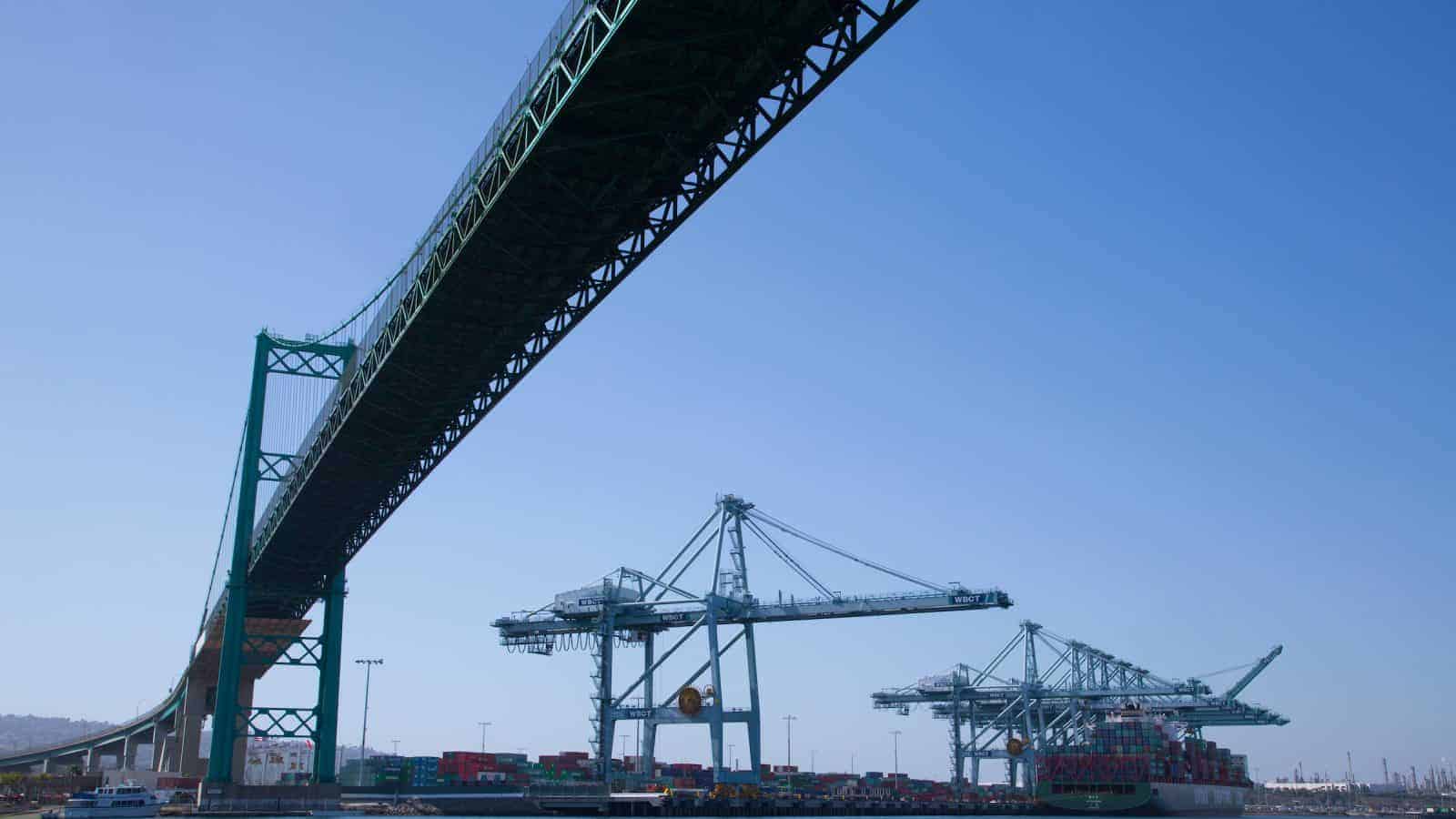
California Ports to Get Upgrades

California’s port system will get a $1.5 billion upgrade, according to Sourcing Journal (subscription).
What’s going on: “The Port of Los Angeles has been awarded $233 million in grants, while the Port of Long Beach received $383 million. The Port of Oakland got $119 million in funding, and the Port of Hueneme received $80 million.”
- “$1.2 billion will go to 15 projects designed to increase the capacity to move goods throughout the state’s global trade gateways while lessening environmental impacts on neighboring communities.”
- At Los Angeles, grant-funded improvements are set to include “a project that augments an existing partial roadway that directly serves 10 percent of all waterborne containers entering and exiting the entire United States.”
The background: The investment announcement by California Gov. Gavin Newsom late last week came less than a month after the Pacific Maritime Association and the International Longshore and Warehouse Union—dockworkers and their employer, respectively—reached a tentative six-year labor agreement at all 29 West Coast ports.
Why it’s important: The grants will decrease port congestion, boost business, add jobs and help operations use more zero-emissions energy, sources told the publication.
What we’re saying: “These types of congestion- and capacity-focused upgrades will ensure that ports across California remain operationally sound for years to come,” said NAM Director of Infrastructure, Innovation and Human Resources Policy Ben Siegrist.
- “As with the historic investment funded by the bipartisan infrastructure law, these improvements will keep products flowing and manufacturing lines open.”
Future Creators: Transportation Central Advances Industry Awareness
As part of Careers on Track, the MI and Union Pacific Railroad partnered with Everfi® to create and launch the Transportation Central module on Future Creators (Endeavor) – a digital education program giving middle and high-school students an opportunity to explore STEM careers. Using interactive gameplay, students explore a variety of professions, encounter real-world scenarios and learn new ways to solve common problems while interfacing with diverse employees along the way.
Transportation Central is an immersive simulation focused on careers in transportation, distribution and logistics (TDL). Other modules explore concepts in advanced manufacturing, data driven decision making and more. Read about how the MI and Union Pacific Railroad are leading the way to raise awareness and inspire students to pursue careers in manufacturing and TDL in the Transportation Central Case Study.
Unlimited access to Future Creators (Endeavor) is provided at no cost to select schools thanks to Union Pacific’s support. Contact Jen White, the MI’s Director of Student Engagement, to learn how you can help the MI provide Future Creators (Endeavor) to more students in schools across the U.S.
Pipeline Gets All Remaining Permits

The Federal Energy Regulatory Commission granted all remaining permits to the Mountain Valley Pipeline project in Virginia and West Virginia on Wednesday, allowing it to resume construction after a pause of more than a year, E&E News’ ENERGYWIRE (subscription) reports.
What’s going on: “In a unanimous order issued Wednesday, the commission said that all work on the 303-mile pipeline could proceed. … The commission also authorized FERC’s Office of Energy Projects to approve any future modifications to the Mountain Valley project as proposed by its sponsors—as long as the director of the office finds them ‘to be needed to complete construction.’”
- FERC approval comes just days after the project received its final water-crossing permit from the Army Corps of Engineers.
- The debt-ceiling deal signed into law this month by President Biden contained provisions requiring approval for the MVP, which the agency first approved in 2017.
Why it’s important: “The pipeline has been described by [supporter and West Virginia Sen. Joe] Manchin and others in Congress as a poster child for … the nation’s inefficient energy permitting system.”
- The MVP—the only natural-gas project under development in Appalachia—will help deliver clean, affordable energy from Appalachian shale reserves to customers in the eastern U.S.
A win for timely permitting: “In its order Wednesday, FERC also said it was setting aside its policy of generally considering requests for rehearing before allowing construction.”
What’s next: Developers plan to restart construction “shortly” and finish this year.
States to Get Funds to Expand Internet Access

More than $42 billion will be given to states to expand their broadband internet access, the White House announced this week, according to The Wall Street Journal (subscription).
What’s going on: “States and territories have been jockeying for months for their share of $42.5 billion allocated in an internet-construction fund called the Broadband Equity Access and Deployment program. The law requires that federal agencies use a new, more accurate map of where high-speed internet service is missing before disbursing the funds.”
- Texas will get the most money under the project ($3.3 billion) followed by California ($1.9 billion). Also set to receive significant sums are the less-populous Alaska, West Virginia and Montana.
The goal: The effort is meant to connect everyone in the U.S. to “affordable, high-speed internet service by 2030,” according to the Journal.
Why it’s important: Approximately 8.5 million U.S. households and businesses are located in areas of the country without access to high-speed internet access, which the Biden administration called “a necessity in today’s society” in an announcement about the funds.
- BEAD is one of six federal internet-construction programs authorized by the NAM-backed bipartisan infrastructure law of 2021.
- The legislation also includes $2.75 billion for digital equity and inclusion and $2 billion in loans and grants for internet infrastructure in rural locations, CNET reports.
Our view: “Manufacturers supported the bipartisan infrastructure law, and today’s historic broadband investment announcement will enhance industry operations through leading edge connectivity,” the NAM tweeted on Monday. “Thank you @POTUS for your leadership to advance domestic [manufacturing] priorities.”
Key Natural Gas Pipeline Wins Final Permit

A natural gas pipeline that would bring affordable energy to customers in the Mid- and South Atlantic regions of the U.S. got its final permit late last week, according to E&E News’ ENERGYWIRE (subscription).
What’s going on: On Friday the planned 303-mile Mountain Valley Pipeline—set to run from West Virginia to southern Virginia—received its water crossing permit, which will allow developers to build the project across rivers and streams in accordance with Section 404 of the Clean Water Act.
- The permit was part of the debt-ceiling deal signed earlier this month by President Biden
- Construction of the MVP, the only large pipeline project currently being built in Appalachia, has been paused for more than a year because of legal battles, according to another ENERGYWIRE (subscription) story.
Why it’s important: The granting of the water crossing permit—which comes more than five years after the pipeline’s initial approval—is a step forward for permitting reform.
- The approvals process for critical infrastructure in the U.S. takes far longer than it does in other countries that have comparable environmental regulations, NAM Vice President of Energy & Resources Policy Brandon Farris told Congress at a recent hearing.
- This lag needlessly delays—or worse, drives overseas—critical infrastructure, Farris said.
Manufacturers act: Last week the NAM, along with members of the NAM’s Council of Manufacturing Associations and Conference of State Manufacturers Associations, launched Manufacturers for Sensible Regulations, a coalition aimed at speeding up the permitting process and addressing the large volume of regulations being handed down by the federal government.
What’s next for MVP: The MVP has approximately four to five months of construction remaining. It could begin service this year or in early 2024, according to one estimate.
- To finish construction, the project will require the permission of the Federal Energy Regulatory Commission, which “must still validate that the project has all their permits,” ENERGYWIRE reports.
Panama Canal Drought Hits Shippers

The Panama Canal—which “handles about one-third of Asia-to-Americas seaborne trade”—is at its lowest level in more than 100 years, a development that could jeopardize global supply chains, according to The Wall Street Journal (subscription).
What’s going on: “The government agency that manages the artificial waterway implemented travel restrictions in May to avoid ships running aground, and since then, some large vessels have had to reduce container loads by roughly one-quarter. Further restrictions could go into effect in late June, authorities say.”
- In the first five months of 2023, rainfall in the canal area was 47% below the historical average.
- The canal, which opened in 1914, depends heavily on rainfall to replenish the tens of millions of gallons of water that flow into the sea each time a ship goes through the canal’s locks.
Why it’s important: “Disruptions in the canal’s operations would hurt Southern Hemisphere exporters and importers in the north. Brazilian meat, Chilean wines and bananas from Ecuador are routinely shipped across the canal, along with copper from Chile and liquefied natural gas from the U.S. Gulf Coast.”
- Panamanian officials are trying to avoid a repeat of the problems that afflicted the Suez Canal in March 2021, when a large containership blocked that waterway for nearly a week, costing billions of trade dollars.
The fallout: “In addition to cutting cargo loads, shipowners are adjusting to Panama Canal restrictions by moving containers to trains to ensure safe passage through locks. In some instances, boxes are unloaded from ships on the Pacific Ocean side of the canal, moved by rail and returned to ships before they continue their voyage through the Atlantic Ocean.”
- The Panama Canal Railway has seen a 20% increase in cargo volume as a result of the drought.
- Shipowners are responding by charging an average of $600 more per box on vessels that cross the canal.
- The daily Asia–U.S. East Coast freight rate was $2,400 per container in May, according to Freightos Baltic Index, but it is expected to rise this month partly due to the drought surcharge.
What’s next: Large container shipping companies “have no plans to divert ships away from Panama”—for now. “[E]xecutives said it could happen if drought conditions persist.”
U.S., China Restart High-Level Discussions

During meetings this week, the U.S. and China attempted to restore high-level bilateral interactions and reverse the tension growing between the two nations, according to The Wall Street Journal (subscription).
What’s going on: “During two days of meetings in Beijing, [U.S. Secretary of State Antony] Blinken and senior Chinese foreign-policy officials agreed to more high-level talks, continuing a thaw after months of near-frozen contacts.”
- “They also promised to find common ground on increasing flights between the two countries and combating the flow of fentanyl into the U.S.”
The background: In recent months, U.S.–China relations have been on a downward trend, following U.S. detection of what the Biden administration said was a Chinese spy balloon.
- Last year, the U.S. imposed restrictions on the export of certain advanced technology to China and is expected to issue new limits on U.S. investments overseas.
- China has taken issue with these moves, as well as with U.S. support for ally Taiwan.
- Some 67% of Americans say China is a “major threat” to the U.S., according to a Pew Research Center questionnaire. That’s up from 43% in 2015.
Topics discussed: During his visit, Blinken raised a number of issues, including tensions over Taiwan and North Korean aggression. He also discussed China’s trade-distorting practices, human rights violations, imprisonment of U.S. citizens and position on Russia’s war against Ukraine, according to POLITICO.
- The meetings also touched on areas of mutual interest, including climate, macroeconomic stability, food security and public health.
What didn’t happen: Blinken’s visit to China—the first by a U.S. cabinet member in more than four years—did not produce substantive advancement on the above issues. However, the meeting served as a starting point for future high-level communications.
- Officials did not address Chinese intelligence movements in Cuba or the establishment of “a military communication channel between the countries to address frequent incidents around Taiwan … a key goal of the Biden administration.”
Business with China: “Blinken said he also met with members of the U.S. business community on Monday, many of whom expressed a desire to continue to grow their operations in China,” according to POLITICO.
- “He said a full decoupling of the American and Chinese economies would be disastrous, pointing to record trade between the two last year, but said the U.S. would continue to take steps to make American supply chains more resilient and deny China technologies that threaten U.S. national security.”