
Timmons: Industry Resilient, but Action Needed

Despite mixed market signals in recent weeks, the U.S. economy is strong and manufacturing is resilient—but Congress must take certain steps to maintain the industry’s competitiveness, NAM President and CEO Jay Timmons told Fox News host Neil Cavuto Monday.
What’s going on: When lawmakers return from their August recess next month, they should prioritize several tax provisions, Timmons said.
- “When … Congress goes back, we’ve got to deal with interest deductibility, and we’ve got to deal with the research-and-development tax deduction,” he continued. “We’ve got to deal with full expensing. Those are things that have expired.” These measures and others are top priorities in the NAM’s tax campaign, Manufacturing Wins.
- Other manufacturing-critical tax provisions are scheduled to expire or be reduced drastically at the end of next year, including the pass-through and estate-tax deductions. What’s more, “candidates on both sides of the aisle … are talking about raising taxes on businesses,” Timmons said. Individual tax rates and tax rates on manufacturers that operate globally are also set to rise at the end of 2025.
Regulatory onslaught: Manufacturers are also struggling with a “regulatory burden that is driving up the cost of doing business,” Timmons told Fox News.
- “We have restrictions on our ability to develop energy sources here, and we have a ban on exports of natural gas. All of those things lead to potential downsides in the economy.”
- The vast majority of Americans support exporting natural gas, a March NAM poll found, but the Biden administration’s indefinite pause on permits to export liquefied natural gas, imposed in January, continues.
Hopeful outlook: “There is a … very positive sense among manufacturers that if we do the right things on the policy front, we’re going to continue [the] expansion in the sector,” Timmons added. “We’re going to continue the record investments that we’ve seen, the record job growth and the record wage growth in the sector.”
The Corporate Tax Rate, Explained
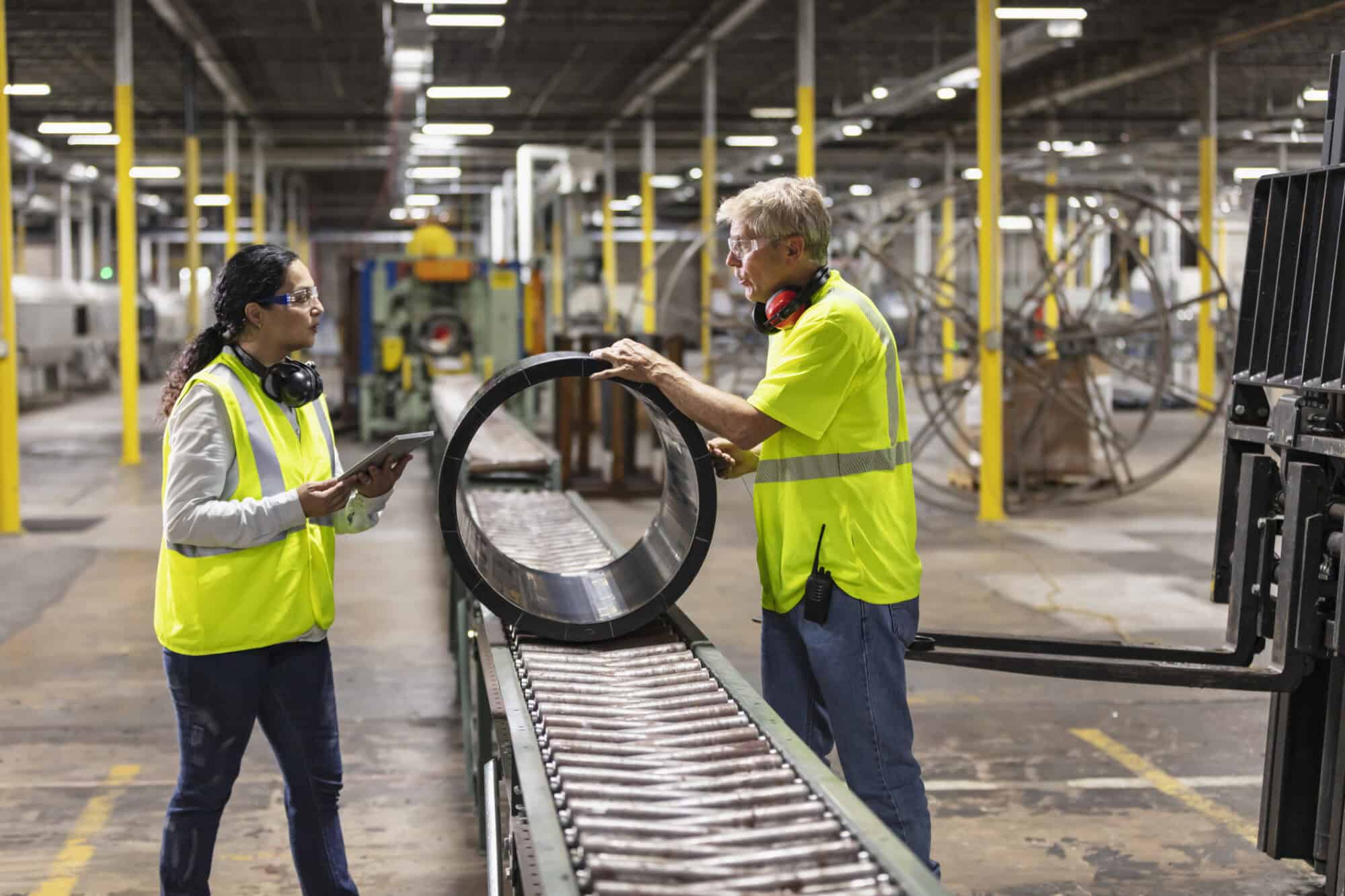
The NAM’s 2025 tax campaign, “Manufacturing Wins,” is focused on preserving tax provisions critical to manufacturing in the U.S. One of those is the corporate tax rate, which the 2017 tax reform lowered from 35% to a globally competitive 21%.
The NAM recently released a tax explainer on the current corporate rate, emphasizing why it’s crucial to U.S. manufacturing’s competitiveness on the world stage.
The background: Prior to 2017, the U.S. corporate tax rate was 35%, the highest among our peers in the Organisation for Economic Co-operation and Development and the third-highest rate in the entire world—making the U.S. an outlier and harming its ability to attract manufacturing investment.
- Tax reform lowered the corporate rate to 21%, aligning the U.S. with the average rate elsewhere in the OECD.
The benefits: Reducing the tax burden on manufacturers led to increased investment throughout the U.S., job creation, wage growth and overall economic expansion.
- In 2018, the year the lower rate took effect, manufacturers had their best year for job creation in more than two decades, creating more than 260,000 positions and increasing wages by 3%—the fastest pace in 15 years.
- NAM surveys conducted prior to tax reform found that nearly 80% of manufacturers were struggling with unfavorable business conditions like high taxes—a figure that dropped to just 12% following the reduction in the corporate rate.
What’s at stake: Although the corporate tax rate is not set to expire at the end of 2025, as other pro-growth provisions are, President Biden’s fiscal year 2025 budget called for an increase to 28%.
- This proposal would return the U.S. to one of the highest corporate tax rates in the developed world, resulting in fewer jobs, lower wages, less innovation and reduced investment in our communities.
What should be done: “Manufacturers are calling on Congress to preserve tax reform in its entirety—including the 21% corporate tax rate,” the NAM said.
- “Congress should maintain a globally competitive corporate rate—enabling manufacturers to continue leading on the world stage while driving innovation and job creation here at home.”
Tax Bill Scheduled for Thursday Vote
Senate Majority Leader Chuck Schumer (D-NY) has scheduled a procedural vote on a bipartisan tax package, though the bill’s fate remains uncertain.
What’s going on: The Tax Relief for American Families and Workers Act would restore expired tax policies that reduce the cost of manufacturers’ investments in R&D, equipment and machinery. Ahead of Thursday’s vote, the NAM called these policies “vital to manufacturing workers and America’s economic future.”
- Immediate R&D expensing: Prior to 2022, manufacturers in the U.S. could fully deduct their R&D expenses in the year those expenses were incurred. But in 2022, first-year R&D expensing expired, making R&D investments significantly more costly, particularly for small and medium-sized manufacturers.
- Enhanced interest deductibility: Also in 2022, a new standard took effect limiting the amount of interest manufacturers can deduct on business loans, making it more expensive for them to invest in growth and expansion.
- Accelerated depreciation: In 2023, 100% accelerated depreciation—which allows manufacturers to immediately expense the full value of their capital equipment purchases—began phasing down, meaning these vital investments are now more costly for manufacturers.
What to expect: Thursday’s procedural vote requires 60 votes in the Senate, a difficult hurdle.
What’s next: Immediate R&D expensing, enhanced interest deductibility and 100% accelerated depreciation are top priorities in the NAM’s 2025 tax agenda. As Congress prepares to address scheduled expirations of other policies from the 2017 tax reform next year, the NAM will continue to call for restoration of these important pro-growth incentives.
The last word: “Competitive tax policy is critical to manufacturers’ ability to compete on the world stage and create jobs here at home,” said NAM Vice President of Domestic Policy Charles Crain. “Congress should restore expired pro-growth tax policies and act to prevent even more devastating tax increases scheduled for 2025.”
Small Manufacturers: Save the Pass-Through Deduction

A critical tax deduction for small businesses is set to expire at the end of 2025, and manufacturers are sounding the alarm as part of the NAM’s “Manufacturing Wins” tax campaign.
Increasing the tax burden: Courtney Silver, president and owner of Concord, North Carolina–based Ketchie, recently emphasized the importance of the pass-through deduction. As an S corporation, Ketchie is one of the many small manufacturers that are eligible for this 20% deduction created by the Tax Cuts and Jobs Act.
- Silver, who chairs the NAM’s Small and Medium Manufacturers Group, warned that the expiration of this provision, along with the planned increase in individual tax rates, will “dramatically increase the tax burden on small manufacturers like Ketchie.”
Decreasing competitiveness: The disappearance of the pass-through deduction would make American companies less competitive on the world stage, predicted Austin Ramirez, president and CEO of Husco, a Waukesha, Wisconsin–based maker of hydraulic and electromechanical components for on- and off-highway vehicles.
- “The loss of the TCJA’s small business provisions would severely hamper our growth trajectory,” he said.
- “The combination of an increased tax rate and the loss of the pass-through deduction would be especially damaging, tilting the playing field against Husco and other pass-through manufacturers.”
Damaging supply chains: “Many small manufacturers are organized as pass-throughs, including most of [our] key suppliers,” said Chuck Wetherington, president of BTE Technologies in Hanover, Maryland.
- “A tax increase on pass-throughs would have a damaging, disproportionate impact on the manufacturing industry.”
Discouraging entrepreneurs: Competitive tax policy is personal for small manufacturers like Hannah Kain, who founded ALOM Technologies out of Fremont, California. “Like many immigrants before me, I came to the U.S. for opportunity,” Kain said.
- “Since I started the company in 1997, we have reinvested every dollar we made into growing the company. … I personally see how hard it is for entrepreneurs—and especially minorities—to start the type of company that must make big investments in equipment, space, inventories and so much more.”
Reducing growth: “[The 2025 tax hikes] will affect manufacturing businesses like ours and make it more difficult for us to hire more employees, raise wages and drive growth for our business,” said Lee Dougherty, a mechanical engineer at Madsen Steel.
- “We need our representatives in Congress to do their part by stopping these tax hikes so that we can continue to invest in our community and the future of our business.”
What you can do: Manufacturers willing to share their own stories about the need to preserve key tax reform measures can visit NAM.org/MfgWins or email the NAM’s tax team to get involved.
Daines, Smucker Staffers Talk Pass-Through Deduction

What’s going on: On Thursday, as part of its 2025 tax campaign, “Manufacturing Wins,” the NAM hosted Noelle Britton, deputy chief of staff for Rep. Lloyd Smucker (R-PA), and Caroline Oakum, tax counsel for Sen. Steve Daines (R-MT), in a virtual roundtable to discuss what’s being done in Congress to maintain the Section 199A pass-through deduction.
- The 20% deduction—created by the 2017 Tax Cuts and Jobs Act to help the many small and medium-sized businesses in the U.S.—is among several vital tax provisions scheduled to expire at the end of 2025. (Pass-throughs are companies whose profits are “passed through” to the owners, who then pay taxes on the entities’ incomes on their personal tax returns.)
- Both Rep. Smucker, who leads the House Ways and Means Main Street Tax Team, and Sen. Daines are leaders of legislation that would make the deduction permanent.
What they’re doing: Sen. Daines introduced the Main Street Tax Certainty Act in the Senate last May, while Rep. Smucker introduced the House’s version of the measure last July.
- The legislation would make the pass-through deduction permanent, providing much-needed certainty to the small and medium-sized manufacturers that have relied on it to increase investments and job creation.
What you can do: The House Ways and Means Committee Tax Teams are collecting companies’ perspectives on how the pass-through deduction has helped manufacturers and other businesses. Similarly, the NAM is collecting stories that can be used as part of our Manufacturing Wins tax campaign.
- Manufacturers willing to share their own stories about the pass-through deduction can email [email protected] or contact the NAM’s tax team.
Sen. Daines: How We’re Working to Avert a Tax Crisis

Manufacturing-critical provisions from 2017 tax reform are set to expire at the end of next year—unless Congress acts. As part of our 2025 tax campaign, Manufacturing Wins, the NAM recently interviewed Sen. Steve Daines (R-MT) to learn more about what these expirations would mean for manufacturers and what Congress is doing to prevent the resulting tax hikes.
Here’s the written interview.
NAM: Sen. Daines, many of tax reform’s pro-manufacturing policies expire at the end of 2025—including those with disproportionate impacts on small manufacturers, like the pass-through deduction and the individual income rate cuts. What is Congress doing to prevent these damaging tax increases?
Daines: The best defense against a looming tax hike is a good offense. Senate Finance Republicans have begun organizing to examine the [Tax Cuts and Jobs Act of 2017] policies expiring next year, and the pass-through deduction is at the top of that list. We can’t allow these provisions to expire and let America’s working families, manufacturers and small businesses face a $6 trillion tax hike. That will make manufacturers less competitive against foreign competition by stifling investment and crushing their bottom line at a time when they should be looking for ways to increase wages and invest in innovation.
NAM: You have introduced the Main Street Tax Certainty Act in the Senate and been a champion for pass-throughs since the TCJA was signed into law. How would your bill prevent tax hikes for pass-through manufacturers?
Daines: The Main Street Tax Certainty Act provides much-needed certainty to America’s small businesses by making the pass-through tax deduction permanent. This helps create good-paying jobs and grows the economy. If it’s allowed to expire, small businesses face an immediate 20% tax hike.
NAM: The Senate Finance Committee has established tax working groups to examine the TCJA expirations. What will be your focus as the committee begins examining these scheduled tax changes?
Daines: My focus is on making the Trump era tax cuts permanent, which will create a more stable, growing economy.
The Pass-Through Deduction, Explained

Through the NAM’s recently launched 2025 tax campaign, Manufacturing Wins, manufacturers are calling on Congress to prevent several devastating tax increases from taking effect at the end of next year.
One of those scheduled increases is the expiration of the Section 199A pass-through deduction—a critical incentive, created by tax reform in 2017, designed to help thousands of small and medium-sized manufacturers invest in their businesses.
The NAM recently released a tax explainer on the pass-through deduction, breaking down what it is, what it does and why its preservation is vital to manufacturing in the U.S. Here are the highlights.
Pass-through defined: The defining characteristic of a pass-through entity is that its business profits get “passed through” to the company owners, who then pay taxes on the business’s income on their personal tax returns.
- The vast majority of businesses in America—96%—are organized as pass-throughs, including S-corporations, partnerships, LLCs and sole proprietorships.
- In manufacturing, pass-throughs are typically small, family-owned firms.
What it’s done for manufacturers: The Section 199A pass-through deduction allows pass-through manufacturers to deduct up to 20% of their qualified business income, decreasing their effective tax rate.
- Combined with a lower individual income tax rate included in the 2017 reform (which reduced the top individual rate from 39.6% to 37%), the pass-through deduction has freed up significant capital for smaller manufacturers to reinvest in their businesses.
- For example, 2018 was the best year for manufacturing job creation in 21 years and the best year for wage growth in 15 years.
What’s in jeopardy: Both the pass-through deduction and the lower individual income tax rates are set to expire at the end of 2025—and they’re certain to hit small and medium-sized manufacturers hard.
- In a recent NAM survey, 93% of pass-through manufacturers said their ability to grow, create jobs and invest in their companies will be stymied if the expirations are allowed to happen.
What should be done: Congress must make the pass-through deduction permanent and keep individual tax rates as low as possible.
The last word: “Small and medium-sized pass-throughs are the backbone of the manufacturing supply chain,” said NAM Vice President of Domestic Policy Charles Crain. “Congress must act before the end of 2025 to preserve the pass-through deduction and prevent devastating tax increases on small businesses throughout the manufacturing sector.”
Q&A: The Looming 2025 Tax Challenge
Visit Manufacturing Wins
VISITThe NAM recently launched “Manufacturing Wins,” the manufacturing industry’s campaign to preserve the benefits of the 2017 tax reforms that are currently scheduled to disappear in 2025—particularly those tax incentives that make it easier for small manufacturers to hire employees and raise wages, invest in equipment, grow their businesses and contribute more to their communities.
NAM Vice President of Domestic Policy Charles Crain explains what’s at stake in 2025 and how manufacturers can get involved in the effort to prevent tax increases.
Q: Manufacturers are facing “tax Armageddon” at the end of 2025. Can you explain what’s happening?
Crain: Tax reform in 2017 was rocket fuel for manufacturers, leading to record job creation, capital investment and economic growth. For example, manufacturing production grew 2.7% in 2018, with December 2018 being the best month for manufacturing output since May 2008. Manufacturing capital spending grew 4.5% and 5.7% in 2018 and 2019, respectively—this shows the direct impact of pro-growth tax incentives on manufacturers investing in new equipment and facilities. But many of tax reform’s pro-manufacturing provisions will expire at the end of 2025. If these provisions are allowed to expire, virtually every manufacturer will face devastating tax increases.
Q: What policies will sunset in 2025, and how will their expiration impact SMMs?
Crain: For small manufacturers organized as pass-throughs—meaning the business’s owners pay tax on the business’s income on their personal returns—two key changes are coming down the pike. First, their tax rate will increase, from 37% to 39.6%. Second, they will lose the pass-through deduction, which provides a tax deduction equal to 20% of the business’s income. In combination, these tax hikes will increase pass-throughs’ effective tax rate by at least 10 percentage points (from 29.6% to 39.6%), resulting in significantly less capital available for equipment purchases, job creation and community investment.
For small manufacturers organized as corporations, the NAM is fighting to prevent any increases in the corporate tax rate. The corporate rate decreased from 35% to 21% in 2017 and is not scheduled to expire—but President Joe Biden has proposed increasing the rate to 28%. The NAM remains staunchly opposed to corporate tax rate increases that punish manufacturers for investing and creating jobs here in America.
For family-owned small manufacturers, their estate tax obligations are scheduled to increase. Tax reform doubled the value of assets that can be passed on without incurring the estate tax; at the end of 2025, the estate tax exemption threshold is scheduled to be reduced by half. The NAM is calling on Congress to maintain the increased exemption—or to repeal the estate tax entirely, preventing family-owned businesses from being sold for parts to pay a tax bill when a loved one passes away.
Q: What else is at stake in 2025?
Crain: Manufacturers of all sizes continue to face uncertainty about the tax code’s treatment of R&D expenses, capital equipment purchases and interest on business loans. Immediate R&D expensing—which allows manufacturers to write off the entire cost of R&D spending in the year incurred—expired in 2022. So did a tax reform provision that allowed businesses to deduct more of the interest they pay on loans when they debt finance a project. And in 2023, 100% accelerated depreciation—which reduces the cost of capital equipment purchases—began to phase down. These expired provisions are vital to manufacturing growth, and the NAM is working to restore and extend them as Congress prepares for the 2025 tax fight.
Q: How can SMMs learn more?
Crain: The NAM recently published “What’s At Stake: Manufacturers Face Devastating Tax Increases in 2025,” which highlights the tax reform provisions that will expire at the end of 2025. The NAM calls on Congress to act to prevent these expirations from stunting manufacturing job creation, growth and innovation.
Q: How can SMMs get involved?
Crain: Manufacturing voices are crucial to the 2025 tax fight. NAM members with a story to tell about the impact of 2017 tax reform on their business—or the damage that the 2025 expirations could inflict—are encouraged to reach out to their NAM membership advisor or to the NAM tax team.
You can also take a few minutes to record a video testimonial calling on Congress to prevent devastating tax hikes on manufacturers. Instructions for submitting a video testimonial are available here—it’s as easy as having a coworker use a smartphone to film a video of you on your shop floor! Completed testimonials can be emailed to the Manufacturing Wins team to be posted to our campaign site: NAM.org/MfgWins
Supreme Court Decision is Game-Changing Transformation for Legal and Regulatory Landscape for Manufacturers
Washington, D.C. – Today, the United States Supreme Court overruled the Chevron doctrine—a requirement that federal courts defer to an administrative agency’s interpretation of an ambiguous statute—that had proven unworkable and incoherent.
“The legal and regulatory landscape has transformed in the blink of an eye. Manufacturers will not waste a moment in seizing this opportunity—an opportunity that we have never seen before—to leverage this decision to rein in the regulations that are holding back manufacturers from improving lives,” said National Association of Manufacturers President and CEO Jay Timmons. “The NAM Legal Center and our best-in-class advocacy team will be on the field, leveraging this decision and the new tools it gives us, to fight back new regulations we are facing today as well as whatever may come our way in the next administration. For anyone who wants to see manufacturing grow and succeed in America, today heralds the possibility for a much brighter future.”
“Today’s ruling is a game changer for manufacturers as Chevron was at least partly to blame for the unpredictability and overreach that have become synonymous with the modern regulatory state,” said NAM Chief Legal Officer Linda Kelly. “We are hopeful that this marks the end of an overbearing regulatory system that had become complex, and compliance in many cases that was contradictory from agency to agency. For the past 40 years, Chevron has tipped the scales in favor of unelected officials and against the regulated public. Now the onus is on Congress to provide clear guardrails and guidelines in its intent to ensure that laws are implemented in a manner that achieves their goal. Manufacturers are eager to work with lawmakers to develop policies that promote innovation, job creation, economic growth and improved quality of life for all Americans.”
“Manufacturers have been the subject of a regulatory onslaught, with agencies’ far-reaching decisions affecting companies of all sizes,” said NAM Managing Vice President of Policy Chris Netram. “The EPA, SEC and DOL—the aggressive nature of rulemaking and enforcement actions that exceed authority come from the alphabet soup of regulators. The NAM has been successful in fighting key rules in court, and today’s decision gives us the ability to challenge even more actions while ensuring future agency actions do not exceed the authority mandated by Congress.”
-NAM-
The National Association of Manufacturers is the largest manufacturing association in the United States, representing small and large manufacturers in every industrial sector and in all 50 states. Manufacturing employs nearly 13 million men and women, contributes $2.89 trillion to the U.S. economy annually and accounts for 53% of private-sector research and development. The NAM is the powerful voice of the manufacturing community and the leading advocate for a policy agenda that helps manufacturers compete in the global economy and create jobs across the United States. For more information about the NAM or to follow us on Twitter and Facebook, please visit www.nam.org.
NAM to Tax Teams: Preserve Tax Provisions Before They Expire

Raising taxes on manufacturers would damage the industry and the U.S. economy as a whole, the NAM told the House Ways and Means Committee this week. That’s why it’s crucial that Congress preserve set-to-expire tax reform provisions.
What’s going on: In a continuation of its Manufacturing Wins campaign, the NAM conveyed a clear message to six of the committee’s specialized “Tax Teams”: act now to protect manufacturers from tax increases.
Why it’s important: Failure to act before the end of next year, when key provisions from 2017 tax reform are set to expire, would result in higher taxes on virtually all manufacturers—which “will cost millions of jobs and put the American manufacturing sector at a severe disadvantage globally,” the NAM wrote.
What’s at stake: The NAM highlighted manufacturers’ top tax priorities for the Tax Teams, discussing why preserving pro-growth tax policy is vital for manufacturers in the United States:
- In communication with the Main Street Tax Team, the NAM called on Congress to preserve tax reform’s reduced individual income tax rates and maintain the 20% pass-through deduction. It emphasized for the Supply Chain Tax Team the importance of tax reform’s reduction in the corporate tax rate, which brought the U.S. from one of the highest rates in the world to a globally competitive 21%. The Global Competitiveness Tax Team received a similar message.
- The NAM detailed for the Rural America Tax Team the damage the estate tax imposes on family-owned manufacturers, and why Congress should not allow more family-owned businesses’ assets to be subject to the estate tax at the end of 2025.
- The NAM continued to push for pro-growth, pro-innovation R&D tax incentives with the U.S. Innovation Tax Team, and it enumerated for the Manufacturing Tax Team the full range of policies that will impact manufacturers at the end of 2025—and called for urgent congressional action to protect manufacturers from tax hikes.
The final word: “Manufacturers of all sizes, throughout the supply chain, are calling on Congress to preserve tax reform in its entirety,” said NAM Vice President of Domestic Policy Charles Crain. “Manufacturers and manufacturing families simply cannot afford the devastating tax increases scheduled for the end of 2025 if Congress fails to act.”