Case Study: The Building Blocks of a Successful Second Chance Hiring Initiative
In early 2021, The Manufacturing Institute began collaborating with Union Pacific to build a Second Chance hiring initiative to expand candidate pools to be more inclusive of those with criminal records. Union Pacific Chairman, President and CEO Lance Fritz made expanding his company’s talent pipelines a priority and considers Union Pacific’s commitment to Second Chance employment an important part of that strategy.
To help design and implement Union Pacific’s Second Chance initiative, the MI partnered with Envoy Advisory via its Envoy initiative to make use of its expertise in inclusive hiring policies and practices and build partnerships with high-performing reentry and workforce organizations in Houston, Texas.
Assessing and adapting Union Pacific’s existing hiring policies and practices allowed for a deeper understanding of the candidate journey and illuminated potential barriers and support gaps for candidates from this population. While the pilot program was aimed specifically at candidates with criminal records, many of the identified employment barriers applied to a broad range of candidates from vulnerable backgrounds. Our case study outlines the three essential components of a successful Second Chance hiring initiative. Read the full case study here.
NEW: Arizona Snap Poll Shows Manufacturing Voters Strongly Oppose Reconciliation Tax
Washington, D.C. – The National Association of Manufacturers and Arizona Chamber of Commerce & Industry released a new snap poll today showing that an overwhelming majority of manufacturing voters in Arizona disapprove of the U.S. Senate’s plan to raise taxes on manufacturers. More than 90% of manufacturing voters opposed the tax, while 91% agreed that the tax would harm manufacturers’ ability to invest in their business, buy new machinery and upgrade facilities and put manufacturing jobs and economic recovery at risk.
“With the U.S. and Arizona economy already showing signs of weakening, this is the wrong time to further undermine growth and the manufacturing sector’s overall competitiveness. As the nonpartisan Joint Committee on Taxation analysis has shown, the corporate minimum tax is disproportionately focused on manufacturers and will limit the sector’s ability to grow and invest—in Arizona and across the country,” said NAM Chief Economist Chad Moutray. “As the survey shows and as other data indicate, it will make it harder to hire more workers, raise wages and invest in our communities. Arizona’s manufacturing voters are clearly saying that this tax will hurt our economy.”
According to recent analyses by the Joint Committee on Taxation and the NAM, the “corporate minimum tax” currently under consideration in the U.S. Senate will largely fall on the backs of manufacturers, cost almost 220,000 jobs and reduce GDP by nearly $70 billion, while reducing labor income by over $17 billion in 2023 alone.
“Arizona job creators will continue to urge lawmakers to reject this manufacturers tax and instead focus on policies that encourage job growth and strengthen our state and national economic competitiveness,” Arizona Chamber of Commerce & Industry President and CEO Danny Seiden said. “In the face of record-high inflation, supply chain backlogs and a major labor crunch, now is not the time to hammer manufacturers with new taxes.”
Background/Methodology:
Conducted by the NAM analytics team, this snap poll collected 223 responses from a statewide sample of Arizona manufacturing workers, managers and advocates. In total, 80% of the responses came via SMS text to web and 20% came via email.
-NAM-
The National Association of Manufacturers is the largest manufacturing association in the United States, representing small and large manufacturers in every industrial sector and in all 50 states. Manufacturing employs more than 12.8 million men and women, contributes $2.77 trillion to the U.S. economy annually and accounts for 58% of private-sector research and development. The NAM is the powerful voice of the manufacturing community and the leading advocate for a policy agenda that helps manufacturers compete in the global economy and create jobs across the United States. For more information about the NAM or to follow us on Twitter and Facebook, please visit www.nam.org.
Illinois Manufacturers’ Association Wins Inaugural COSMA Leadership Award
San Diego, California – For their work to attract and maintain the manufacturing workforce, the Illinois Manufacturers’ Association won the 2022 Leadership Award from the Conference of State Manufacturers Associations. COSMA members also serve as the NAM’s official state partners and drive manufacturers’ priorities on state issues, mobilize local communities and help move federal policy from the ground up in all 50 states and Puerto Rico.
“I am so pleased to present the inaugural COSMA Leadership Award to the Illinois Manufacturers’ Association,” said Kris Johnson, president of the Association of Washington Business and chair of COSMA. “These are challenging times, but manufacturers in America have demonstrated once again, as they have throughout our nation’s history, that they are equal to the challenge. All manufacturers should be proud of the role they have played in navigating the pandemic, and the Illinois Manufacturers’ Association should be especially proud of the innovative ways it has helped its members address the workforce challenges we have all faced. Congratulations to my friend Mark Denzler and his talented team.”
The association’s recent achievements included its $7 million Manufacturing Jobs Campaign aimed at attracting students, veterans, communities of color, women, ex-offenders and other individuals to the manufacturing sector. They were also asked by Governor JB Pritzker to co-chair the state’s Equipment Task Force during the pandemic and appointed by Chicago Mayor Lori Lightfoot to lead the B2B Recovery Group that included manufacturing, transportation and warehousing, construction and utilities companies in the state.
“Mark is more than an inspirational colleague and true friend. He is an amazing representative for Illinois’ manufacturing workers on the national stage,” said NAM President and CEO Jay Timmons. “At a time when there are more than 800,000 open jobs in our industry, we need the efforts of groups like the IMA to help us find that next generation of talent and strengthen manufacturing competitiveness so that we can continue to lead our economy and our country toward a better future.”
In this inaugural year, the COSMA Leadership Award drew many extraordinary applications, each demonstrating how manufacturing associations across the country are rising to meet workforce and supply chain challenges in new and innovative ways.
-NAM-
The National Association of Manufacturers is the largest manufacturing association in the United States, representing small and large manufacturers in every industrial sector and in all 50 states. Manufacturing employs more than 12.8 million men and women, contributes $2.77 trillion to the U.S. economy annually and accounts for 58% of private-sector research and development. The NAM is the powerful voice of the manufacturing community and the leading advocate for a policy agenda that helps manufacturers compete in the global economy and create jobs across the United States. For more information about the NAM or to follow us on Twitter and Facebook, please visit www.nam.org.
New Study: Ports Stoppage Would Be Devastating Hit to Manufacturers’ Competitiveness
Cost Economy Half a Billion Dollars a Day, Destroy 41,000 U.S. Jobs
Washington, D.C. – As negotiations between the Pacific Maritime Association and International Longshore and Warehouse Union near a critical deadline, manufacturers are sounding the alarm about potential economic consequences of a port stoppage if disruption were to occur over two weeks at the ports of Los Angeles and Long Beach, the nation’s largest port complex. According to a study by Inforum Economics, a 15-day disruption would cost the U.S. economy nearly half a billion dollars a day—for a total of $7.5 billion—and destroy 41,000 jobs, including more than 6,100 in manufacturing.
As the industry continues to grapple with historic supply chain challenges, inflationary pressures and rising transportation and energy costs, manufacturers are calling on the parties to reach an agreement immediately to avoid this continued uncertainty.
“The ports of Los Angeles and Long Beach support a major share of cargo relied upon by American businesses and consumers, supporting supply chains across the entire country. With supply chains already stretched thin, inflation at its highest level in four decades and concerns of a recession rising, any disruption would mean a devastating hit to our economy and to manufacturers’ competitiveness,” said National Association of Manufacturers President and CEO Jay Timmons. “The disruption would be felt immediately. Manufacturing jobs will be lost if parts and supplies don’t arrive. New equipment, machinery and products can’t be built when ships are backed up and there is no one available to unload and process cargo. Our overseas customers won’t wait for us to fix these disruptions, either—they’ll simply find other suppliers, weakening U.S. manufacturing competitiveness in the process.
“This is why the Pacific Maritime Association and the International Longshore and Warehouse Union must not allow a disruption at these ports. Manufacturers, our millions of employees and the countless others whose lives and livelihoods depend on the products we make are counting on the PMA and the ILWU to reach a resolution and keep the ports running.”
Background: At the time of publication, the PMA and ILWU are engaged in labor negotiations. The NAM commissioned an analysis using the Inforum LIFT economic model to quantify the impacts of a 15-day closure at the Los Angeles and Long Beach ports. Specifically, it estimates how such a closure would impact U.S. employment, output and income. These ports have experienced historic disruptions and bottlenecks since late 2020, and nearly 84% of manufacturers now list freight and transportation costs as a key driver of inflation.
-NAM-
The National Association of Manufacturers is the largest manufacturing association in the United States, representing small and large manufacturers in every industrial sector and in all 50 states. Manufacturing employs more than 12.7 million men and women, contributes $2.71 trillion to the U.S. economy annually and accounts for 58% of private-sector research and development. The NAM is the powerful voice of the manufacturing community and the leading advocate for a policy agenda that helps manufacturers compete in the global economy and create jobs across the United States. For more information about the NAM or to follow us on Twitter and Facebook, please visit www.nam.org.
New Unionization Changes Could Harm Manufacturers

An ongoing push for new unionization policies would be damaging for manufacturers and their workforces, and the NAM is leading the fight against them. NAM Director of Labor and Employment Policy Brian Walsh recently laid out what these efforts are and what they mean for the manufacturing industry.
The background: Recent unionization efforts at major corporations like Starbucks and Amazon have gained headlines across the US. But, according to Walsh, these movements are part of a much broader effort:
- “Where manufacturers should be really concerned…is the possible changes to union-organizing activity through legislation, such as the PRO Act, or through decisions from the National Labor Relations Board that will change current interpretations of labor law and enact card check nationwide,” said Walsh.
Card check: In case you aren’t familiar with it, card check is an alternative to the secret ballot elections that are required to occur with federal oversight.
- To begin the unionization process, card check efforts require over 50% of employees to sign a card indicating their interest in forming a union. Card check proposals also jeopardize employees’ right to privately cast their ballots and could lead to less secure union elections, according to Walsh.
- “The NLRB’s General Counsel, Jennifer Abruzzo, aims to overturn longstanding practices surrounding union elections and card check policies,” added Walsh. “She has also called for overruling prior standards that have given employers the right to speak to their employees on union organizing. This would be devastating for employers.”
PRO Act: “Manufacturers support workers’ federally protected right to collectively bargain, but the Protecting the Right to Organize Act would hurt relationships between employers and employees by allowing unions to access personal employee information in union-organizing drives,” said Walsh.
- “It is also another way to eliminate the secret ballot by taking away the ability for workers to privately cast their votes in a union election. This makes a worker’s vote known on a physical card for union organizers and their co-workers to see—making them susceptible to pressure campaigns.”
The NAM in action: The NAM is advocating against these policies and has been successful at holding back the PRO Act in the Senate.
- Most recently, the NAM has been leading a campaign to make sure that card check language is not included in Congress’ final China competition bill.
What’s ahead: “Because of the composition of the NLRB, we expect many cases to be decided against employers,” said Walsh. “This is where the work of the NAM Legal Center is going to be really important in our efforts to beat back union tactics. We will be engaged in NLRB proceedings—and are prepared to go to court when necessary.”
Get involved: To take action on this issue, go here.
Timmons: America Is Stronger Thanks to MacKie’s Leadership
Washington, D.C. – National Association of Manufacturers President and CEO Jay Timmons released this statement on the retirement of American Bakers Association’s longtime President and CEO Robb MacKie.
“Manufacturing in America today is stronger thanks to the exemplary leadership of Robb MacKie. For nearly two decades, I’ve known Robb as a true friend and a source of wise counsel. Through the years, I’ve learned from him and regularly drawn inspiration from his passion for manufacturing. He chaired the NAM’s Council of Manufacturing Associations during an incredibly consequential time—as our industry navigated and responded to the COVID-19 pandemic, social unrest and threats to our democracy. He poured his heart and energy into our cause, just as he always has at the ABA, and he has strengthened the association community with his years of leadership and advocacy for the industry. Throughout his association career, Robb has demonstrated an unshakeable dedication to the principles that have made America exceptional—free enterprise, competitiveness, individual liberty and equal opportunity—and has always worked to uphold those values through his tenure at ABA and his service on the CMA.
“The business association community will sorely miss working closely with Robb. We’re losing an important voice as he steps down. The NAM and his many friends and colleagues in the CMA are fortunate to have benefitted from his vision, support and leadership, and it is with a sense of deep gratitude that we wish him and his family nothing but the best.”
-NAM-
The National Association of Manufacturers is the largest manufacturing association in the United States, representing small and large manufacturers in every industrial sector and in all 50 states. Manufacturing employs more than 12.7 million men and women, contributes $2.71 trillion to the U.S. economy annually and accounts for 58% of private-sector research and development. The NAM is the powerful voice of the manufacturing community and the leading advocate for a policy agenda that helps manufacturers compete in the global economy and create jobs across the United States. For more information about the NAM or to follow us on Twitter and Facebook, please visit www.nam.org.
Manufacturers on Supreme Court Decision
Washington, D.C. – National Association of Manufacturers President and CEO Jay Timmons released this statement following the Supreme Court’s ruling in Dobbs v. Jackson Women’s Health Organization:
“America is at its best when we address difficult questions in a spirit of compassion and empathy, with respect for each other’s deeply held views. That is the example that we will strive to set at the NAM. Our mission is to uphold the values of free enterprise, competitiveness, individual liberty and equal opportunity, which we know have made America exceptional and kept manufacturing strong.
Even amid all positions and strongly held views, many businesses must now discern how best to support employees and families within the framework of the law. The NAM will work to connect our member companies with the legal, HR and health care information and resources they need to navigate the effects of the ruling.”
-NAM-
The National Association of Manufacturers is the largest manufacturing association in the United States, representing small and large manufacturers in every industrial sector and in all 50 states. Manufacturing employs more than 12.7 million men and women, contributes $2.71 trillion to the U.S. economy annually and accounts for 58% of private-sector research and development. The NAM is the powerful voice of the manufacturing community and the leading advocate for a policy agenda that helps manufacturers compete in the global economy and create jobs across the United States. For more information about the NAM or to follow us on Twitter and Facebook, please visit www.nam.org.
DACA Recipients Deserve Certainty

As we mark a decade since the introduction of Deferred Action for Childhood Arrivals, millions of hardworking people—many of whom were essential workers during the pandemic—remain uncertain of their future, NAM President and CEO Jay Timmons said today, as he urged Congress to act.
What’s happening: The vast majority (94%) of those eligible for DACA, a program that provides two-year deportation deferments for some non-U.S.-born young people, are employed in the country’s workforce, Timmons noted in communication to Congress.
- “More than three-quarters of DACA recipients were essential workers during the COVID-19 pandemic,” Timmons said. “In fact, DACA recipients are involved in work across the economy, from construction to hospitality to manufacturing.”
The manufacturing angle: The manufacturing sector, which has nearly 1 million job openings, can’t afford to lose skilled members of its labor pool, according to Timmons.
- “Further disruptions to the legal status of this worker population would be devastating,” he said.
What can be done: Legislators should make moves before the scheduled July 6 Court of Appeals hearings on DACA’s legality, Timmons recommended.
“Congress should act ahead of the courts and legislate to ensure a stable future for this population. We look forward to engaging with [policymakers] as we work towards a solution for these deserving individuals.”
Manufacturers Warn of Harmful Impact of Proposed Interest Expense Limitation
Analysis Shows Limiting Interest Deductibility Disproportionately Harms Manufacturers, Costs Jobs
Washington, D.C. – Following the release of an analysis on the damaging effects of a proposed interest expense limitation under consideration by Congress, National Association of Manufacturers Managing Vice President of Tax and Domestic Economic Policy Chris Netram released the following statement.
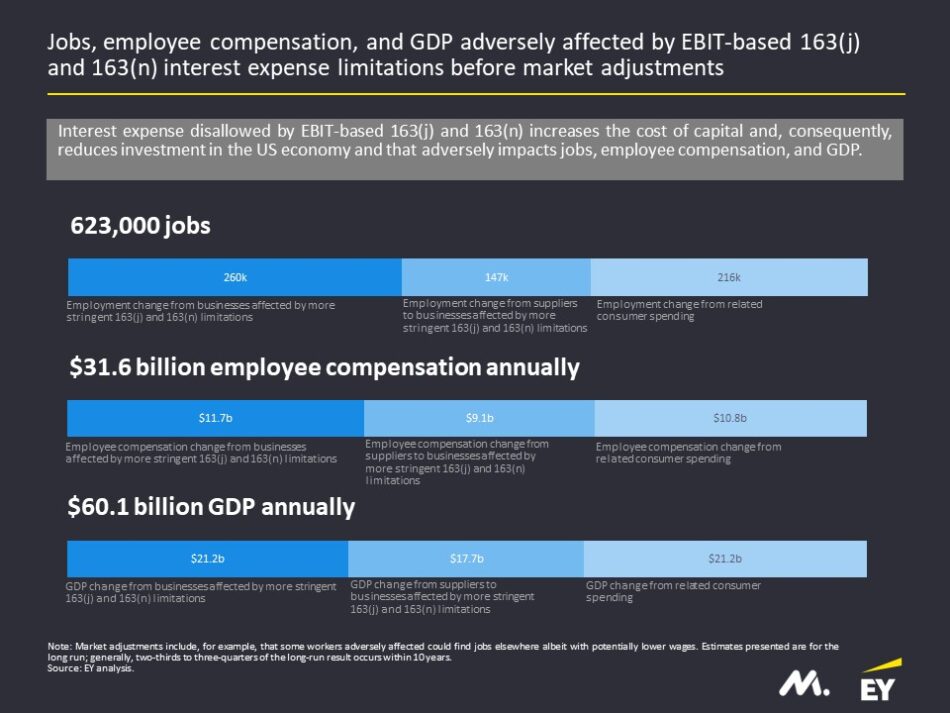
“Manufacturers are already facing incredible economic headwinds due to increased input costs, labor shortages and strong inflationary pressures. This analysis shows that limiting tax deductions for interest on business loans disproportionately harm manufacturers at a perilous time—costing hundreds of thousands of jobs and billions of dollars in economic growth at a time when our industry is trying to drive our nation’s recovery.
“When Congress passed the Tax Cuts and Jobs Act, manufacturers raised wages, invested in U.S. operations and spurred growth. Congress should be considering proposals that double down on the TCJA’s winning record rather than considering tax increases that will sabotage our recovery.”
The analysis was prepared by EY’s Quantitative Economics and Statistics group.
Key Findings:
The EBIT-based 163(j) and proposed163(n) interest expense limitations before market adjustments would cost:
- 623,000 Jobs
- $31.6 Billion in Employee Compensation Annually
- $60.1 billion in GDP Annually
-NAM-
The National Association of Manufacturers is the largest manufacturing association in the United States, representing small and large manufacturers in every industrial sector and in all 50 states. Manufacturing employs more than 12.7 million men and women, contributes $2.71 trillion to the U.S. economy annually and accounts for 58% of private-sector research and development. The NAM is the powerful voice of the manufacturing community and the leading advocate for a policy agenda that helps manufacturers compete in the global economy and create jobs across the United States. For more information about the NAM or to follow us on Twitter and Facebook, please visit www.nam.org.
“It Changed a Lot in My Life”: Tyson Foods’ Workforce Programs
If it hadn’t been for his cousin, Tagba Djato-Bougonou might never have found Tyson Foods.
In 2017, the engineer was working at a bank in Iowa, where he’d ultimately relocated after 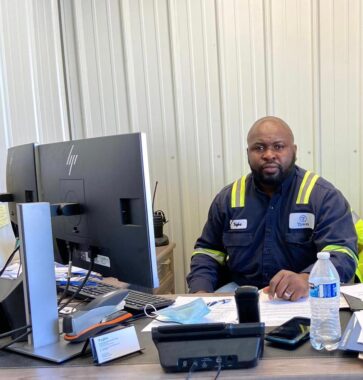 emigrating from Togo in West Africa. He was living with his cousin, who was working at Tyson Foods, when the cousin told him about Tyson’s 1+2 Maintenance Program.
“He told me about the good stuff that Tyson has and the 1+2 Maintenance Program and what I could achieve with it,” Djato-Bougonou recalls. “And I thought, ‘OK, I’m going to take a shot with that program.’”
- Djato-Bougonou, who has an engineering background and a graduate degree from a U.S. university, was quickly hired on as part of the initiative.
- 1+2 allows new hires to “earn while you learn” by splitting their workdays between a classroom and hands-on work in a Tyson facility. It gets its name from the one year of education and training participants do, followed by the two years they commit to working for the company.
The results speak for themselves: now a full-time project engineer in Tyson’s Fresh Meats department, Djato-Bougonou is also pursuing a Ph.D. in innovation and project management.
Tyson’s workforce initiatives are increasingly designed to find and reward employees like Djato-Bougonou, who come to Tyson with impressive professional backgrounds earned in other countries.
- “We try to find candidates that, like Tagba, have a deep portfolio outside the U.S. and [whom] we can upskill, with some English and some recertification in the U.S.,” said Tyson Foods Workforce Development Trailblazer Anson Green, who leads economic opportunity efforts, including the in-plant career-development program Upward Pathways.
- In many of the more rural communities that are home to Tyson plants, “there is no large labor pool to draw from,” Green said. Creating unique paths for non-native-born employees to fill skilled-worker roles is a strategy that has helped fill this void.
The success stories are numerous, including many team members who came to the company to apply for one job but, owing to education or work experience garnered internationally, were able to continue on a professional path they thought they’d had to give up.
- One team member, formerly a nurse in her home country, is now developing her English skills and preparing for recertification in the U.S. to work at one of Tyson’s onsite health clinics, according to Green.
- Another team member who now works at a Tyson Foods’ Arkansas plant was previously a legal aide in the Supreme Court of the Dominican Republic. With Tyson’s support, she is also developing her English skills and will be applying to work as a paralegal in the company’s corporate office in Northwest Arkansas.
The last word: For Djato-Bougonou and other Tyson team members who have benefited from an encouraging corporate leadership, the sky’s now the professional limit.
- “I wanted to be part of things which can make a big difference in people’s lives,” Djato-Bougonou said, adding that with the 1+2 Program under his belt, he now feels empowered to do just that. “This program … gave me quite a lot of new skills. It changed a lot of things in my own life.”