October CPI Read Aligns with Expectations
Consumer prices rose 0.2% over the month and 2.6% over the year in October, in line with consensus expectations but higher than the 2.4% over-the-year increase in September. Core CPI, which excludes more volatile energy and food prices, stayed at a 3.3% over-the-year increase and remains higher than overall CPI.
Shelter increased 0.4% over the month and 4.9% over the year in October, accounting for more than 65% of the yearly increase of the all-items index. On the other hand, food price increases have slowed considerably, rising 0.2% over the month and 2.1% over the year in October. Prices for transportation services also remain high, rising 0.4% over the month and 8.2% over the year, with motor vehicle insurance increasing 14.0% over the year.
Energy costs, which were flat over the month, fell 4.9% over the year in October, helping to restrain the headline inflation rate. This decline is due partly to energy prices being somewhat elevated in October 2023. While energy commodity prices are down over the year, electricity prices are up 4.5%.
Although the over-the-year headline rate ticked up from the previous month, markets are still anticipating a 25-basis-point rate cut at the Federal Open Market Committee’s next meeting in December. However, slowing progress on inflation might upend the Federal Reserve’s previous easing plans for 2025, pointing to the possibility of the FOMC’s interest rate target being cut at a slower pace.
Inflation Ticks Up

Inflation rose again last month (The Wall Street Journal, subscription).
What’s going on: The consumer price index increased 0.2% in October, the fourth consecutive increase (Bureau of Labor Statistics).
- “[P]rices were up 2.6% from a year earlier, in line with economists’ expectations. Core inflation, at 3.3%, also matched forecasts,” according to the Journal.
The details: Shelter prices rose 0.4% in October, accounting for more than half the increases overall (BLS).
- Food prices inched up 0.2%, while energy prices were unchanged after having declined 1.9% in September.
What it means: The news strengthened investor confidence that the Federal Reserve will cut rates in December for the third time this year in an effort to hit its 2% inflation goal, the Journal reports.
- “The October CPI report will likely support the notion that the last mile of inflation’s journey back to target will be the hardest,” Wells Fargo economists wrote in a memo to clients (USA Today).
Manufacturer Sentiment Declines

Manufacturer sentiment fell in the third quarter of this year, according to the NAM’s Q3 2024 Manufacturers’ Outlook Survey, out Wednesday.
What’s going on: Results of the survey, which was conducted Sept. 5–20, reflect “preelection uncertainty,” NAM President and CEO Jay Timmons said—but also larger economic concerns.
- “The good news is that there is something we can do about it,” said Timmons. “We will work with lawmakers from both parties to halt the looming tax increases in 2025; address the risk of higher tariffs; restore balance to regulations; achieve permitting and energy security; and ease labor shortages and supply chain disruptions.”
Key findings: Notable data points from the survey include the following:
- Some 62.9% of respondents reported feeling either somewhat or very positive about their business’s outlook, a decline from 71.9% in Q2.
- A weaker domestic economy was the top business challenge for those surveyed, with 68.4% of respondents citing it.
- Nearly nine out of 10 manufacturers surveyed agreed that Congress should act before the end of 2025 to prevent scheduled tax increases on manufacturers.
- The overwhelming majority—92.3%—said the corporate tax rate should remain at or below 21%, with more than 71% saying a higher rate would have a negative impact on their businesses.
- More than 72% said they support congressional action to lower health care costs through the reform of pharmacy benefit managers.
The last word: “When policymakers take action to create a more competitive business climate for manufacturers, we can sustain America’s manufacturing resurgence—and strengthen our can-do spirit,” Timmons said.
- “This administration and Congress—and the next administration and Congress—should take this to heart, put aside politics, personality and process and focus on the right policies to strengthen the foundation of the American economy.”
Economic Uncertainty Fuels Lower Optimism for Manufacturers
Washington, D.C. – The National Association of Manufacturers released its Manufacturers’ Outlook Survey for Q3 2024, which, reflecting overall uncertainty across several challenges, shows a drop in manufacturing sentiment in the third quarter.
“The preelection uncertainty explains in part the drop in optimism, but economic pressures and policy threats are also at play. The good news is that there is something we can do about it,” said NAM President and CEO Jay Timmons. “We will work with lawmakers from both parties to halt the looming tax increases in 2025; address the risk of higher tariffs; restore balance to regulations; achieve permitting and energy security; and ease labor shortages and supply chain disruptions.
“Manufacturers are the backbone of the U.S. economy, creating jobs, investing in our communities and developing products that make life better for everyone. When policymakers take action to create a more competitive business climate for manufacturers, we can sustain America’s manufacturing resurgence—and strengthen our can-do spirit.
“This administration and Congress—and the next administration and Congress—should take this to heart, put aside politics, personality and process and focus on the right policies to strengthen the foundation of the American economy.”
Select Survey Findings:
- The NAM conducted the Q3 2024 Manufacturers’ Outlook Survey Sept. 5–20. In Q3, 62.9% of respondents felt either somewhat or very positive about their company’s outlook, falling from 71.9% in the second quarter. The average over the past four quarters is 67.4%.
- A weaker domestic economy was cited as manufacturers’ top concern in Q3 2024, with 68.4% claiming it is their primary challenge. This was followed by rising health care costs (62.9%) and an unfavorable business climate (60.5%). Attracting and retaining a quality workforce now ranks as the fourth-highest concern, after remaining at the top of this list since Q4 2017.
- Manufacturers want Congress to prevent tax increases. Nearly 9 out of 10 respondents agree that Congress should act before the end of 2025 to prevent scheduled tax increases on manufacturers. The 20% pass-through deduction, individual tax rates and the estate tax exemption threshold are scheduled to expire or become less competitive at the end of 2025.
- Tax increases will harm growth in manufacturing in the United States, with 92.3% of manufacturers contending that the corporate rate should remain at or below 21%. If the corporate rate is increased from 21% to 28%, more than 71% of respondents said this increased tax burden will impact their business negatively.
- Lawmakers need to act to address health care costs for manufacturing workers. More than 72% of respondents support congressional action to reduce health care costs by reforming pharmacy benefit managers, while less than 6% oppose and 21.7% are uncertain.
The NAM releases these results to the public each quarter. Further information on the survey is available here.
-NAM-
The National Association of Manufacturers is the largest manufacturing association in the United States, representing small and large manufacturers in every industrial sector and in all 50 states. Manufacturing employs nearly 13 million men and women, contributes $2.91 trillion to the U.S. economy annually and accounts for 53% of private-sector research and development. The NAM is the powerful voice of the manufacturing community and the leading advocate for a policy agenda that helps manufacturers compete in the global economy and create jobs across the United States. For more information about the NAM or to follow us on Twitter and Facebook, please visit www.nam.org.
Existing Home Sales Falls 4.2% YoY in August
Existing home sales dipped 2.5% in August and fell 4.2% from August 2023. Housing inventory rose to 1.35 million units, reflecting a 0.7% increase from July and a 22.7% boost from last year. The median existing home price was $416,700, up 3.1% from last year, with all four U.S. regions reporting price increases.
Single-family home sales decreased 2.8% from July, with the median price increasing 2.9% from August 2023 to $422,100. Condo and co-op sales held steady month-over-month but declined 11.6% from the previous year, with the median price up 3.5% from the prior year to $354,200.
Homes were typically on the market for 26 days in August, up from July’s 24 days and 20 days in August 2023. First-time buyers made up 26% of sales, matching the all-time low from November 2021 and down from 29% in both July and a year ago. All-cash sales accounted for 26% of transactions in August, while investor purchases represented 19%. Distressed sales remained steady at 1%.
In the Northeast, existing home sales dropped 2.0% from July, with a median price of $503,200, up 7.7% from last year. The Midwest saw no change in sales month-over-month, but the median price rose to $315,400, a 3.8% increase from August 2023. In the South, sales fell 3.9% from July, with a median price of $367,000, reflecting a 1.6% year-over-year rise. The West reported a 2.7% sales decline from July and a 1.4% decrease from the previous year, with a median price of $622,500, up 2.2% from a year ago. The housing market remained sluggish with sales dipping across the country.
Signs of a Rebound for Residential Construction
Building permits rose 4.9% in August but are 6.5% lower than August 2023. Permits for single-family homes were 2.8% higher than July but were down 0.5% in the past year. Permits for buildings with five or more units surged 8.4% from July but are down a significant 16.8% in the past year.
In August, housing starts increased 9.6% over the month and 3.9% over the year. Starts for single-family homes were up 15.8% from July and 5.2% from August 2023. On the other hand, starts for buildings with five or more units declined 6.7% from July and were down 6.2% from August 2023.
Housing completions in August were up 9.2% from July and a significant 30.2% higher than August 2023. Single-family home completions were down 5.6% from July to 1,029,000 but up 8.4% over the year. Completions for buildings with five or more units rose 36.5% and were 79.2% higher than August 2023.
Philadelphia Fed Manufacturing Survey Turns Positive in September
In September, Philadelphia’s regional manufacturing activity was mixed. The index for current general business activity turned positive, rising from -7.0 to 1.7. Nearly 22% of firms reported increased activity this month, while 20% reported decreases and nearly 51% reported no change. On the other hand, the indexes for new orders and shipments declined and turned negative. Firms reported an increase in employment after declining last month, with the employment index rising back into positive territory at 10.7. Firms also provided forecasts on production levels, with a higher share of firms reporting an increase in production (nearly 38%) than those reporting a decrease (28%).
Price indexes moved higher, with firms continuing to report overall increases in prices. The prices paid index rose to its highest reading since December 2022, reflecting the notable portion of firms experiencing higher input costs. The prices received index also rose, undoing the previous month’s decrease.
Looking ahead, most future indicators increased. The index for future general business activity rose slightly to 15.8, indicating growing optimism among firms. A higher proportion of firms still expected increases in activity. Additionally, the new orders, shipments and future employment indexes also rose. Although the future prices paid index increased, the future prices received rose by a larger margin. Meanwhile, the future capital expenditures index moved up to its highest reading since March 2022.
NY State Manufacturing Activity Grows for the first time in 2024
Manufacturing activity in New York state grew in September for the first time in nearly a year, with the headline general business conditions index rising 16 points to 11.5. The new orders index climbed 17 points to 9.4, a multiyear high, while the shipments index rose 18 points to 17.9, its highest level in a year and a half. Unfilled orders increased slightly, while inventories rose 11 points to zero, indicating inventories are now level after two months of declines. Delivery times were little changed, and supply availability was the same reading (-2.1) as August.
Employment continued to shrink modestly, with the index for the number of employees coming in at -5.7. The average employee workweek recovered some after a steep drop the prior month, signaling a slight increase in hours worked. Input and selling prices were little changed, as reflected in the prices paid index at 23.2 and the prices received index at 7.4. Manufacturers continued to face rising costs while operating in a weakened pricing environment.
Firms were more optimistic about the future. The future business activity index rose eight points to 30.6, with nearly 45% of respondents expecting conditions to improve over the next six months. However, the capital spending index fell 11 points, dipping below zero for the first time since 2020.
Manufacturing Job Openings Decline
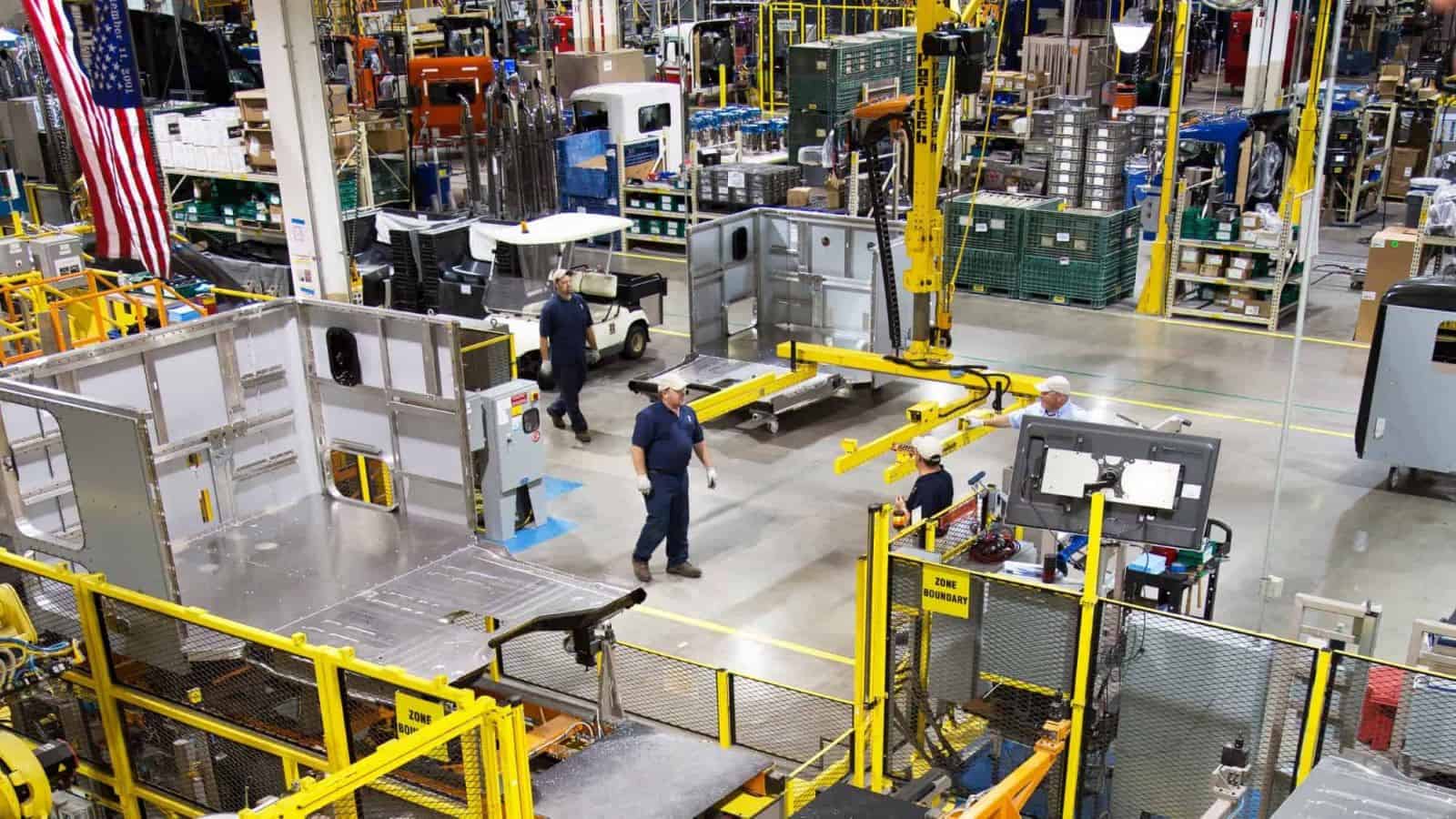
The number of U.S. job openings in manufacturing decreased in March, according to new data from the U.S. Bureau of Labor Statistics.
- Meanwhile, the number of job openings in the larger economy remained about the same, at approximately 8.5 million.
What’s going on: There were 570,000 open positions in the U.S. manufacturing industry in March, down from an adjusted 587,000 in February.
- Open positions in durable goods manufacturing also declined, to 353,000 in March from an adjusted 379,000 in February.
- Openings in nondurable goods, however, inched up to 217,000 from an adjusted 208,000.
Hires and quits: Hiring in the sector remained about the same as the last reading, coming in at 323,000 in March (down marginally from February’s 324,000).
- Total separations—which include quits, layoffs, discharges and other severance of employment—decreased slightly in March (to 330,000) from February (an adjusted 338,000).
Inflation Stayed Elevated in March

Inflation, as measured by the Federal Reserve’s preferred gauge, remained elevated last month (CNN).
What’s going on: “The Personal Consumption Expenditures price index … accelerated to 2.7% for the year ended in March. … That rate was above economists’ expectations for a 2.6% gain and landed above February’s reading of 2.5%.”
- Prices increased 0.3% on a monthly basis, the same pace as in February.
Core PCE: So-called “core” PCE, which excludes often-volatile food and energy prices, remained steady at 2.8%.
Spending: Consumer spending stayed strong in March, rising 0.8% from February and exceeding economists’ expectations.